
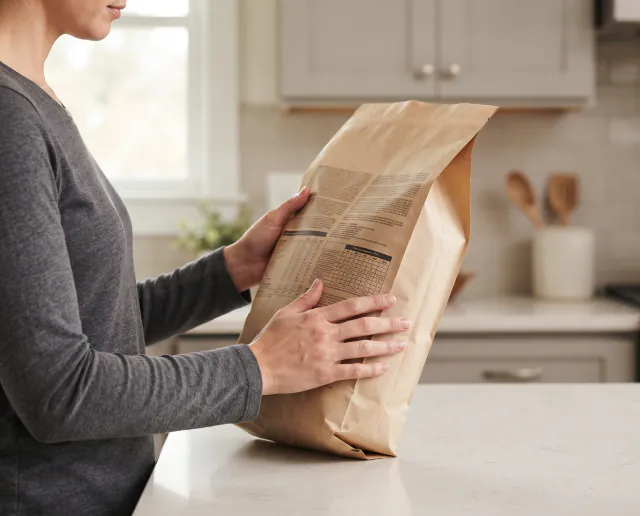
Dog food packaging carries a lot of information, but most of it is designed to be looked at rather than read. Bright photography, confident phrases and a bold ingredient name on the front are competing for attention, while the figures that actually describe what is in the bag sit in smaller print further down. Learning to find and interpret those figures takes a few minutes and makes a genuine difference to comparing products fairly.
This guide walks through the parts of a label worth checking in order: the completeness statement, the ingredients list, the analysis figures, and the feeding guideline, along with the regional differences in how those sections are worded.
Start with the completeness statement
Look for a statement confirming whether the food is complete for a stated life stage, or complementary. This single line does more work than any other part of the label, because it tells you whether the product is designed to be fed on its own or needs combining with something else. The article on understanding complete and balanced dog food covers what that distinction means in practice.
The exact wording and the regulatory body behind it differ between regions. Labelling conventions in the European Union and the United Kingdom are not identical to those used in the United States, Canada or Australia, and a term that carries a defined legal meaning in one country may be used loosely in another. Where a specific claim matters to you, checking the manufacturer’s own guidance for your region is more reliable than assuming a term means the same thing everywhere.
Read the ingredients list for what it actually shows
Ingredients are listed by weight at the point of manufacture, heaviest first. That single rule explains a common source of confusion: a named fresh meat listed first looks impressive, but fresh meat contains a large proportion of water, so once that water is accounted for, the actual contribution of meat protein to the finished, dried product can be smaller than it first appears.
A meat meal, by contrast, has already had most of the moisture removed before it goes into the mix. Weight for weight in the finished food, a meat meal often contributes more actual protein than the same listed weight of fresh meat, even though “chicken meal” sounds less appealing on packaging than “fresh chicken.” Neither form is automatically superior. The point is that ordering position alone, especially at the very top of the list, does not tell you as much about actual protein content as it appears to.
Beyond the first few items, an ingredients list also shows what has been added for a specific purpose, such as named vitamins, minerals, or preservatives. A long list is not inherently worse than a short one, and a short list is not automatically “cleaner” in any meaningful nutritional sense. What matters is whether the finished product, taken as a whole, is formulated to be complete.
Compare analysis figures carefully
Most labels carry a guaranteed or typical analysis, usually giving percentages for protein, fat, fibre and moisture. These figures are useful for comparing similar products, but they become misleading if you compare a dry food directly against a wet food without adjusting for moisture first.
Dry kibble typically contains around 10 percent moisture, while wet or tinned food can contain 70 to 80 percent moisture or more. A wet food showing 8 percent protein on its label is not automatically lower in protein than a dry food showing 25 percent, because most of that wet food’s weight is water that dilutes every figure on the label. The way analysts handle this is to convert both figures to a dry-matter basis, effectively asking what the protein percentage would be if all the moisture were removed. This guide will not walk through a worked calculation, since a specific formula presented as definitive risks being applied incorrectly to products it was not intended for. The concept itself is the useful part: never compare a wet and dry product’s protein, fat or fibre figures directly without accounting for the difference in moisture first, and treat any comparison chart that skips this step with some caution.
Treat the feeding guideline as a starting point
Every complete food carries a feeding guideline, usually a table linking a dog’s weight to a daily amount. These figures are calculated from averages across a breed or weight range and are a reasonable starting point, not a fixed instruction for an individual dog. They generally cannot account for an individual dog’s actual body condition, activity level, neuter status, metabolism or health status, all of which change how much energy that specific dog needs from the same food.
The practical approach is to use the guideline as a starting figure, weigh the food rather than estimating by eye, and adjust gradually based on how the dog’s body condition changes over several weeks. A vet or veterinary nurse can help assess body condition directly if there is any doubt.
Be cautious with terms that carry no fixed regulatory meaning
Words like “premium,” “natural,” “holistic” or “gourmet” appear widely on packaging without a consistent, universally enforced definition behind them in most jurisdictions. They may describe a genuinely different product in some cases, but they are marketing language rather than nutritional information, and they do not substitute for the completeness statement, the ingredients list or the analysis figures. The same caution applies to imagery and descriptive front-of-pack copy generally: treat it as an invitation to check the detail rather than a substitute for it.
Putting it together
A useful label-reading habit takes only a few minutes: confirm the food is complete for the right life stage, glance at the ingredients list with the meat-versus-meal distinction in mind, compare analysis figures only against similar products or on a dry-matter basis, and use the feeding guideline as a starting point to be adjusted rather than a fixed rule. None of this requires specialist training, and it puts far more useful information in an owner’s hands than reading the front of the pack alone.