
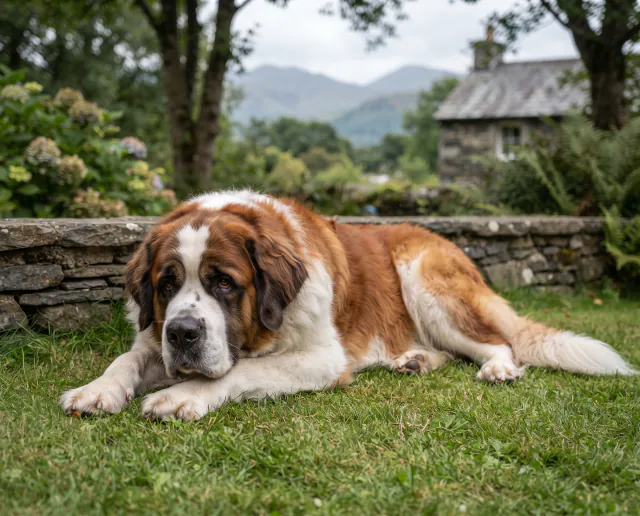
Also known as: Saint Bernard.
At a glance
Key facts
The essentials to compare before deciding whether this breed fits your home and routine.
- Size
- Giant
- Lifespan
- 8 to 10 years
- Energy
- Low to medium
- Temperament
- Gentle, patient and slow moving with strangers and family alike
- Good with children
- Often good, patient with children but heavy on its feet
- Exercise
- About 45 minutes of steady walking a day
- Trainability
- Moderate
- Grooming
- Twice weekly brushing, heavier during the seasonal coat drop
- Estimated monthly cost, GBP
- £150 to £260 per month
Before the St Bernard became a fixture of Christmas cards and brandy barrel jokes, it worked the Great St Bernard Pass between Switzerland and Italy, where monks kept a heavy, thick coated dog to find travellers caught by weather and avalanche. That original role required a calm, patient animal that would work steadily in appalling conditions and show no aggression toward an exhausted stranger it had just located. The gentleness people associate with the breed today is not sentiment invented later. It is close to the exact temperament the job demanded.
Modern St Bernards keep a great deal of that character while carrying considerably more bulk than their working ancestors, and that combination of size and mildness produces a dog that is genuinely easy to like but genuinely hard to manage in the practical sense. Anyone considering one needs to think less about temperament, which tends to be reliable, and more about what a dog of this size costs, how it grows and how short a time it is likely to be around.
Temperament in the home
A settled St Bernard is famously unbothered by household chaos, tolerant of clumsy handling from children and rarely inclined to guard resources or space in the way some giant breeds do. That patience has limits, and a dog this heavy leaning, sitting on feet or simply turning around in a small room can cause real injury without any bad intention behind it, so young children need supervision based on physics rather than temperament. Barking is infrequent, and most individuals are more interested in company than in patrolling. Long stretches left alone do not suit the breed well, since it was bred to work closely with people rather than to occupy a garden independently.
Exercise and training
Adults need only moderate exercise, and around 45 minutes of unhurried walking a day satisfies most individuals, since the breed was built for endurance in cold conditions rather than speed or high drive. Heat is the greater obstacle to exercise planning than distance. A heavy coated dog of this size overheats readily in anything above a mild British summer day, and walks should move to the cooler parts of the day accordingly, with fresh water and shade always available. Growth management matters enormously here. A St Bernard puppy can gain many kilograms a month, and controlling that growth rate through appropriate food, limiting jumping and repetitive stairs, and avoiding forced exercise until the growth plates close protects joints that will carry a very heavy adult frame for years afterward. Training benefits from an early start precisely because a fully grown St Bernard that has never learned polite lead manners becomes very difficult to redirect.
Coat and grooming
Coats vary between a shorter dense type and a longer rough type, and both carry a thick undercoat that comes away in substantial quantities during the spring and autumn coat change. Twice weekly brushing is the baseline, rising to daily during a heavy blow, and a good undercoat rake earns its keep. Drool is a defining and unavoidable feature of the breed, particularly around mealtimes, after drinking or in warm weather, and furnishing choices, car interiors and visitors’ clothing all need to accommodate it. Facial folds and the skin around the mouth need regular checking and cleaning to avoid soreness, and nails, ears and the pads of feet that carry this much weight all deserve routine attention.
Health and lifespan
An eight to ten year lifespan is typical, shorter than many owners expect from a dog whose gentle nature suggests a long companionship. Hip and elbow dysplasia are well documented concerns in the breed, and a UK buyer should always ask to see hip and elbow scores carried out under the BVA and Kennel Club scheme for the parents. Heart conditions, including dilated cardiomyopathy, are worth asking a breeder about, along with any history of entropion or other eyelid problems that affect heavy skinned, loose faced breeds. Bloat is a genuine risk given the deep chest, and owners should know the signs before they ever need them. Weight management across the dog’s life, not just as a puppy, makes a measurable difference to joint comfort in the later years.
Costs and space
Everything about keeping a St Bernard costs more than an average dog, from the volume of food through to insurance premiums, which climb steeply once giant breed status and any recorded joint issues come into play. A working figure of £150 to £260 a month is a reasonable starting estimate, though actual costs depend heavily on insurer, region and the individual dog, and medication is priced by body weight. Space needs to include room for a very large bed, wide enough doorways and, ideally, a car boot that can take the dog without a struggle. A garden with shade is more valuable than one with distance, given how the breed manages heat.
Verdict
The St Bernard suits a patient household with space, a cool part of the house to retreat to in summer, a realistic budget for veterinary and insurance costs, and an owner willing to manage growth carefully through puppyhood. Families that value a steady, tolerant giant over an energetic dog often find the breed exactly what they hoped for.
Anyone without the space, the budget for a giant breed’s veterinary care, or the tolerance for drool and heavy shedding should look elsewhere, and prospective owners should go in with clear eyes about a life expectancy considerably shorter than most family dogs.