
At a glance
Key facts
The essentials to compare before deciding whether this breed fits your home and routine.
- Size
- Giant
- Lifespan
- 8 to 10 years
- Energy
- Medium
- Temperament
- Gentle, patient and devoted to family life
- Good with children
- Usually very good and famously gentle with children
- Exercise
- About an hour of walking a day, more when swimming
- Trainability
- Moderate
- Grooming
- Brushing several times weekly, with heavy shedding twice a year
- Estimated monthly cost, GBP
- £160 to £270 per month
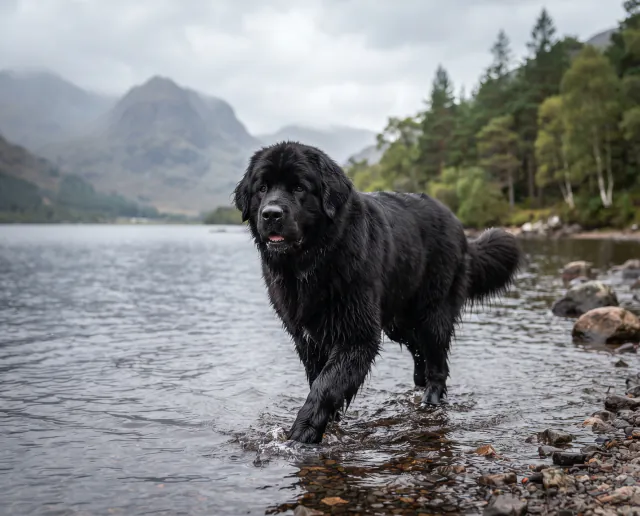
Fishermen off the coast of Newfoundland used to rely on a big, water loving dog to haul nets, retrieve gear that went overboard and, on more than one recorded occasion, pull a person from the sea. That working history explains almost everything about the modern breed, from webbed feet and a naturally water resistant coat to a calm, steady temperament that copes well with cold water, boats and strangers in distress. Little of that working purpose survives in most households today, but the physical and mental traits it selected for remain intact.
What is left is a huge, heavily coated dog with a famously gentle disposition, sometimes called a nanny dog for the patience it tends to show around children. That reputation is well earned in most lines, but it does not remove the practical realities of a dog that can weigh 60 kilograms and drools freely, especially after drinking.
Suitability
A Newfoundland is typically patient, unflappable and affectionate, traits that make it genuinely good with sensible children, though as with any giant breed a toddler and a large dog should never be left together unsupervised, simply because of size and weight rather than temperament. The breed tends to be sociable with visitors rather than wary, which makes it a poor natural guard dog but an easy one to introduce to new people and other animals. Space matters, both for the dog itself and for the coat it distributes around a house, and a household without a reasonably large garden or nearby water access will find the breed’s favourite activity hard to provide. First time owners take on a Newfoundland less often than an experienced one, and the breed’s biddable nature does not remove the practical weight of size, coat and a shortened life expectancy that need honest consideration first.
Exercise
An hour of walking a day covers most of the exercise an adult needs, though the breed’s real enthusiasm is for water rather than pavement. Access to a safe lake, river or the sea transforms exercise into something the dog visibly relishes, and supervised swimming is an excellent way to build fitness without the joint strain of repeated impact on land. Puppies should be kept to gentle, short outings while the frame is still developing, since rapid growth on a heavy skeleton makes early stairs and forced exercise unwise. Cold water rarely bothers the breed thanks to its dense double coat, though owners should still rinse and dry a wet dog thoroughly afterwards to prevent skin problems developing underneath all that hair.
Grooming
The coat is thick, oily to the touch and genuinely water resistant, and it needs brushing several times a week to prevent matting, particularly behind the ears, under the front legs and around the trousers at the back end. Twice a year the undercoat is shed in earnest, and daily brushing during those weeks is the only realistic way to keep loose hair under control. A slicker brush and a metal comb, used together, work through the undercoat more effectively than a single tool. Bathing a dog this size is a substantial task, and many owners rely on a walk-in shower, a hose in the garden during warmer months or an occasional visit to a professional groomer. Wet coat left to dry naturally in a warm house can develop a distinct smell, so towelling off promptly after any swim or rain saves trouble later.
Health
A Newfoundland typically lives eight to ten years, at the shorter end for a dog of its intelligence and temperament, and buyers should factor that in from the start. Subaortic stenosis, a narrowing near the heart that can affect exercise tolerance and, in severe cases, cause sudden collapse, is well documented in the breed, and a cardiac check by a veterinary cardiologist is a reasonable thing to ask breeding parents to have had. Cystinuria, an inherited condition affecting how the kidneys handle certain amino acids and which can lead to bladder stones, has a DNA test available, and responsible breeders test for it. Hip and elbow scoring under the BVA and Kennel Club scheme matters for a dog this size, and keeping a Newfoundland lean throughout its life reduces the load on joints that already carry a great deal of frame.
Choosing and training
Newfoundlands are among the more biddable giant breeds, generally eager to please and quick to learn basic manners, though patience and consistency still matter given the size involved. Socialisation should start early regardless, since a dog this size needs confident, calm reactions to traffic, other dogs and busy places long before it reaches full weight. Litters are not plentiful, and prospective buyers often wait for a suitable one, so contacting the breed club early and asking about health testing in both parents is worthwhile. Visiting adult dogs and asking current owners about the practical realities of coat care, drool and space gives a far better picture than photographs alone.
Verdict
The Newfoundland suits a patient household with space, access to safe water, a tolerance for hair and drool, and a genuine appreciation for a calm, devoted giant breed. Families with children often find the breed’s temperament matches its reputation closely.
A dry climate preference, an aversion to constant coat maintenance, or an unwillingness to accept a shortened lifespan should send a prospective owner elsewhere. This is a breed best chosen by people who have already met adult Newfoundlands and liked exactly what they saw.