Also known as: German Mastiff, Deutsche Dogge.
At a glance
Key facts
The essentials to compare before deciding whether this breed fits your home and routine.
- Size
- Giant
- Lifespan
- 7 to 10 years
- Energy
- Medium
- Temperament
- Gentle, sensitive and physically overwhelming
- Good with children
- Often good, though sheer size demands supervision
- Exercise
- About an hour a day once mature, carefully limited while growing
- Trainability
- Moderate
- Grooming
- Weekly brushing and constant shedding of short hair
- Estimated monthly cost, GBP
- £130 to £250 per month
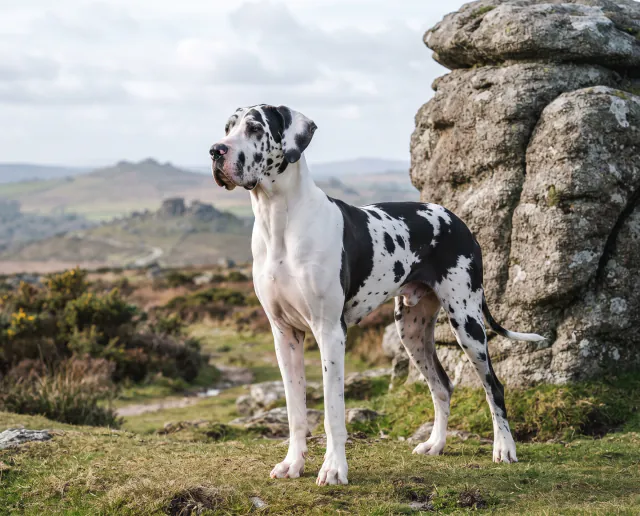
A Great Dane standing at the kitchen worktop is not begging. It is browsing, at eye level, without stretching. That single image explains more about the breed than any temperament description, because almost every difficulty and every pleasure of ownership follows from size. Adult males commonly reach 76cm or more at the shoulder and can weigh over 60kg, which puts the dog’s head above most tables and its shoulders level with a child’s face.
The breed came from Germany, where it was bred to hunt wild boar and later kept as an estate guard dog, and the modern temperament has been softened a long way from that work. Most are calm, affectionate and notably sensitive, and many are less energetic than a spaniel a fifth of their weight. None of that reduces the practical consequences. A Great Dane needs a household that has thought about doorways, car boots, veterinary bills and the fact that it is buying a comparatively short relationship.
Living with the breed
A well-raised Dane is usually quiet and undemanding in the house, sleeping for much of the day in whatever spot the family occupies. Leaning is a breed characteristic, and a dog that plants its full weight against a visitor’s legs is being friendly rather than pushy. Space matters less than layout. The dog needs a bed large enough to lie flat on, clear routes through the house and floors that do not send it skidding. Tails clear coffee tables and split open against walls, which is a real and painful nuisance. Children are usually safe with a steady Dane, though toddlers and giant dogs need constant adult supervision simply because of the physics. Long periods alone suit the breed badly; they are companion animals despite the guard dog history.
Daily exercise
An adult needs surprisingly little, and about an hour a day of steady walking keeps most of them content. Puppies need considerably less than instinct suggests. A Dane grows from roughly a kilogram at birth to a substantial adult inside eighteen months, and forced exercise, long walks, stairs and repeated jumping during that period place real strain on immature joints. Short, frequent outings are the safer pattern until the dog is fully grown. Adults enjoy a controlled run in a safe field, though a galloping dog of this weight can injure itself on rough or slippery ground. Recall and lead manners need to be solid, because nobody restrains a 60kg dog by strength.
Training and mental work
Gentle handling is not optional here. Danes tend to be sensitive to tone and shut down or become worried under harsh correction, and a frightened giant is far harder to manage than a frightened terrier. Reward-based training started in puppyhood is the practical route. Priorities are walking politely on a lead, keeping four feet on the floor, standing calmly for veterinary handling and settling on a bed while life carries on. Teach these while the puppy still weighs less than the handler. Mental work can be modest, since scent games, chew items and short training sessions satisfy most individuals. Careful socialisation matters because a wary Dane frightens people even when it means nothing by it.
Grooming and shedding
The short single coat needs little more than a weekly going over with a rubber mitt or bristle brush, which lifts a surprising volume of dead hair. Shedding continues throughout the year. Baths are occasional and awkward, so many owners settle for a hose or a wipe down and a large supply of towels. Nails should be trimmed regularly, as an overgrown nail on a heavy dog alters how it stands. Check the elbows and hocks for pressure sores, which develop where a heavy body rests on hard floors, and provide thick padded bedding. Skin folds are not an issue, but ears, teeth and any lumps deserve a routine check.
Health and costs
Life expectancy is short, commonly seven to ten years, and prospective owners should accept that before falling for a puppy. Gastric dilatation and torsion is the emergency to understand thoroughly; a deep-chested dog that becomes restless, retches without producing anything or swells behind the ribs needs a vet immediately, not in the morning. Heart disease, hip dysplasia and a neck condition affecting the spinal cord are all recognised in giant breeds, so ask breeders about heart testing, hip scoring and what their lines have produced. Costs run well above those for an average dog. A figure of £130 to £250 a month is indicative rather than fixed, and food, insurance, grooming and veterinary care each vary; medication and anaesthesia are priced by weight, and giant breed insurance premiums reflect the risk. Insure early, before anything is recorded on the notes.
Verdict
The Great Dane suits a calm household with space, a large vehicle, a genuine budget and someone at home for much of the day. Owners who want an affectionate, quiet, low-mileage companion and can handle the practicalities often find no other breed compares.
A small home, a tight budget for veterinary care or an unwillingness to face a life expectancy measured in single figures should all rule the breed out. Meeting adult Danes and talking honestly to their owners about costs and ages is the most useful research available.