Also known as: Berner Sennenhund.
At a glance
Key facts
The essentials to compare before deciding whether this breed fits your home and routine.
- Size
- Giant
- Lifespan
- 7 to 10 years
- Energy
- Medium
- Temperament
- Gentle, steady and closely attached to family
- Good with children
- Usually very good, with supervision around a very large dog
- Exercise
- About 1 hour a day, split and taken in cool conditions
- Trainability
- Beginner friendly
- Grooming
- Brushing several times a week with heavy shedding
- Estimated monthly cost, GBP
- £120 to £220 per month
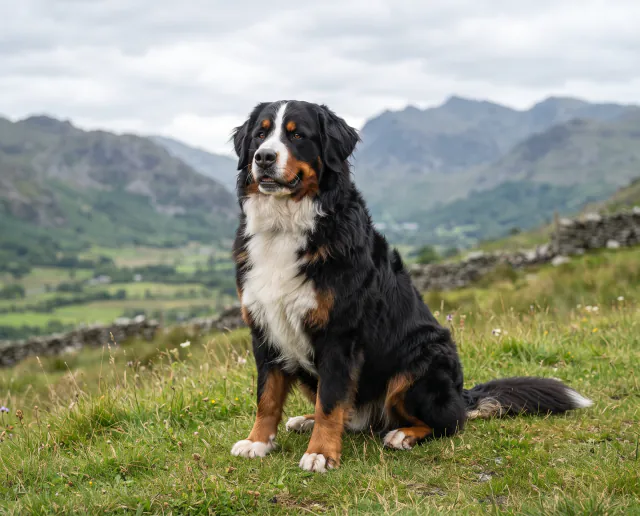
A Bernese Mountain Dog is a farm animal in the literal sense. The breed comes from the canton of Bern in Switzerland, where it drove cattle, guarded the yard and pulled carts of milk and cheese to market, and it was built for weight and steadiness rather than speed. An adult male can reach seventy centimetres at the shoulder and weigh more than fifty kilograms, with a heavy tricolour coat on top of that.
Size shapes every practical decision that follows, from the car to the sofa to the price of a course of medication. The other hard fact is lifespan. Berners are among the shorter-lived breeds and many owners have only seven to ten years, which deserves facing before anyone falls for a puppy.
Suitability
Temperament is why people persist. Most Berners are gentle, affectionate and remarkably tolerant of family noise, and they want to be in the room with their people rather than out in a kennel. They are usually good with children, though a wagging tail clears a coffee table and a friendly lean will knock a small child over, so supervision here is about physics more than character. The breed is sensitive and does badly with shouting or rough handling. A first-time owner can manage one when ready for the scale, but nobody should take on a Berner without room for a very large bed, a car that fits a crate and the strength to control an adolescent on a lead.
Exercise
Adults need around an hour a day, spread across two or three outings, and are content with steady walking rather than sustained running. Puppies need considerably less, and protecting growing joints matters more in a giant breed than in almost any other. Avoid stairs where possible, keep jumping in and out of the car to a minimum and let a young Berner set its own pace. Heat is the limiting factor for the rest of its life. A thick black double coat traps warmth, and a dog comfortable in February can be in trouble on a mild June afternoon, so walk early, carry water and use shade. Carting and gentle hill walking suit fit adults well.
Grooming
The long double coat needs brushing several times a week to stay free of mats, with particular attention behind the ears, on the trousers and around the ruff. Shedding is heavy and continuous, rising further in spring and autumn, and the hair is long enough to be conspicuous on furniture and clothing. An undercoat rake and a slicker are the two tools worth owning. Shaving the coat for summer is counterproductive, since it insulates in both directions. Feet grow tufts that collect mud and grit and benefit from tidying, and nails on a heavy dog need to stay short for comfortable movement.
Health
Berners carry a heavier burden of disease than most breeds and prospective owners should look at this squarely. Cancer is the most significant concern in the type, and any lump, lameness that does not resolve, or unexplained loss of condition warrants prompt veterinary assessment rather than watchful waiting. Hip and elbow scoring should be documented for both parents, along with eye testing and the DNA test for degenerative myelopathy. Depth of chest also brings a bloat risk, so learn to recognise a swollen abdomen, unproductive retching and pacing, and know the fastest route to an emergency vet. Insurance for a giant breed is expensive and premiums climb steeply with age, so obtain quotes before committing.
Choosing and training
Ask a breeder directly about longevity and causes of death in the lines behind the litter. Anyone who answers openly is worth waiting for, and waiting lists are usually long. Meet the mother, see the puppies with her and look for calm, confident behaviour rather than picking the boldest in the pen. Training should start the week the puppy arrives, because everything taught to a twelve kilogram baby has to hold at fifty. Loose-lead walking, a reliable settle, standing still for grooming and accepting handling of feet and ears are the priorities. Reward-based methods suit a sensitive breed, while pressure and correction tend to shut a Berner down.
Size and lifespan
Males typically stand 64 to 70 cm (25 to 27.5 in) at the shoulder and weigh 38 to 50 kg (84 to 110 lb). Females are somewhat smaller, usually 58 to 66 cm (23 to 26 in) and 36 to 48 kg (80 to 105 lb). The heavy tricolour coat adds visual bulk on top of an already substantial frame.
A typical lifespan is 7 to 10 years, shorter than most breeds this guide covers and one of the genuine trade-offs of choosing a giant breed. Cancer rates are notably higher in Bernese Mountain Dogs than in many other breeds, which is worth discussing openly with a vet and a responsible breeder rather than treated as a minor footnote.
Verdict
A Bernese Mountain Dog suits a household with space, physical strength, a generous budget and company for the dog through most of the day. Families who want a calm giant involved in everything, and who accept hair, drool and mud as part of the arrangement, rarely regret the choice.
The breed is wrong for anyone on a tight budget, in a small flat, or unable to face the likelihood of a short life and substantial veterinary costs. Go into it with clear eyes, insure early, keep the dog lean and cool, and make the most of the years available.