Some dogs treat mealtimes as a race, emptying a bowl in a matter of seconds with barely a pause for breath. It can look almost comic, but fast eating brings genuine downsides: dogs who bolt their food are more prone to regurgitating shortly afterwards, can swallow a surprising amount of air along with the food, and often seem uncomfortable rather than satisfied once the bowl is empty. Slowing a dog down at mealtimes is one of the simpler adjustments an owner can make, and it also opens the door to using mealtimes for mental stimulation rather than treating eating as a job to get through quickly.
This guide covers why slower eating matters, practical tools for achieving it, how to introduce a slow feeder without creating frustration, and how enrichment feeding fits into a dog’s existing ration rather than adding to it.
Why slowing eating down is worth doing
Beyond the obvious mess and discomfort of a dog who regurgitates shortly after wolfing down a meal, fast eating is discussed by vets alongside the risk factors for bloat, a serious and potentially life-threatening condition, particularly in large, deep-chested breeds. The relationship is not a simple cause-and-effect one, and eating quickly is one factor discussed among several rather than something that reliably predicts the condition on its own, but it is a genuine reason for extra caution in breeds already considered at higher risk, such as the Great Dane, Weimaraner or German Shepherd. Slowing eating down, alongside general precautions such as avoiding strenuous exercise immediately around mealtimes, is a sensible habit for these breeds in particular, and a vet can advise further on individual risk and precautions.
For dogs of any size and breed, slower eating generally means calmer digestion, less swallowed air, and a mealtime that lasts long enough to actually register as satisfying rather than being over almost as soon as it begins.
Practical options for slowing eating down
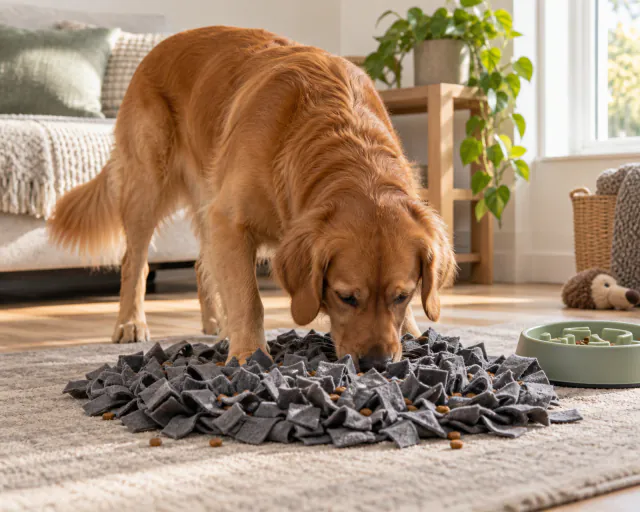
A range of tools exist for this purpose, and which one suits a particular dog depends on their size, food type and temperament. Slow-feed bowls, with raised ridges, spirals or partitions moulded into the bowl itself, work well for both dry and wet food and force a dog to work around the obstacles rather than taking large mouthfuls. Snuffle mats, made of fabric strips a dog noses through to find scattered kibble, slow eating down and add a scent-based challenge at the same time.
Food-dispensing toys, which release kibble gradually as a dog rolls, noses or paws at them, work well for dry food and double as an activity in their own right. Scatter feeding, simply throwing a measured meal across a safe area of garden or lawn for the dog to sniff out and find piece by piece, costs nothing beyond the food itself and works surprisingly well for many dogs, provided the area is safe, clean and free of anything the dog should not eat.
Introducing a slow feeder without causing frustration
Not every dog takes to a slow feeder immediately, and a dog who is hungry and used to a fast, easy meal can become frustrated rather than engaged if the first attempt is too difficult. Start with an easy version of whatever method is chosen: a slow-feed bowl with a gentle, shallow pattern rather than a complex maze, a snuffle mat with kibble sitting fairly close to the surface, or a food-dispensing toy set to release food easily.
Watch how the dog responds over the first few uses. A dog who works steadily and finishes within a reasonable time is coping well, and difficulty can be increased gradually from there. A dog who gives up, paws at the tool in obvious frustration, or takes an excessively long time to get a normal-sized meal may need an easier option, a different type of feeder entirely, or a return to a standard bowl while other methods are tried. The aim is a slower, more engaging meal, not a test the dog struggles to pass.
Enrichment feeding replaces part of a meal, it does not add to it
A genuinely important point often missed is that enrichment feeding should generally use part of a dog’s already-measured daily ration, not add extra food on top of it. If a dog’s usual bowl meal is measured to suit their body condition and energy needs, taking a portion of that same measured amount and using it in a snuffle mat, puzzle feeder or scatter session in the garden keeps the day’s total calories the same while adding mental stimulation. Adding unmeasured extra kibble specifically for enrichment, on top of an already complete daily ration, risks the same slow weight gain covered in the guide on helping a dog maintain a healthy weight, just via a route that looks more like play than feeding.
A simple way to manage this in practice is to weigh out the day’s full ration in the morning, as covered in that same guide, and treat enrichment sessions as one of the ways that ration gets delivered across the day, alongside or instead of a straightforward bowl meal, rather than as something separate.
When slow feeding isn’t the right approach
Slow feeding is not universally appropriate. Dogs who are anxious eaters, who approach food nervously, eat only when left alone, or seem uneasy rather than simply quick, generally need reassurance and an easy, predictable meal rather than an added obstacle, at least until any underlying anxiety has been addressed. Introducing a puzzle feeder to an already anxious eater can add stress rather than remove a problem, and in that situation, a straightforward bowl meal fed calmly and consistently is usually more helpful than any slow-feeding tool.
Where fast eating is a new or sudden change in a dog previously happy to eat at a normal pace, or where a dog seems distressed rather than simply eager at mealtimes, that change is worth mentioning to a vet before assuming a slow feeder alone will resolve it, since a change in eating behaviour can sometimes reflect an underlying health issue rather than a simple habit to manage.
Making it part of the routine
Slow feeders and enrichment feeding work best as an ordinary part of how a dog is fed, rather than an occasional novelty. Rotating between a slow-feed bowl, a snuffle mat and scatter feeding across the week keeps the experience varied without needing to buy an expanding collection of gadgets, and keeping the total amount fed consistent with what the dog actually needs, regardless of which method delivers it, keeps the benefit genuinely about mealtime pace and mental stimulation rather than accidentally becoming extra food.