- Session length
- 10 to 20 minutes per visit, building slowly towards longer stays
- Skill
- Settle and calmness
- Suits
- Any age
What you need
- A portable mat or thin bed the dog already settles on at home, used only for settling
- A fixed lead of about two metres (six feet) and a well-fitted harness
- A lick mat or food-stuffed toy the dog enjoys lying down with
- A travel water bottle or collapsible bowl
- Small soft food rewards for calm behaviour
A dog who can settle beside a table while people eat, talk and walk past is welcome in far more places, and much easier to take on days out. The skill is not obedience in the usual sense. It is the dog choosing to relax in a place full of smells, noise and movement, and that comes from building duration, then distraction, in venues you choose carefully, rather than hoping a long walk will be enough to tire the dog out.
Purpose
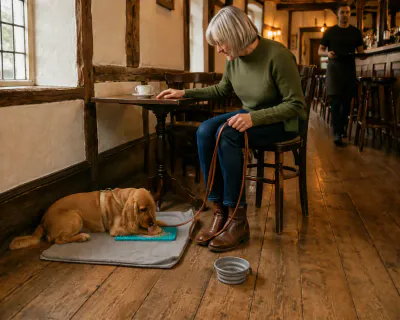
By the end of this lesson the dog should lie on its own mat beside your table for twenty minutes in a moderately busy dog-friendly cafe or pub, taking food, ignoring passing people and getting up only when you release it. The mat matters: it is a portable piece of home that tells the dog what the job is wherever you put it down.
Prerequisites
- A settle on the mat at home for five minutes on cue, as taught in settle on cue.
- Loose lead walking past people on a quiet street, so the walk in does not wind the dog up.
- A walk, a sniff and a toilet stop before every visit. A dog that has not had a chance to move and empty is unlikely to settle.
Equipment
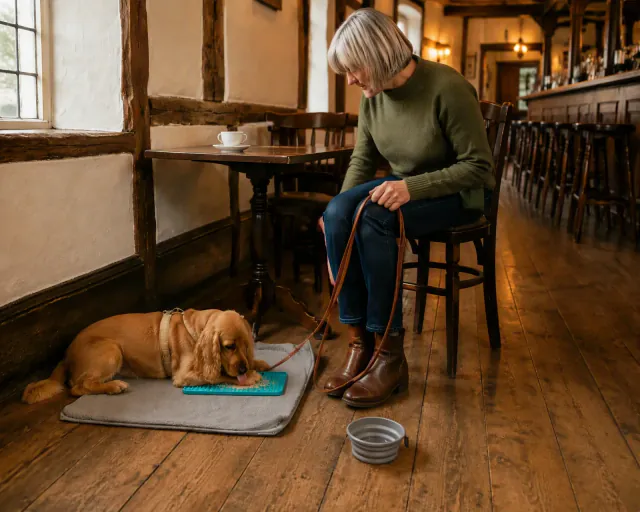
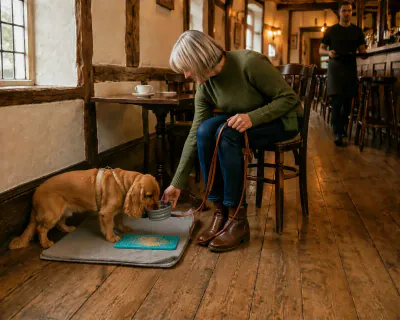
Use the mat or thin bed the dog already settles on at home, kept only for settling so it carries that meaning with it. A lick mat or stuffed food toy gives the dog something calm to do with its mouth; our guide to lick mats explains which designs suit which dogs and how to keep them clean. Carry water in a travel bottle or collapsible bowl, because venues cannot always offer a bowl and a thirsty dog is a restless one. A fixed lead keeps the dog close without trailing across the floor.
Method
- Rehearse at home first. Put the mat beside a kitchen chair, sit down with a drink and pay the dog for lying on it, as if you were out. Repeat this with a lick mat so the whole routine is familiar.
- Choose a quiet dog-friendly venue at its quietest time, such as a weekday morning. Check the venue’s rules before you go. Pick a table in a corner or against a wall.
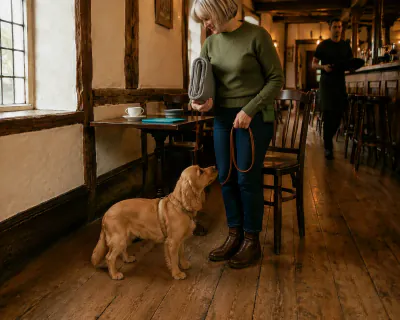
- Put the mat down before you sit, on the side away from the walkway. Let the dog step on to it, then sit down.
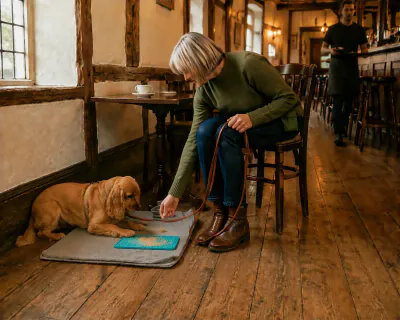
- When the dog lies down, feed a piece of food on the mat between the front paws. Keep paying calmly every thirty seconds or so for the first few minutes.
- Offer the lick mat once the dog is lying down, so it becomes something the dog enjoys in position rather than a lure to get it there.
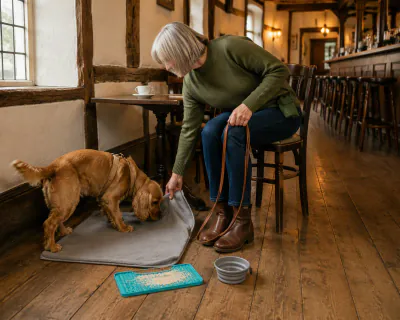
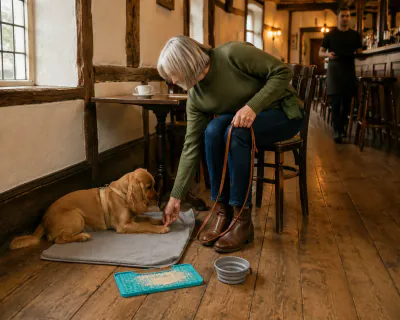
- Offer water from the collapsible bowl every so often, then lift the bowl away so nobody trips on it and it cannot be knocked over.
- When a person walks past and the dog looks, wait for the dog to look away or rest its head again, then quietly drop a piece of food on the mat. You are paying the return to calm.
- Stay ten minutes on the first visit and leave while the dog is still relaxed. A short visit that ends well teaches more than a long one that ends in whining.
- Extend duration first. Over several visits to the same quiet venue, build to fifteen, then twenty minutes, while gradually spacing out the food.
- Then add distraction by visiting the same venue at a busier time, or a new quiet venue. Go back to ten minutes and frequent food whenever you change the setting.
Session length
Ten to twenty minutes per visit, a few times a week, is the right pace at first. Longer stays come later. Keep training visits separate from important social occasions, when your attention will be elsewhere.
Progression criteria
Move on when the dog lies on the mat for twenty minutes in a moderately busy venue, getting up no more than once, and resettles within a minute without help, across three visits to two different places. If the dog cannot manage that, shorten the visit or go back to a quieter time.
Common mistakes
Arriving with an under-exercised dog and expecting it to settle is the most common mistake. So is choosing the busiest time on a first visit, or a table beside the door where every arrival walks past. Letting friendly strangers fuss the dog breaks the settle and teaches the dog to watch for people. Leaving the food at home once the dog seems calm often leads to a relapse on the next busy visit.
Troubleshooting
If the dog will not lie down, the setting is too much for now, so return to home rehearsals and then a quieter venue. If the dog settles and then starts whining after a while, you have stayed too long, so end earlier next time. If the dog is fine indoors but restless on an outdoor terrace, the traffic and passers-by are a separate distraction; treat the terrace as a new venue. Our guide to teaching a dog to settle covers the wider habits that make settling easier at home and away.
Safety and when to stop
Never tie the dog to furniture or leave it unattended, even for a moment. Watch for signs of heat, such as heavy panting, a wide tongue or restlessness, and leave warm, crowded rooms or sunny terraces early; the guide to heat risk awareness explains what to watch for. Do not let the dog eat dropped food. If the dog barks, trembles, hides or keeps trying to leave, the venue is not a training setting for this dog yet, and a dog showing fear or distress needs a qualified behaviourist working alongside your vet.
Next lesson
Continue with scent work foundations, which gives the dog a demanding, calm job to do and pairs well with settling afterwards.
Useful tool
The dog exercise planner helps you plan a walk and some sniffing before a visit, which is often the difference between a dog that settles in five minutes and one that never does.