- Session length
- 5 to 10 minutes, no more than six to eight searches, once a day
- Skill
- Scent work
- Suits
- Any age
What you need
- Eight identical metal tins with lids punched with small holes, or similar washable containers with smooth edges
- Small pieces of strong-smelling soft food, such as plain cooked chicken
- A treat pouch you can reach without looking down
- Six plain open cardboard boxes for the later stages
Sniffing is how a dog gathers most of its information about the world, and a structured search turns that habit into calm, focused work that fits in a room the size of a kitchen. This lesson teaches a food-based search. The dog learns to work along a line of identical tins, find the one holding food and tell you by holding its nose still at that tin until you pay. Searching methodically, committing to an answer and waiting to be paid are the habits that more formal scent work relies on later.
Purpose
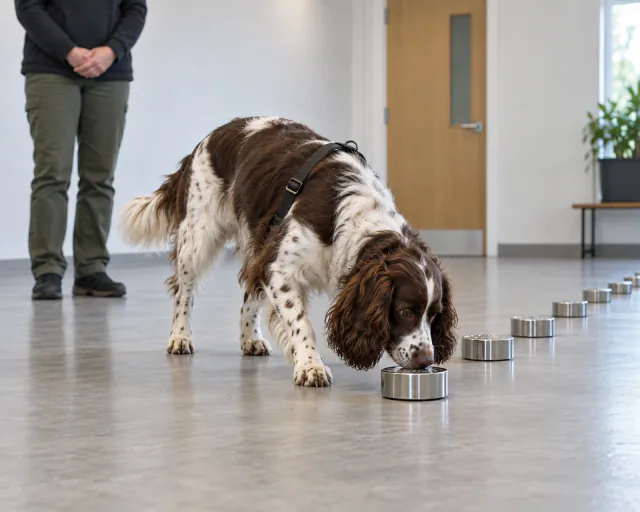
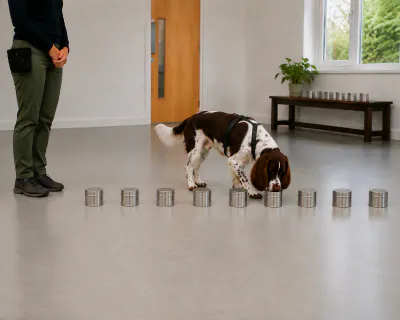
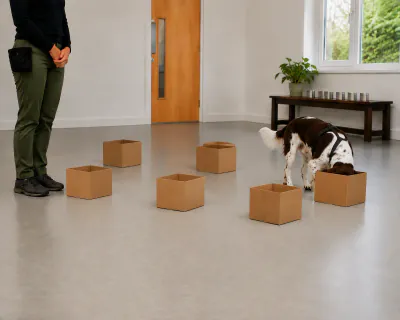
By the end of this lesson the dog should search a line of eight closed tins, with the food tin placed anywhere in the row, and hold their nose at the right one for about two seconds before you mark and pay. You should also be able to hide the food tin in one of several open boxes spread around a room and watch the dog check the boxes one at a time instead of racing about. For many dogs ten minutes of this is more tiring than a much longer walk, which makes it useful on wet days, for dogs on restricted exercise with their vet’s agreement, and for dogs who find busy walks hard work.
Prerequisites
- The dog can wait briefly while you put something down, as taught in wait and leave it.
- The dog takes food gently and shows no guarding of food, bowls or objects.
- A quiet indoor space you can use for every session at first. A new room is a new distraction.
Equipment
Use identical containers so the only difference between them is what is inside. Small metal tins with lids work well: punch a ring of small holes in each lid so the smell escapes but the dog cannot reach the food. Choose containers with smooth edges, too large to swallow, and wash all of them in hot water before the first session. Strong-smelling soft food such as plain cooked chicken makes the early searches easy. Keep the payment food in a pouch you can reach without looking down, because a handler rummaging in a pocket distracts the dog at the exact moment it should be concentrating. If the dog already enjoys working food out of toys, food-dispensing toys are a sensible way to keep the nose busy between sessions. Plain open cardboard boxes are all you need for the later stages.
Method
- Choose one tin to be the food tin for the whole lesson and mark its underside with a strip of tape. Using the same tin every time stops the empty ones picking up the smell of food.
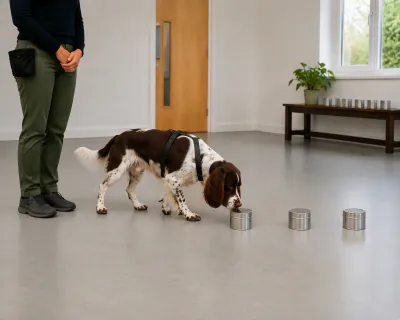
- Put the food tin on the floor with its lid off. Let the dog watch you drop a piece of food into it, say your search cue, such as find it, and release them to eat. Repeat five times.
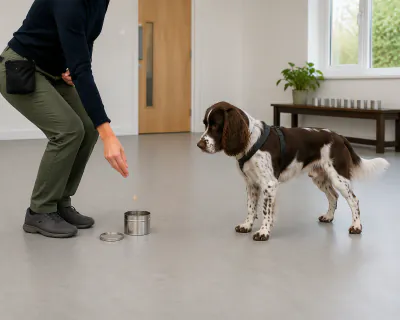
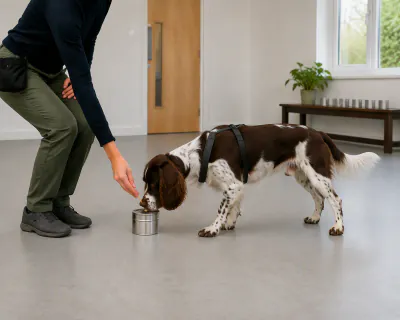
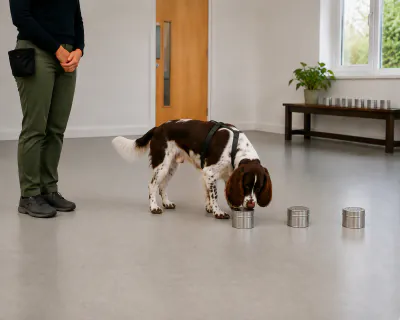
- Put the lid on with a piece of food inside. Say the cue. The moment the dog’s nose touches the lid, mark with yes and place a piece of food from your pouch on the lid, right at the nose. The food inside stays where it is. Paying at the tin teaches the dog that the answer is found at the source, not at your hand.
- Add two clean, empty tins, one either side, about 30 centimetres (a foot) apart. Handle all three the same way. Send the dog to search. Say nothing while they sniff the empty tins, and mark and pay at the lid as soon as the nose reaches the food tin.
- Build duration first. Wait half a second of nose on the food tin before marking, then one second, then two. If the dog starts pawing or nudging the tin, you waited too long, so mark sooner for the next few searches.
- Move the food tin between searches, to the left, the right and the middle, so the dog cannot learn a position instead of a smell.
- Extend distance next. Build the line to five tins, then eight, spaced about 50 centimetres (20 inches) apart, and start the dog two metres (six feet) back from the line, then four metres (thirteen feet).
- Stand upright and still while the dog searches, with your hands clasped and your eyes on the far end of the row. Dogs read people well, and a glance or a lean towards the right tin turns a search into a guessing game about you.
- Add distraction only when eight tins are reliable. Put the dog’s favourite toy in one empty tin so they learn to pass it and keep working for the food.
- Move to boxes. Spread six open cardboard boxes across the room and put the closed food tin inside one of them. Cue the search, then mark and pay at the box when the dog holds their nose over the tin.
- Finally, place the food tin somewhere in the room at nose height or below, behind a chair leg or beside a door frame, and let the dog search the whole space.
- End each session while the dog is still keen, with a scatter of a few pieces of food on the floor as a relaxed finish.
Session length
Five to ten minutes, with no more than six to eight searches, once a day is plenty. Searching is harder work than it looks, and a dog who is tired will start guessing. Give water and a short rest between searches. Food used in training counts towards the day’s intake, so weigh the payment food out beforehand and take it from the daily ration. The guide to treats and daily energy intake explains how to keep the total sensible.
Progression criteria
Move on to boxes when the dog finds the food tin and holds their nose on it for two seconds in nine searches out of ten, with the tin in different positions in a line of eight, across three separate sessions. Move on from boxes to the whole room when nine out of ten box searches are correct. If the dog cannot reach that standard, shorten the line or reduce the boxes to three and rebuild.
Common mistakes
Helping is the most common mistake: pointing, leaning, staring at the right tin or saying the cue again as the dog passes it. Marking before the nose has stopped rewards a dog who sweeps past, while waiting far too long produces pawing and knocked-over tins. Letting the dog get the food out of the source tin teaches them to raid rather than indicate. Moving on too quickly, especially to a new room on the same day as more tins, stacks two changes at once.
Troubleshooting
If the dog paws or knocks the tins over, stick them to a board with a little double-sided tape and mark earlier. If they race along the line and miss the food tin, space the tins further apart and shorten the line. If interest fades, use better food, fewer searches and a session before a meal rather than after one. A dog who stares at you instead of searching is waiting for help, so stand still, clasp your hands and look away. Many gundogs and hounds rush the first few searches and settle into a steadier rhythm with practice, though that is a tendency rather than a rule. The guide to enrichment and boredom has more ideas for using searching as part of an ordinary week.
Safety and when to stop
Stop if the dog becomes frantic, whines, digs at the floor or pushes the tins hard, and make the next session easier. Keep everything that could be swallowed out of the search area and put the tins away when you finish. Do not add essential oils or scented products: this lesson uses food alone, and some scented products are unsuitable for dogs. A dog who stiffens, freezes, growls or eats very fast over found food is showing guarding, which needs individual assessment by a qualified behaviourist working with your vet rather than more searching; the guide to resource guarding explains what to look for. A sudden loss of interest in food or sniffing can have a physical cause and belongs with your vet.
Next lesson
Continue with retrieve to hand, which builds another natural behaviour, carrying, into a reliable exercise with a clear finish.
Useful tool
The dog exercise planner helps you count search sessions as part of the day’s mental work, so a dog who has searched well in the morning is not also expected to manage a long, busy walk straight afterwards.