- Session length
- 5 minutes, once or twice a day, split between the two cues
- Skill
- Impulse control
- Suits
- Any age
What you need
- Two grades of food, one ordinary and one clearly better
- A flat, non-slip floor and an internal doorway or a gate
- A lead and well-fitted harness for the outdoor stages
- A low value object such as a dropped sock or a dull toy for the first leave repetitions
Wait and leave it are two cues doing two different jobs, and teaching them as one muddled idea is why neither works when it matters. Wait means pause where you are until I say otherwise. Leave it means turn away from that thing and I will make it worth your while. Both rest on the same principle: the dog chooses restraint because it pays.
Purpose
By the end of this lesson the dog should hold position at an open internal doorway for five seconds until released, and turn their head away from food on the floor on one cue. Both are small, testable standards, and both matter every day.
Prerequisites
- The dog takes food from your hand without snatching.
- The dog will sit or lie down and stay there briefly.
- You have a doorway indoors that does not lead outside.
Equipment
You need two grades of food: the ordinary grade is what the dog is asked to leave, the better grade is what they are paid with. That difference makes leave it a good deal rather than a loss. For the wait work, choose an internal door or a stair gate on a floor where the dog can sit without slipping.
Method
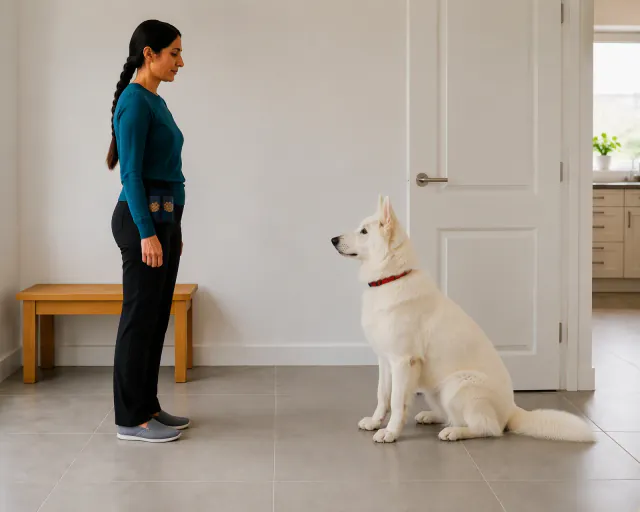
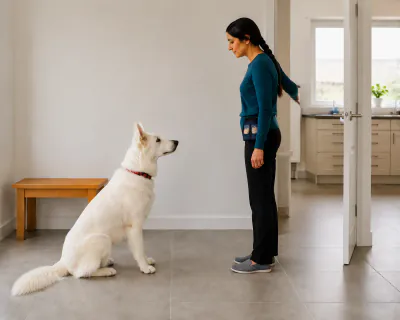
- Start with wait. Ask the dog to sit a metre (three feet) back from a closed internal door.
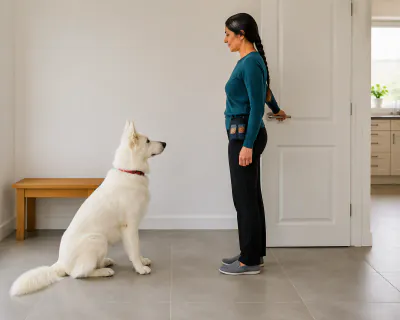
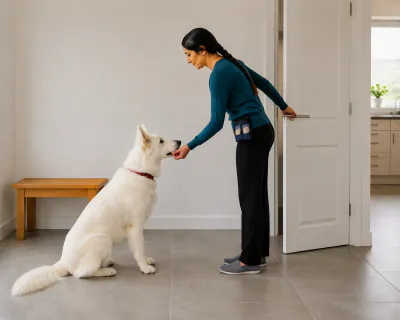
- Put one hand on the door handle. If the dog stays still, feed in position and release with a word such as off you go. If the dog moves, reset without comment and make the next repetition smaller.
- Extend duration first. Rest your hand on the handle for one second, then two, then five, feeding in position before each release.
- Now change the picture rather than the duration. Move the handle without opening the door, then open it a few centimetres (an inch or two), then a hand’s width. Close it if the dog moves and repeat at the previous width.
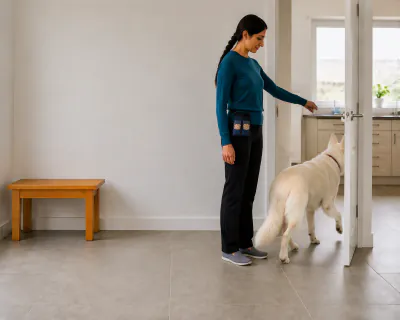
- Build to a fully open door with the dog holding position for five seconds. Feed in position, then release. The release is the only permission to move through.
- Add distance next, keeping duration at five seconds. Step through the doorway, turn, and release the dog from the far side.
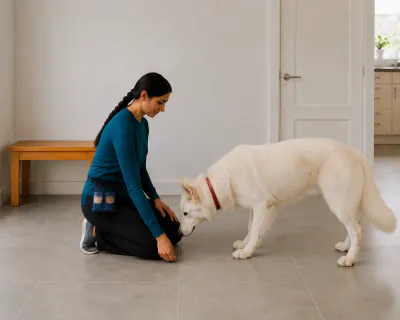
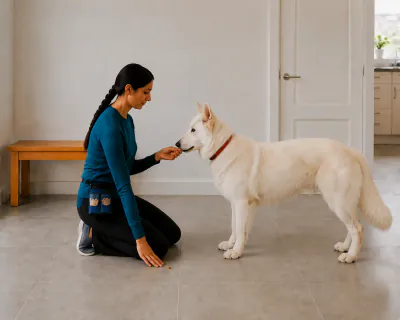
- Now start leave it, as a separate exercise on another day if you prefer. Kneel with an ordinary piece of food inside a closed fist resting on the floor.
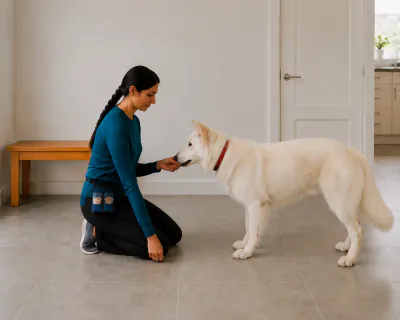
- Let the dog nose, lick and paw at your hand. Say nothing and do not move it. The instant they move their head away, even slightly, pay a better piece from your other hand.
- Repeat until the dog turns away as soon as the fist touches the floor, then add the cue, saying leave it once just before your hand goes down.
- Open the fist slightly so the food is visible, ready to close it if the dog dives in. Then place food on the floor with your hand over it, then beside it, then a step away. Pay from the other hand.
- Extend distance last. Drop a piece of food and walk past it with the dog on lead, cueing leave it as you approach, paying as you pass.
- Only when both cues are solid indoors, add distraction. Move to the garden, then a quiet path, shortening duration and distance again each time the place changes.
Session length
Five minutes, once or twice a day, split between the two cues rather than combined. Six to ten repetitions of one exercise is plenty, because impulse control work is mentally demanding and a tired dog starts guessing.
Progression criteria
Move on when the dog holds position at a fully open internal door for five seconds in nine repetitions out of ten, and turns away from food on the floor on one cue in nine out of ten, across three sessions in two rooms. Count any lunge, snatch or step through the door as a failure. If you fall short, halve the duration or the door opening and rebuild.
Common mistakes
Using leave it as a scolding word makes the cue predict something unpleasant, so the dog stops trusting it. Paying with the item they were asked to leave teaches them that staring at it produces it. Saying wait and never releasing the dog makes the cue meaningless. Repeating the cue while the dog creeps forward teaches them it applies loosely, so say it once and manage the outcome.
Troubleshooting
If the dog cannot stop nosing your closed hand, the step is too hard, so start with the fist already on the floor and pay a head turn of a centimetre or two. If wait falls apart at the front door, the excitement of going out is a distraction you have not built up to, so practise there when no walk follows. If the dog picks things up outdoors and swallows them, manage with a lead and, where appropriate, a properly fitted basket muzzle introduced gradually, while the training catches up.
Safety and when to stop
Stop this lesson if the dog stiffens, freezes, hardens their eyes or growls over food or objects. That is resource guarding, and it needs a qualified behaviourist working with your vet, not a home exercise. A dog who suddenly starts eating unusual items, or becomes unwilling to give things up, should be seen by a vet, since appetite and behaviour changes can have medical causes. Never open a dog’s mouth to remove something, and never use startle, spray or shock to enforce leave it.
Next lesson
Continue with drop it, reliably, which turns an occasional trade into a cue that works with anything your dog picks up.
Useful tool
The dog food calculator is worth using alongside this lesson, because impulse control work uses a noticeable amount of food, best taken out of the daily ration rather than added on top.