- Session length
- 3 to 5 minutes, five to eight repetitions, once or twice a day
- Skill
- Retrieval
- Suits
- Any age
What you need
- A soft canvas dummy about 20 centimetres (8 inches) long, or a plain soft toy long enough to hold across the middle
- A long line of five metres (about sixteen feet), clipped to a well-fitted harness
- Small soft food rewards the dog will work for outdoors
- A treat pouch worn on the side of your feeding hand
A retrieve is not one behaviour but five joined together: pick the item up, hold it, carry it, come back and let go into your hand. Most dogs described as not fetching can manage some of those parts and not others. The usual failure is the last part, where the dog grabs the toy and runs off or drops it just out of reach. This lesson builds the chain backwards from a calm hold, paying each part with food, and uses a long line outdoors so running off with the dummy is never practised.
Purpose
By the end of this lesson the dog should fetch a soft dummy rolled or gently thrown about five metres (sixteen feet) across short grass, come straight back and deliver it into your hand, letting go on a cue. It should happen in a quiet, enclosed space with the dog on a long line. That is not yet an off-lead retrieve, a retrieve from cover or water, or the steady, sent-on-command retrieve that gundog work asks for. Those build on a clean delivery to hand, which is why it comes first.
Prerequisites
- The dog gives up a toy for a food trade on one cue, as taught in drop it, reliably. If your dog is still young, the puppy drop and release lesson is the gentler starting point.
- The dog returns on a long line from about ten metres (thirty three feet) in a quiet space.
- No stiffening, growling or running off to protect toys or chews.
Equipment
A soft canvas dummy about 20 centimetres (8 inches) long is easy to hold across the middle and too big to swallow. A plain soft toy of similar size works for dogs who find canvas dull. Avoid balls small enough to disappear down the throat and never use sticks. A five-metre (sixteen-foot) long line on a well-fitted harness means you can always stop the dog from turning the exercise into a chase; the guide to long lines for recall training covers lengths and materials. Wear food in a treat pouch on the side of your feeding hand, because the trade has to be ready the instant the dog arrives.
Method
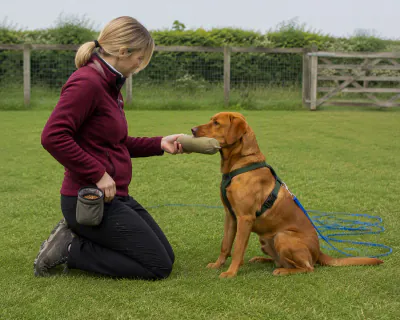
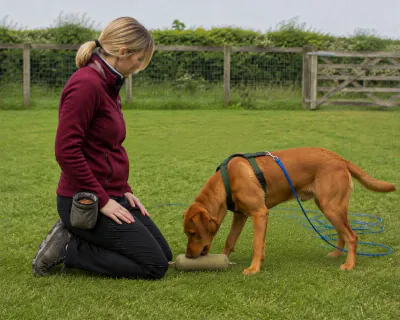
- Sit or kneel with the dog in front of you in a quiet room or garden. Hold the dummy level, just below the dog’s mouth. The instant the dog touches it with their mouth, mark with yes and pay. Repeat until the dog reaches for it straight away.
- Wait for a gentle close. Mark when the mouth closes softly round the middle of the dummy, still with your hand on it. Pay, and take the dummy back as the food arrives.
- Build duration first. Keep your hand on the dummy and wait half a second, then one second, then two, before you mark. Chewing or mouthing means the hold is too long for now, so shorten it.
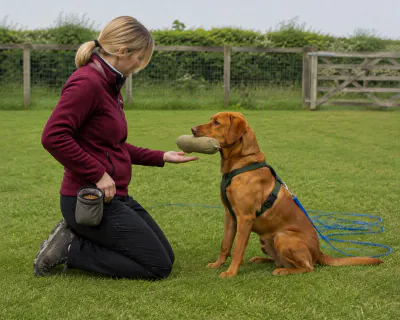
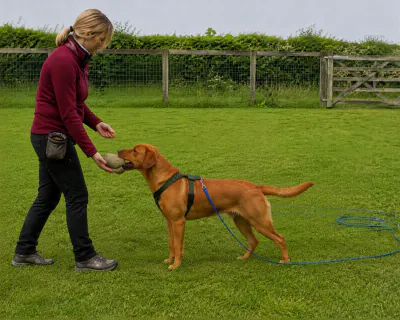
- Let the dog take the weight. Loosen your fingers so the dog holds the dummy alone for one second, with your hand cupped just underneath. Mark, then trade food for the dummy. Build to five seconds.
- Now teach the pick-up. Place the dummy on the ground at your feet and give your retrieve cue, such as fetch. Mark and pay when the dog lifts it into your waiting hand. Move it a pace away, then a metre (three feet).
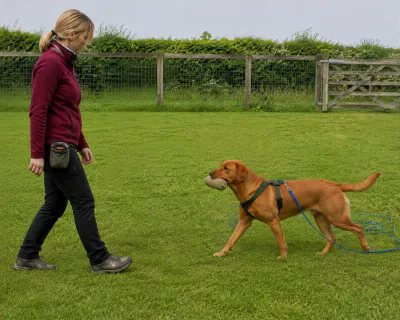
- Add carrying. When the dog is holding the dummy, take one step backwards, then two, then three, so the dog walks after you holding it. Receive it with one hand cupped underneath and give food from the other hand.
- Put the release on cue. With your hand under the dummy, say give, and bring food to the dog’s nose only after the word. Never pull or grab; the dog lets go because the food is better than the dummy.
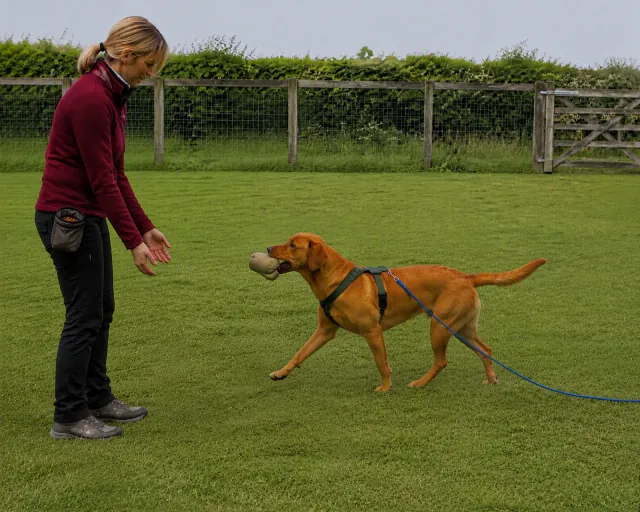
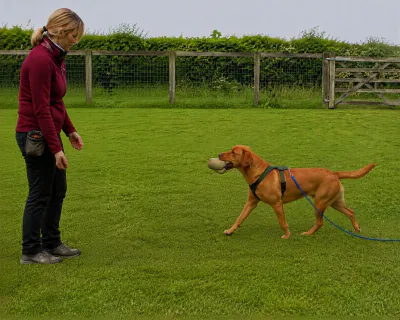
- Take it outside to a quiet, enclosed space and clip on the long line. Roll the dummy about one metre (three feet). Send the dog, and as they pick it up, step backwards to draw them in. Receive, trade, and repeat.
- Extend distance, and only distance, to two, three and then five metres (sixteen feet). If the dog veers away, do not chase. Step backwards, gather the line calmly and walk away from the dog so coming to you is easier than leaving.
- When rolled retrieves from five metres are reliable, throw the dummy gently instead of rolling it, keeping the distance the same.
- Add distraction last. Move to a slightly busier place and drop back to one metre for the first few repetitions.
- Put the dummy away after every session. An item that appears only for training stays valuable, while one left lying about becomes something to chew.
Session length
Three to five minutes, with five to eight repetitions, once or twice a day is enough. Stop while the dog is still bringing the dummy back eagerly. The food used counts towards the dog’s daily intake, so measure it out in advance and take it from the day’s ration.
Progression criteria
Move on when the dog completes nine retrieves out of ten from five metres, delivering to your hand without dropping the dummy or veering away, across three sessions in two different places. A retrieve where you reeled the dog in or took the dummy from the mouth does not count. If you cannot reach nine out of ten, go back to the last distance that worked and rebuild.
Common mistakes
Chasing the dog, even playfully, teaches that the dummy starts a game of keep-away. Grabbing the dummy or pulling it out of the mouth makes many dogs grip harder or drop it early to avoid the grab. Throwing too far too soon skips the carrying and delivery stages the dog has not learned yet. Repeating the retrieve until the dog loses interest teaches them to wander off. Playing tug at the moment of delivery rewards holding on rather than letting go.
Troubleshooting
If the dog drops the dummy at your feet, go back to holds with your hand beneath and pay the hold at your hand. If they run off with it, shorten the distance, walk backwards more and practise in a narrow space such as a hallway, where the only way to go is back towards you. A dog who will not pick the dummy up may find it more interesting if you move it along the ground in short jerks first. Many retrievers and spaniels carry naturally, while plenty of hounds and terriers show little interest in retrieving, though those are tendencies rather than rules. The safe toy play lesson helps dogs who get overexcited around toys.
Safety and when to stop
Stop if the dog limps, is stiff after sessions or becomes reluctant to run, and speak to your vet. Keep repetitions short and the ground flat, especially for young dogs who are still growing and for older dogs. Avoid hot weather. Never force the mouth open or use an ear pinch, a toe pinch or any method that works by discomfort. A dog who freezes, growls, turns away with the dummy or snaps when you reach for it is guarding, and that needs individual assessment by a qualified behaviourist working with your vet rather than more practice.
Next lesson
Continue with cooperative nail trims, which uses the same patient building of a chain, one small part at a time, for a job many dogs dislike.
Useful tool
The dog exercise planner helps you fit short retrieve sessions into the week alongside walks, so fetching stays a training exercise rather than a replacement for varied exercise.