
- Session length
- 2 to 4 minutes, once a day
- Skill
- Cooperative care
- Suits
- Any age
What you need
- Nail clippers or a nail grinder sized for the dog
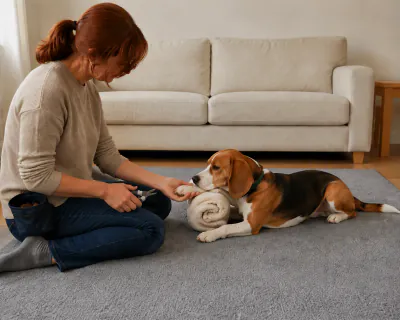
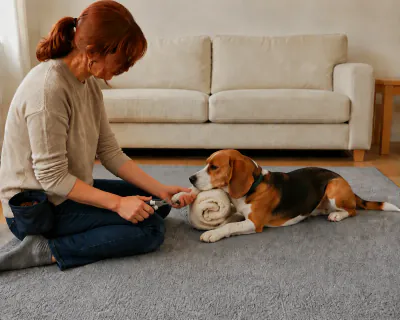
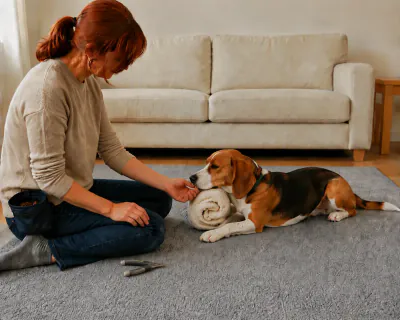
- A towel rolled to about 10 centimetres (4 inches) high, used only as a chin rest
- A non-slip rug or mat
- Small, soft, high-value food rewards in a treat pouch
- A lick mat spread with soft food, for dogs who settle better when licking
- A clean cotton pad or folded kitchen towel kept within reach
Nail trims usually go wrong in the same way. The dog pulls a foot back, the owner holds on to finish, and the next time the clippers come out the dog leaves the room. After a few rounds of that, a two-minute job becomes a monthly struggle or a trip to the groomer with a muzzle. This lesson takes the start button from the beginner grooming work and applies it to the grooming task most dogs find hardest: a foot held still while something presses on a nail. The dog chooses when each repetition begins, and a lifted chin ends it, so there is never a reason to escape.
Purpose
By the end of this lesson the dog should rest their chin on a towel and keep it there while you trim a thin sliver from every nail on one foot, and then on the others across a few short sessions. The goal is not a full pedicure in one sitting. It is a routine you can repeat every few weeks for the rest of the dog’s life without either of you dreading it. Frequent small trims also let the quick recede along with the nail, as the guide to nail care for dogs explains, so the job gets easier over time rather than harder.
Prerequisites
- The dog already accepts brief touches and a supported hold on each paw, as built in handling for grooming.
- Someone experienced, such as a vet, veterinary nurse or groomer, has shown you on your own dog where the quick sits. On dark nails it cannot be seen from outside, which makes a demonstration more valuable, not less.
- The clippers or grinder have lived in view for a few days and have been picked up and put down near the dog with food following.
Equipment
Choose one tool and stay with it through the lesson. Clippers cut in a single squeeze; a grinder files a little at a time and suits some dogs with dark nails, though its noise and vibration bother others. The comparison of nail clippers and grinders sets out how the main types differ. Roll a towel to about 10 centimetres (4 inches) high so the dog’s chin rests on it comfortably while lying down, and keep it only for this job so it stays meaningful. Wear a treat pouch so the feeding hand never has to go far. Some dogs cope far better when they have something to lick, and for them a lick mat spread with a thin layer of soft food can replace the towel: licking means carry on, and stopping to look up means pause. Keep a clean pad within reach in case a nail bleeds.
Method
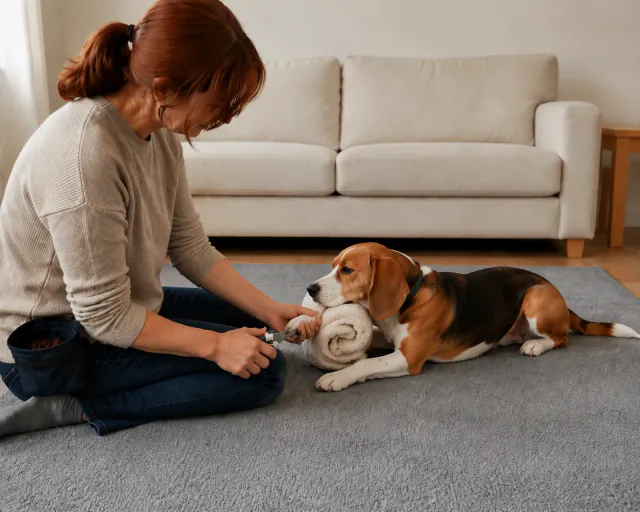
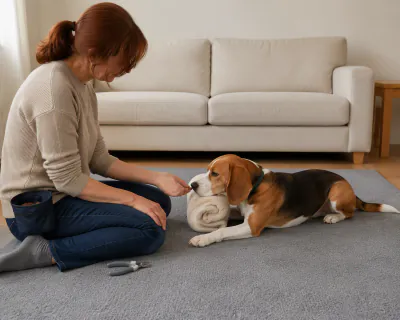
- Teach the start button on its own first. Sit on the rug with the rolled towel in front of the dog. When the dog lowers their chin onto it, mark with a calm word and feed. Repeat until the chin goes down within a second or two of the towel appearing.
- Build duration on the chin rest before any handling: two seconds, then five, then ten, feeding while the chin stays down. Release with a word such as all done and take the towel away.
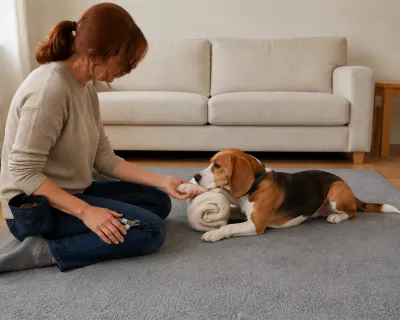
- With the chin down, cup one front paw loosely from underneath for two seconds, let go, then feed. The clippers rest closed on your knee, visible but still.
- Pick the clippers up, touch the closed jaws against the tip of one nail for one second, take them away, then feed. Work across several nails and all four feet over a few sessions. If you use a grinder, run it switched on at a distance first, then touch the switched-off grinder to a nail, then the running grinder for one second.
- Treat a lifted chin as a pause every time. Release the paw at once, rest both hands in your lap and wait. If the chin returns within about ten seconds, carry on at an easier step. If it does not, end the session calmly.
- When touching is relaxed, trim one thin sliver from the tip of a single nail, about 1 to 2 millimetres (around a sixteenth of an inch) and well short of the quick. Put the clippers down straight away and feed two or three pieces in a row.
- Stop after that one nail for the first few sessions, even if the dog seems fine. Ending early is what keeps the next session easy.
- Extend by nails, not by pressure: two nails, then a whole foot, then a front and a back foot in one session. Keep the rule of one squeeze, clippers down, food.
- Change one thing at a time once a foot is easy: a back foot rather than a front, the dog standing rather than lying, a different room, then a second person holding the food while you trim.
- Check the dewclaws in every session. They never touch the ground, so they grow unchecked and deserve their own slow introduction.
Session length
Two to four minutes, once a day, is plenty. Most of that time is spent on the chin rest and on touches that lead nowhere, and that is deliberate. A dog who has had forty uneventful touches for every cut stops treating the clippers as a warning sign. On a maintenance schedule later, trimming one or two feet every few days keeps nails short without ever needing a long sitting.
Progression criteria
Move on when the dog offers the chin rest without prompting, keeps it through a trim of every nail on one foot, and stays loose throughout, in three sessions out of four. Loose means soft eyes, an easy tail and breathing that does not change when the clippers touch a nail. A dog who holds still with a rigid body and a fixed stare is enduring the trim rather than accepting it, and that does not count towards moving on.
Common mistakes
Holding on when the dog pulls the foot back is the fastest way to lose everything this lesson builds, because it teaches the dog that the chin rest is a trap. Trimming every nail in one go because the dog tolerated the first four asks too much on a good day and sets up a bad one. Rushing past the touch-only stage because the nails are already long makes the first cut far riskier. If the nails are overgrown, have a vet or groomer bring them back to a manageable length while you train, rather than using that job as your first session.
Troubleshooting
If the chin lifts every time the clippers move, the clippers are still too close to the start, so go back to leaving them on the rug and touching the paw with an empty hand. If the dog accepts front feet but pulls away from back feet, practise the back feet with the dog standing, which many dogs find easier than having a hind leg lifted while lying down. If the sound of the clippers closing is the problem, squeeze them on a piece of dry spaghetti near the dog and then feed, so the sound predicts food before it ever arrives at a nail. Dogs with thick fur between the toes, including many spaniels and setters, may need that fur trimmed back first so you can see what you are cutting.
Safety and when to stop
Stop at once if the dog growls, snaps, freezes hard or tries to scramble away. That dog needs a vet check for pain in the feet, legs or back, and then help from a qualified behaviourist, not more repetitions at home. If you cut into the quick, stay calm, press a clean pad firmly on the tip and hold it steady. If bleeding has not stopped after a few minutes, or the dog seems sore afterwards, contact your vet. End the session there and go back two steps next time, since a painful cut is exactly the experience this lesson exists to avoid. Curling nails, a nail growing towards the pad, a split nail, a limp or a sudden dislike of having a foot touched all need a vet before home trims continue.
Next lesson
Continue with teaching a dog to accept toothbrushing, which uses the same chin rest and the same pause to build a daily mouth routine.
Related reading
The guide to grooming tool basics covers brushes, combs and the rest of a home grooming kit, so the next item a dog meets can be introduced in the same patient way.