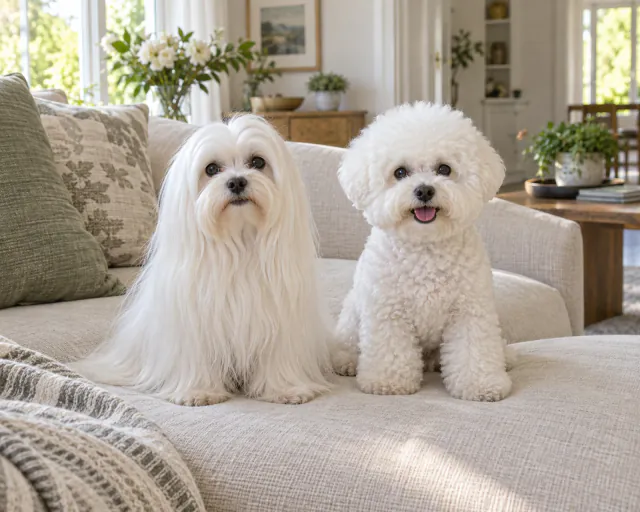
At a glance, a Maltese and a Bichon Frise can look like variations on the same theme: small, white, fluffy and unmistakably bred for companionship rather than work. Both have a long Mediterranean history as ornamental lapdogs, both shed very little, and both turn up on the same shortlists from buyers who want a toy breed without the heavy shedding of a larger dog. The resemblance stops at the coat, though. Underneath, the two breeds differ in temperament, exercise needs, trainability and how forgiving they are of a first-time owner, and those differences are worth weighing before choosing between them.
The comparison also matters because both breeds get lumped into the same “easy toy dog” category by people unfamiliar with either, when in practice the daily grooming commitment and the personality on offer are different enough to steer a decision. Both breed profiles are worth reading in full: Maltese and Bichon Frise.
How they compare
| Trait | Maltese | Bichon Frise |
|---|---|---|
| Size | Toy | Toy |
| Exercise needs | Under 30 minutes, two short walks plus play | 30 to 60 minutes, roughly 45 minutes to an hour |
| Grooming and shedding | Low shedding, daily brushing needed | Low shedding, daily brushing plus professional clip every 4 to 6 weeks |
| Trainability | Moderate | Beginner-friendly |
| Temperament | Confident, affectionate, firmly attached to its people | Cheerful, sociable, playful, eager to please |
| Good with children | Supervision important | Generally suitable |
| First-time owner suitability | Possible with support | Possible with support |
| Typical lifespan | 12 to 15 years | 14 to 15 years |
| Indicative monthly cost | £90 to £160 | £90 to £150 |
Temperament and personality differences
The Maltese profile describes a confident, occasionally stubborn dog that is deeply attached to its chosen people and quick to bark at anything unfamiliar, following from room to room and objecting to closed doors. The Bichon Frise profile paints a more universally sociable picture: naturally friendly with strangers, other dogs and generally with cats raised alongside them, with a background as a performing breed that still shows in its cheerful showmanship. Neither breed is described as reserved, but the Bichon comes across as the more outward-facing of the two, while the Maltese is framed as more singularly devoted to its own household.
Exercise and energy differences
Both breeds have modest exercise needs compared with most dogs, but the Bichon Frise sits a notch higher. The Maltese profile puts daily exercise at under 30 minutes, two short walks plus indoor play, and specifically warns against repeated jumping on and off furniture given the breed’s light frame. The Bichon Frise profile calls for 45 minutes to an hour, noting that the breed is playful rather than driven and that agility and trick training suit it particularly well, drawing on its performing history. Neither breed needs open countryside or vigorous daily activity, and much of either dog’s exercise can happen indoors through games and short training sessions.
Grooming and coat differences
Both coats shed very little, which is the main reason either breed appeals to owners managing hair around the home, but the maintenance routines differ in character rather than in total effort. The Maltese’s long, straight, silky coat needs daily brushing to prevent matting, plus daily attention to tear staining around the eyes, a well-documented feature of the breed given how visibly marks show against white hair. Many Maltese owners choose a shorter clip specifically to reduce this daily workload. The Bichon Frise’s curly coat also mats quickly without daily brushing down to the skin, and additionally needs professional clipping every four to six weeks to maintain the breed’s characteristic rounded shape, a recurring cost the Maltese does not carry to the same degree. Both breeds are prone to tear staining and both need close dental care, since small, crowded mouths are common to both.
Training and trainability differences
This is one of the clearer differences between the two. The Bichon Frise profile rates trainability as beginner-friendly, describing the breed as food motivated and generally quick to pick up house manners and basic obedience, making early sessions genuinely enjoyable. The Maltese profile rates trainability as moderate, noting that a stubborn streak means results depend heavily on consistency, and specifically flags that housetraining can take longer than with some other toy breeds and needs a fixed routine maintained well past the point an owner expects the dog to have learned it. Both breeds respond well to short, food-based sessions, but the Bichon is the more forgiving choice for an owner without much prior training experience.
Health and lifespan differences
Lifespan is broadly similar, with the Maltese profile citing 12 to 15 years and the Bichon Frise profile citing 14 to 15 years, both long spans typical of toy breeds. Patellar luxation and eye conditions screened under the BVA and Kennel Club eye scheme appear on both profiles as conditions worth asking a breeder about. The Bichon Frise profile additionally flags urinary stones as reasonably well documented in the breed, noting that straining to urinate, passing only small amounts or blood in the urine needs same-day veterinary attention, along with skin sensitivities and allergic reactions that can show as itching or recurrent ear infections. The Maltese profile places more emphasis on dental disease as a long-term concern given the breed’s crowded mouth, alongside the tear staining already mentioned. Neither profile suggests one breed carries a materially heavier overall health burden than the other, but the specific conditions worth researching differ.
Cost and space differences
Both breeds suit flats and small homes comfortably, and both are listed as possible for first-time owners provided support is available. Monthly costs are close, with the Maltese profile citing £90 to £160 and the Bichon Frise profile citing £90 to £150. The real cost difference is structural rather than headline: a Bichon owner is likely paying a groomer on a fixed six-to-eight-week schedule for life, while a Maltese owner doing daily home grooming can reduce professional grooming costs, provided they are willing and able to keep up the daily routine themselves. Neither breed tolerates being left alone for long stretches well, with both profiles noting limited ability to be left and describing distress or destructive behaviour as a real possibility without gradual training.
Which one suits you?
Choose the Maltese if you want a strikingly coated companion, are happy to take on a genuinely daily grooming and tear-care routine yourself, and prefer a dog whose devotion is concentrated on you rather than spread across every visitor. Choose the Bichon Frise if you want an easier breed to train from day one, a temperament that is reliably sociable with children and strangers, and you would rather budget for a regular professional groom than manage the coat entirely at home.
Both breeds need a household with a reasonable amount of time at home, and neither is the right choice for a home left empty most of the day. If neither profile feels quite right once you have weighed grooming style against trainability, try the breed comparison tool against other toy breeds, or use the breed finder to widen the search based on your actual daily routine.