
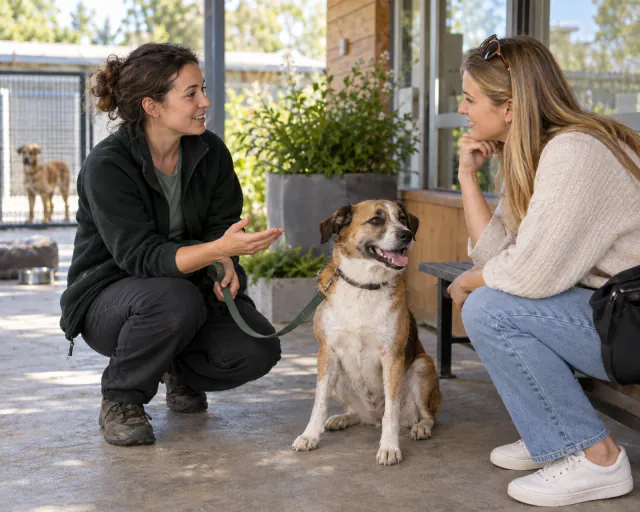
Adopting from a rescue or shelter is a different process from buying from a breeder, and it comes with its own set of useful questions. A good organisation will generally be glad to answer these in detail, because a well-matched adoption is in everyone’s interest, including the dog’s. This guide sets out what to ask, and why the answers matter more than any general assumption about what a rescue dog is like.
Rescue and shelter systems vary enormously between organisations and between countries, ranging from small volunteer-run groups to large established charities to municipal or council facilities, and assessment standards, record-keeping and post-adoption support differ accordingly. Because of this variation, the questions below matter more than assuming any fixed standard applies everywhere.
What is known about the dog’s history
Ask what the organisation actually knows about the dog’s background, and be attentive to the difference between confirmed information and reasonable guesswork. Some dogs arrive with a documented history from a previous owner; others are strays or transfers with very little known for certain. A good organisation will be clear about which parts of a dog’s story are known and which are inferred from behaviour, rather than presenting guesswork as fact.
Ask specifically why the dog needed rehoming if that is known, since dogs end up in rescue for a wide range of reasons unrelated to the dog’s own behaviour, including a change in an owner’s housing, health, finances or family circumstances.
How the dog has been assessed, and around what
Ask what behavioural assessment the dog has been through, who carried it out, and what it covered. Many organisations assess dogs around handling, food, toys, other dogs, and sometimes cats or children, though the thoroughness and consistency of this varies between organisations. If your household includes children, other dogs, cats or other pets, ask directly whether the dog has been specifically assessed around that type of animal or situation, rather than assuming a general “good with everyone” label covers your particular circumstances.
Be aware that a shelter or foster environment is not the same as a settled home, and a dog’s behaviour in that setting is not always a complete picture of how it will behave once settled. A thoughtful organisation will usually flag this limitation rather than presenting an assessment made under kennel or foster stress as a complete character reference.
What support is available after adoption
Ask what happens if you have questions or concerns once the dog is home. Many organisations offer behaviour advice, a helpline, or ongoing contact for a period after adoption, and some offer a trial period during which an adoption can be reconsidered if it genuinely is not working, though the terms of this vary. Ask specifically what the process is if things are not going well, since a good organisation would rather help you work through a difficulty, or take the dog back if necessary, than see a placement fail quietly with no support.
Health, vaccination status and known medical needs
Ask for the dog’s current vaccination and health status, whether it has been neutered, microchipped and treated for parasites, and whether the organisation is aware of any ongoing medical needs, allergies or conditions. Ask what veterinary records exist and whether they can be passed on to your own vet. Reputable organisations generally carry out at least a basic veterinary check before rehoming a dog, and many carry out considerably more, but standards vary, so it is worth asking rather than assuming.
Setting reasonable expectations for the adjustment period
Ask what the organisation typically tells new adopters to expect in the first weeks. Many dogs need a period of adjustment as they settle into a new environment and routine, sometimes described informally as a decompression period, during which a dog’s behaviour in the home can differ noticeably from how it behaved during assessment or in a foster setting. A dog that seems subdued at first may become more confident, and occasionally more challenging in specific ways, once it feels secure enough to show its full personality. This is a normal part of many adoptions rather than a sign that something has gone wrong, and a good organisation will generally prepare you for it rather than presenting the dog’s first few days as a complete preview of life together.
Ask what a sensible timeline for settling in looks like for the type of dog you are adopting, and what signs would suggest a genuine problem worth raising, as distinct from an expected adjustment.
Why asking matters more than assuming a standard
Because rescue and shelter practice varies so much by organisation and by country, the same question can have a very different answer depending on where you are and which organisation you are working with. Asking directly, and expecting clear, specific answers rather than general reassurance, tells you far more about a particular organisation’s standards than its size, appearance or reputation alone. If you are still weighing whether a rescue or a breeder route suits your circumstances better, rescue versus breeder covers that comparison directly, and questions to ask a breeder covers the equivalent ground for that route.