
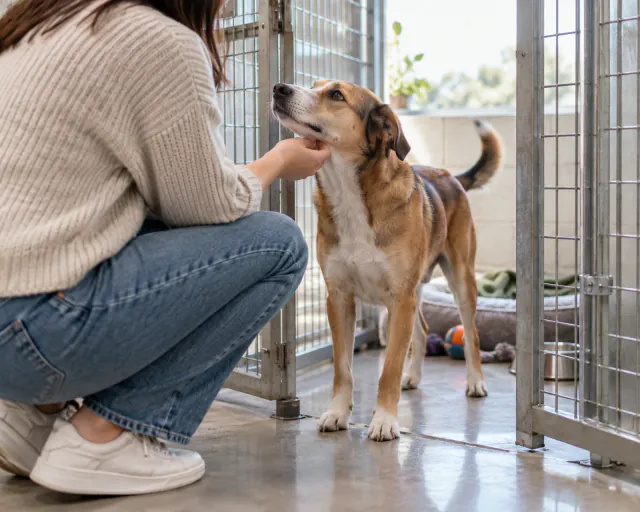
People often frame rescue and breeder routes as a moral choice rather than a practical one, and that framing gets in the way of a genuinely useful comparison. Both routes bring dogs into good, well-matched homes every day, and both routes can also go badly if approached carelessly. The more useful question is what each route typically involves in practice, what it asks of you, and what trade-offs come with each, so you can choose the one that actually fits your circumstances and expectations.
It also helps to know upfront that neither route is uniform. Breeder licensing and regulation vary considerably between countries and even between regions within a country, and the same is true of rescue and shelter systems, which range from small volunteer-run groups to large established charities to municipal or council-run facilities, with correspondingly different levels of assessment, support and record-keeping. What follows describes typical practice rather than a fixed standard everywhere.
What a responsible breeder route typically involves
A responsible breeder route usually starts well before any puppies are born, with health screening of both parents for conditions relevant to the breed, using recognised tests or schemes where these exist. Reputable breeders are generally willing to show you the original certificates or results for this screening, rather than simply telling you the line is healthy.
You would typically expect to see the puppies with their mother, in the place where they were raised, more than once if possible. This lets you observe the mother’s temperament, the environment the puppies have been raised in, and how the puppies have been socialised to early handling, everyday household sounds and different surfaces. A breeder taking this seriously will usually ask you detailed questions about your home and circumstances too, since matching a puppy to a suitable home matters to a breeder who intends to stand behind their dogs.
Ongoing support is a common feature of this route. Many breeders remain a point of contact for advice through the dog’s life, and a genuinely responsible breeder will usually want to know if things are not working out, often with a written or verbal commitment to take a dog back rather than have it passed on elsewhere or end up in a shelter. This is one of the clearer signs of a breeder who takes long-term responsibility for the dogs they produce, rather than treating the sale as the end of their involvement.
What a rescue or shelter route typically involves
A rescue or shelter route typically starts with an application and assessment process rather than a straightforward purchase. This often includes questions about your household, experience, work pattern and home environment, and many organisations carry out a home visit or ask for references before approving an adoption, though the thoroughness of this process varies significantly between organisations and countries.
Support here usually comes from the organisation’s own knowledge of the individual dog, built up during the time the dog has been in their care. A rescue that has held a dog for some weeks or months, and observed it around staff, volunteers, other dogs or in a foster home, is often able to give a genuinely useful account of that specific dog’s temperament and needs, sometimes more detailed than what a breeder can tell you about a young puppy who has not yet developed a settled personality. Many organisations also offer post-adoption support, ranging from a phone line for behaviour questions to a formal trial or settling-in period.
The trade-off is that a rescue dog’s full history is often only partly known, particularly for dogs that arrived as strays or from difficult previous situations. A good organisation will be upfront about the gaps in what they know rather than filling them in with guesswork, which is worth listening for during the adoption process.
The genuine trade-offs
The breeder route generally gives you input into a dog’s earliest experiences from day one, along with documented health screening on the parents and, often, a known lineage. It generally involves a longer wait, since responsible breeders do not always have puppies available and do not overbreed to meet demand, and it involves an upfront cost that is usually higher than an adoption fee.
The rescue route often gives you a dog whose adult temperament is already largely visible and has usually been assessed by people with direct experience of that dog, and adoption fees are often lower and sometimes include initial veterinary work such as vaccination, neutering or microchipping, depending on the organisation and country. It can involve an unclear or partial history, a waiting or approval process that some applicants find intrusive, and sometimes a more limited choice of individual dogs available at any one time compared with searching among multiple breeders.
Neither route is a shortcut. Both a careless breeder purchase and a rushed rescue adoption without proper assessment can lead to a poor match between dog and household, while a considered approach to either route can lead to a very good one.
Both charity and licensed commercial routes exist in each category
It is worth being clear that “breeder” is not synonymous with unregulated, and “rescue” is not synonymous with charitable. Many countries license and inspect commercial breeders to some standard, while some breeders operate as hobbyists producing occasional litters without commercial licensing requirements applying to them. Equally, some rescue and rehoming organisations are registered charities, others are informal volunteer networks, and some pet relocation and rehoming services operate on a commercial or semi-commercial basis. None of these labels alone tells you how well-run a specific organisation is. The questions you ask matter more than the category the organisation falls into.
Making the comparison useful
Once you have a general sense of which route appeals more, or if you are still weighing both, the detailed question lists in questions to ask a breeder and questions to ask a rescue or shelter are the practical next step. Both cover the specific things worth asking before committing to either route, and working through the relevant one will tell you far more about a particular breeder or organisation than any general comparison of the two routes can.