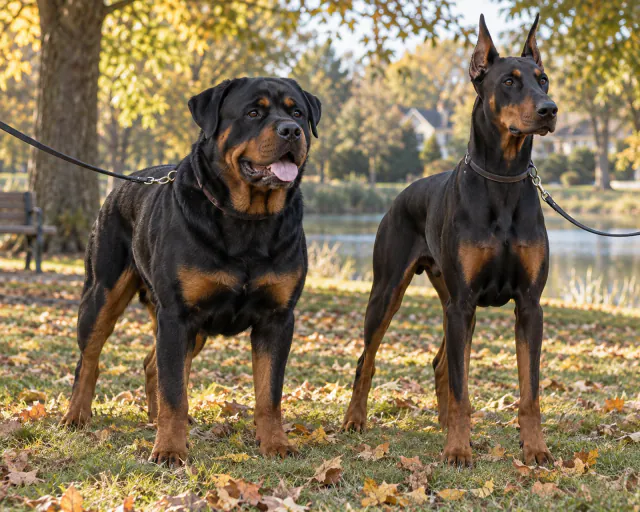
Anyone researching a large, capable German breed with a genuine guarding instinct usually ends up looking at the Rottweiler and the Dobermann side by side, and the reasons run deeper than reputation alone. Both breeds were developed in Germany within a similar era for close working relationships with a handler in public settings, both were among the earliest breeds used in police work, and both carry a public image shaped more by films and headlines than by the animals most owners actually live with. The comparison is worth making carefully, because the two differ meaningfully in size, build and how closely they expect to live alongside their household.
Comparison at a glance
| Trait | Rottweiler | Dobermann |
|---|---|---|
| Size | Large, males 61 to 69 cm, up to 50 kg | Large, roughly 70 cm, leaner build |
| Exercise needs | About 90 minutes a day plus regular training | At least 90 minutes a day plus daily training |
| Grooming and shedding | Low grooming, more shedding than the short coat suggests | Low grooming, light but constant shedding |
| Trainability | Needs an experienced handler | Needs an experienced handler, learns very quickly |
| Temperament | Calm, confident and closely attached to its household | Alert, sensitive and closely bonded, wants constant inclusion |
| Good with children | Often good with family children, under constant adult supervision | Better suited to older children in a home managing a large, fast dog |
| Good for first-time owners | Experienced owner preferred | Experienced owner preferred |
| Time alone | Moderate tolerance | Limited tolerance |
| Typical lifespan | 8 to 10 years | 10 to 13 years |
| Indicative monthly cost | £110 to £200 | £100 to £180 |
Temperament and personality differences
Both breeds are described as closely attached to their own household rather than distant working dogs, but the character of that attachment differs. The Rottweiler is described as calm and confident, typically undemanding indoors and inclined to lean its whole weight against a favourite person, with guarding behaviour that is real but tends to appear as the dog matures towards two years old rather than showing constantly. The Dobermann is described as more sensitive and more insistent about physical contact and constant inclusion, wanting to follow one person from room to room, and its guarding instinct is expressed mainly through alertness and noise rather than the steadier, more settled presence typical of the Rottweiler. The Dobermann’s guide is explicit that the breed copes badly with rough handling, inconsistency or being left to work out the rules alone, a sensitivity not emphasised to the same degree for the Rottweiler.
Exercise and energy differences
Exercise needs are close between the two, both rated at roughly ninety minutes a day plus regular structured training. The Rottweiler is described as a trotting breed rather than an endurance athlete, better suited to steady work than sprinting, and a heavy dog of this build overheats quickly, so summer exercise needs to move to cooler hours. The Dobermann is built leaner and covers ground more economically, making it a workable partner for running or long hikes once mature, with real free running recommended rather than lead walking alone. Both breeds need growth respected in the first year to eighteen months, with forced exercise and repeated jumping restricted until the skeleton has finished developing.
Grooming and coat differences
Both breeds are low maintenance in terms of grooming routine, needing only a weekly session with a rubber mitt or hound glove, though both shed more than their short coats suggest. The Rottweiler’s shedding rises noticeably in spring and autumn. The Dobermann’s shedding is described as light in volume but constant year round, with fine, stiff hairs that work into fabric. The Dobermann has markedly less natural insulation than the Rottweiler, and its guide notes that a lean, short coated dog genuinely needs a coat in cold weather and a proper bed to avoid pressure sores on hard flooring, a consideration not raised for the more heavily built Rottweiler.
Training and trainability differences
Both breeds need an experienced handler and respond well to reward-based methods, with harsh treatment producing problems in either. The Rottweiler’s training priorities centre on physical management given its sheer mass and low mechanical advantage for a handler, with loose-lead walking established before the puppy grows heavy, a reliable settle, calm passing of other dogs and a routine for the doorbell. The Dobermann is described as learning fast with a long memory, willing to work all evening for food and engagement, but also quick to notice unfairness, where punitive handling produces either a shut down or a defensive dog. Muzzle training taught positively is recommended for the Rottweiler as neutral equipment; the Dobermann’s guide instead emphasises an off switch indoors and a rule about barking at the door, reflecting its more vocal alertness.
Health and lifespan differences
This is one of the most significant differences between the two. The Rottweiler’s typical lifespan of 8 to 10 years is notably shorter than the Dobermann’s 10 to 13 years, despite the Dobermann’s own lifespan already being on the shorter side for its size. Recognised health concerns differ by breed. The Rottweiler is associated with hip and elbow issues, congenital heart disease including subaortic stenosis, a DNA-tested condition causing juvenile laryngeal paralysis and polyneuropathy, cruciate ligament injury, bone cancer and gastric torsion, the last of which is a medical emergency requiring immediate veterinary care. The Dobermann is associated with heart conditions requiring regular screening, a bleeding disorder with an available DNA test, and issues affecting the neck, spine, hips, thyroid and liver. Heart screening is described as the most significant health check for the Dobermann specifically, and it should be done regularly using scans and monitoring rather than a single check. Neither list diagnoses an individual dog, and any breeder should provide current, dated documentation rather than assurance.
Cost and space differences
Costs sit in a similar band, with the Rottweiler’s indicative £110 to £200 a month and the Dobermann’s £100 to £180, both reflecting a large breed with insurance premiums that climb steeply in later life. Both need a house with a secure, tall garden rather than open land as such, and both need a bed large enough for their frame and a household that is not empty for full working days. The Dobermann’s guide is more explicit about limited tolerance for time alone, describing separation as something that must be taught patiently from puppyhood, while the Rottweiler is rated as having moderate tolerance for being left.
Which one suits you?
If you want the calmer, more settled presence indoors and can accept a shorter typical lifespan, alongside genuine physical strength that demands a confident handler for every member of the household, the Rottweiler fits that profile. If you want a leaner, faster dog that is likely to live somewhat longer but needs more consistent inclusion, gentler handling and closer attention to separation from puppyhood, the Dobermann is the closer match. Both are unsuitable for a first-time owner without professional support, a household away all day, or anyone drawn to either breed’s reputation rather than its actual daily demands.
The breed comparison tool can help you weigh either breed against other large guarding types, and the breed finder is a sensible next step if a large, powerful dog with this level of training commitment turns out not to match your household honestly.