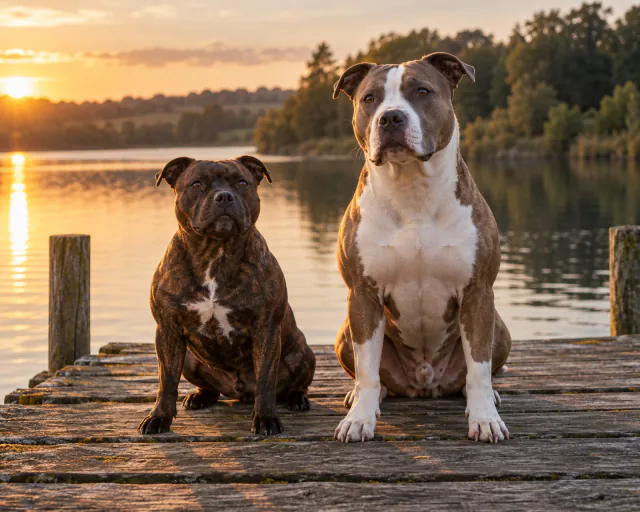
The Staffordshire Bull Terrier and the American Staffordshire Terrier are confused constantly, and the shared name is only part of the reason. Both descend from the same nineteenth century crosses of bulldog and terrier types developed in Britain, and the split happened afterwards, when dogs exported to the United States were bred larger and heavier for the show ring while the type that stayed in England kept its smaller, faster build. The result is two related but distinct breeds that people frequently mistake for each other, or assume are simply the same dog under two names.
Comparison at a glance
| Trait | Staffordshire Bull Terrier | American Staffordshire Terrier |
|---|---|---|
| Size | Medium, 36 to 41 cm, 11 to 17 kg | Medium to large, 43 to 48 cm, 22 to 32 kg |
| Exercise needs | About 1 hour a day plus play and training | 1 to 2 hours daily with training built in |
| Grooming and shedding | Low grooming, moderate shedding | Low grooming, moderate and fairly constant shedding |
| Trainability | Moderate | Moderate |
| Temperament | Affectionate, bold and people-focused | Confident, affectionate and physically bold |
| Good with children | Often affectionate, with careful supervision | Often affectionate, with careful supervision |
| Good for first-time owners | Possible with support | Possible with support |
| Home suitability | Suits a small home with good walking access | Suits a medium home with a securely fenced garden |
| Typical lifespan | 12 to 14 years | 12 to 15 years |
| Indicative monthly cost | £80 to £150 | £80 to £140 |
| Kennel Club recognition | Recognised by the UK Kennel Club since 1935 | Recognised by the American Kennel Club, not the UK Kennel Club |
Temperament and personality differences
Both breeds share the intense human attachment that defines bull-type terriers generally, and both were selected for tolerance of people rather than tolerance of other dogs, which remains highly variable between individuals in each breed. The Staffordshire Bull Terrier’s profile emphasises affection and boldness with a strong pull towards company. The American Staffordshire Terrier’s profile leans towards confidence and physical boldness, with particular attention paid to arousal, since these dogs move from relaxed to highly excited quickly and take time to settle again. Neither breed should be assumed sociable with other dogs on the strength of its friendliness with humans, and reactivity in adolescence, roughly twelve to eighteen months, is recognised in the American Staffordshire Terrier specifically.
Exercise and energy differences
The two breeds sit close together on exercise, though the American Staffordshire Terrier’s guide allows for a longer daily total, one to two hours across two or more outings, against the Staffordshire Bull Terrier’s roughly one hour of purposeful exercise plus play and training. Both benefit from mental work folded into physical activity rather than treated as an afterthought, since a dog of either breed run to exhaustion daily tends to become fitter rather than calmer. Both can overheat during hard activity given their heavy muscle, so warm weather calls for adjusted plans and available water.
Grooming and coat differences
Grooming is straightforward and near identical for both. The Staffordshire Bull Terrier needs a weekly brush and occasional bathing, with pale hair noticeable on furnishings despite the short coat. The American Staffordshire Terrier needs a weekly rub down with a rubber mitt, with shedding described as moderate and constant rather than seasonal. Skin deserves attention in both breeds, since recurring skin problems are recognised in the Staffordshire Bull Terrier and allergic and contact skin problems are common in bull-type breeds generally, including the American Staffordshire Terrier, and any persistent irritation needs veterinary diagnosis rather than repeated changes of food.
Training and trainability differences
Both breeds are rated as moderately trainable and respond well to reward-based methods, with harsh handling raising arousal rather than reducing it in either. Priorities are similar across the two: loose-lead walking, recall, calm greetings and comfortable acceptance of handling and veterinary examination. The American Staffordshire Terrier’s guide specifically recommends positive muzzle training regardless of local law, since it removes stress from vet visits and travel where legislation applies to bull-type dogs. Careful, managed introductions to other dogs and cats are recommended for both breeds, with neutral coexistence a reasonable goal even where a dog does not enjoy busy dog parks or off-lead group play.
Health and lifespan differences
Lifespans are close, 12 to 14 years for the Staffordshire Bull Terrier and 12 to 15 years for the American Staffordshire Terrier. Recognised screening for the Staffordshire Bull Terrier includes DNA testing for hereditary cataracts and L-2-hydroxyglutaric aciduria alongside eye and elbow assessment. Recognised screening for the American Staffordshire Terrier includes hip scoring, eye testing, cardiac assessment and DNA testing for cerebellar ataxia. Both breeds should be kept at a lean body condition to protect joints and reduce the effects of warm weather. Ask any breeder for original, dated documentation covering the relevant tests for the specific breed rather than a general assurance about bull-type dogs as a group.
Legal status and recognition differences
This is where the two breeds genuinely diverge rather than merely resembling each other closely. The Staffordshire Bull Terrier has been recognised by the UK Kennel Club since 1935 and is not a restricted type under UK law. The American Staffordshire Terrier is recognised by the American Kennel Club but not by the UK Kennel Club, and breed specific legislation in some countries restricts or bans bull-type dogs more broadly, so checking local law before acquiring either breed, and particularly before travelling with one, is essential. Where legislation applies, requirements around insurance, muzzling and registration add cost and restrict movement, and insurance itself can be harder to arrange for either breed where insurers treat bull-type dogs differently.
Cost and space differences
Costs sit close together, with the Staffordshire Bull Terrier’s indicative £80 to £150 a month overlapping the American Staffordshire Terrier’s £80 to £140. Space needs differ slightly with size: the Staffordshire Bull Terrier suits a smaller home with good walking access, while the somewhat larger American Staffordshire Terrier is described as needing a medium home with a securely fenced garden rather than land as such. Both breeds tend to struggle with long routine absences, since both value company closely, and both need everyone handling the lead to have confidence and consistent skill given their strength.
Which one suits you?
If you want the smaller, more established breed with a longer UK history and Kennel Club recognition, the Staffordshire Bull Terrier is the more straightforward choice, particularly for a smaller home. If you are drawn to a somewhat larger, heavier dog and are prepared to research the legal position in your own country and any country you might travel to, the American Staffordshire Terrier is worth considering, with the understanding that recognition and legislation vary in ways that genuinely affect day-to-day ownership. Both breeds reward committed, consistent training and careful management of introductions to other dogs, and neither suits an owner looking for a low-effort, hands-off companion.
Use the breed comparison tool to check either breed against other terriers or family dogs you are considering, and try the breed finder if you are not yet sure a bull-type terrier is the right category of dog for your household at all.