
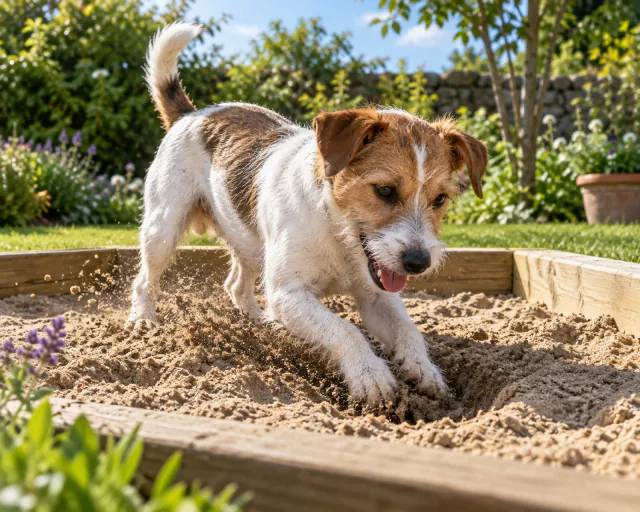
A dug-up flower bed or a fresh crater in the lawn is one of the more visible frustrations of living with a dog, and it often arrives with a question about what the dog is “trying to do.” Digging is rarely a single motivation. It can be an instinctive foraging or hunting behaviour, a way of finding comfort in hot or cold weather, a response to boredom or anxiety, or simply an activity a dog finds satisfying in its own right, and more than one of these can be true for the same dog at the same time.
This guide covers the common reasons dogs dig, why after-the-fact punishment is one of the least effective responses available, and the constructive alternatives that channel the behaviour rather than fight it. Some individuals and breeds have a genuinely strong instinctive drive to dig, and for those dogs, management that gives the behaviour a legitimate outlet tends to work far better than any attempt to eliminate it completely.
Instinctive foraging and hunting behaviour
Many terriers, along with a range of other breeds and individuals bred for work below ground or for finding vermin, carry a strong instinctive drive to dig. This is not naughtiness, it is a piece of hardwired behaviour that shows up regardless of how well exercised or how well trained a dog otherwise is. A dog catching the scent of a rodent, worm activity or another animal underground will often dig with real determination and focus, because the behaviour is doing exactly what it evolved to do.
This category of digging is the hardest to eliminate because it is not primarily driven by an environmental problem you can fix. A dog with a strong instinctive drive to dig will usually always want to dig to some degree, and the realistic goal is providing an acceptable place to do it rather than expecting the urge itself to disappear.
Temperature regulation
Dogs dig to create a cooler patch of bare earth to lie on during hot weather, and a similar den-like impulse can appear in cold weather, when a dug-out hollow offers some shelter from wind. This type of digging tends to appear in a fairly predictable spot, often in shade near the house or under a tree, and tends to increase sharply during a heatwave or a cold snap.
Providing better shade, a paddling pool for cooling off in hot conditions, or a warm, sheltered bed in cold conditions often reduces this type of digging, because it addresses the underlying need for comfort directly rather than only the resulting hole.
Boredom and anxiety
A dog left in the garden for long stretches with little else to do will often dig simply because it is something to do, and this is one of the more preventable causes. Increasing physical exercise appropriate to the dog, along with mental enrichment such as scent work, food puzzles, and regular training sessions, tends to reduce digging that is rooted in an under-stimulated day.
Anxiety, including distress at being left alone or separated from people or other dogs, can also drive digging, sometimes concentrated at fence lines, gates or points of access, as part of a broader pattern that might include barking, described in more detail in the barking guide, pacing or vocalising. Digging that is intense, repetitive, focused on escape routes or accompanied by other signs of distress is worth discussing with a qualified behaviourist and a vet, since anxiety-driven digging usually needs a broader plan rather than a change to the garden alone.
Digging for its own sake
Some dogs dig simply because they enjoy it, in much the same way some dogs enjoy chasing a ball regardless of any deeper motivation. This can appear as an occasional activity with no obvious trigger, sometimes in fresh or recently turned soil that is easier and more rewarding to dig into. This category tends to respond well to being given a legitimate place to do it, since the digging itself is the reward and there is no underlying deficit to fix.
Why punishing digging after the fact does not work
By the time an owner discovers a hole, the digging happened minutes, hours or sometimes a full day earlier. A dog cannot connect a scolding delivered long after the event with the specific act of digging, so a delayed punishment does not reduce future digging. What it reliably does is teach the dog to be wary of the owner’s mood around the garden, or to dig only when the owner is not watching, neither of which solves the original problem and both of which damage trust for no benefit.
Reducing digging effectively means addressing why it is happening and managing the environment, not catching the dog in the act and reacting more quickly, which is rarely practical in any case.
Providing a designated digging area
For dogs with a strong drive to dig, whether instinctive or simply for enjoyment, a designated area such as a sandpit or a boxed-off patch of loose soil, positioned somewhere the resulting mess is acceptable, gives the behaviour a legitimate outlet. Make the area appealing by burying safe toys, chews or treats in it and encouraging the dog to dig there specifically, so the spot becomes reliably rewarding on its own.
Redirect a dog calmly towards the designated spot if you catch digging starting elsewhere, without scolding, and reward digging in the correct area generously, particularly in the early stages of establishing the new habit.
Protecting valued areas of the garden
Fence off flower beds, vegetable patches or other areas you want to protect with low barriers, planting the most vulnerable areas out of easy reach, or using chicken wire laid flat just under the soil surface, which most dogs find unpleasant to dig into without being harmed by it. Combine this with the designated digging area above, so the dog has somewhere satisfying to go instead of only somewhere they are excluded from.
Being realistic about what management achieves
For a dog with a strong instinctive drive to dig, expect to manage the behaviour for the dog’s whole life rather than to train it away permanently. This is a realistic and entirely manageable outcome, similar to a herding breed that will always want to chase movement to some degree. A sensible mix of a legitimate digging spot, protected valuable areas, and adequate physical and mental stimulation lets most households live comfortably alongside a dog who digs, without an unrealistic expectation that the instinct itself will disappear.