A dog first aid kit has one job: to help you keep a dog safe and reasonably stable for the short period between an incident happening and getting professional veterinary care. It is not a way to treat a dog at home instead of visiting a vet, and it is not a substitute for the judgement of someone qualified to examine the animal. Framed that way, putting a kit together is straightforward, and knowing where the line sits matters just as much as knowing what to put in the bag.
Most households never open a dog first aid kit in a genuine emergency, and that is the point. Having the right basic items ready, and knowing roughly how you would use them, removes one source of panic from a situation that is already stressful, and it means you are not searching the house for scissors or a clean bandage while a dog is distressed.
What a basic kit should contain
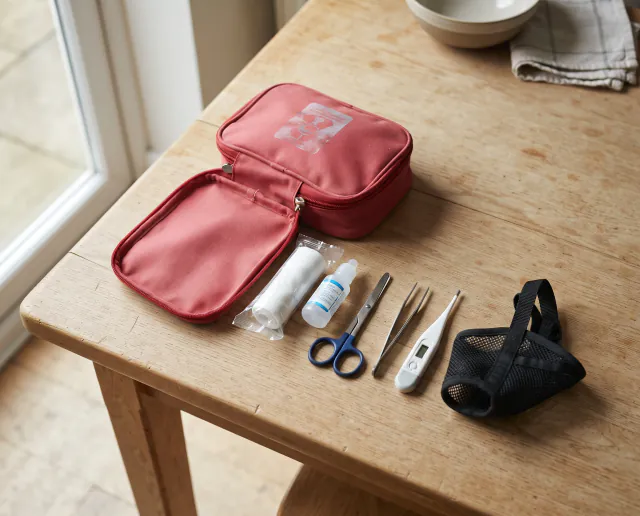
A sensible kit is small, portable and easy to check periodically rather than an elaborate medical case. Useful contents include:
- Non-adherent sterile dressings, sized for covering a wound without sticking to it.
- A conforming (self-adhesive or crepe-style) bandage to hold a dressing in place without needing tape directly on fur or skin.
- Sterile saline solution for flushing dirt or debris from a wound or an eye.
- Blunt-ended scissors, which are safer than pointed scissors for cutting bandage material or matted fur near a wound without risking further injury.
- Tweezers, useful for removing a visible splinter, thorn or similar small foreign object from a paw pad where it can be done safely and without causing distress.
- A digital thermometer suitable for animal use, since a dog’s normal temperature range differs from a person’s and a vet may ask for a reading over the phone in some situations.
- A properly sized muzzle appropriate to your dog, even if your dog has never needed one and you hope it never will. A dog in pain, however gentle its temperament normally is, may bite reflexively when handled, and a muzzle protects both the dog and the people helping it during transport, provided the dog is not vomiting, struggling to breathe or showing signs that make muzzling unsafe.
- A soft, secure lead and, for smaller dogs, a way to carry them safely such as a sturdy blanket or a suitable carrier.
- A written list of important contact numbers: your usual vet practice, the nearest emergency out-of-hours veterinary provider, and a friend or neighbour who could help with transport if you cannot drive yourself.
- A copy of any relevant medical history, current medication and known allergies, particularly useful if you are travelling, boarding the dog, or if a different vet to your usual practice ends up treating the dog.
Keep the kit somewhere it will actually be grabbed in a hurry, check it every few months for anything that has gone out of date or been used and not replaced, and take a version of it with you when travelling or on longer walks away from easy vehicle access.
What home first aid is genuinely for
Home first aid exists to support getting a dog safely to veterinary care, and the safest approach stays firmly within that limit. Controlling active bleeding with firm, direct pressure using a clean dressing, keeping a dog calm, warm and as still as reasonably possible, and arranging safe transport are the core of what a kit and a calm response can achieve. Speak to your vet or the emergency line as early as possible in any incident, ideally while you are already moving towards help, since they can guide you through what to do in the specific situation far better than a general checklist can.
Home first aid should stop there. It is not the moment to attempt anything beyond basic, safe stabilisation, and going further than that carries real risk of making an injury worse, delaying proper treatment, or causing additional distress to a dog that is already frightened and in pain.
What not to do
Never give a dog any human painkiller or other human medication under any circumstances, including anything left over from a previous illness in a person or another animal. This is one of the most common and most dangerous mistakes owners make in a genuine emergency, made with entirely good intentions. Many human medications that are safe for people are toxic to dogs even in small amounts, and there is no safe dose of a human painkiller for a dog to work out at home. If a vet decides pain relief is appropriate, they will prescribe something suitable for the individual dog and its situation.
Do not attempt to clean or explore a deep wound beyond gently flushing visible surface debris with saline, and do not try to remove an object that is embedded deeply rather than sitting loosely on the surface, since doing so can cause further damage or trigger bleeding that is harder to control outside a clinical setting. Do not attempt to realign a limb that looks abnormally positioned, and do not force a dog to bear weight to “test” an injury. Do not offer food or water to a dog that may need sedation or a general anaesthetic shortly afterwards, unless a vet has specifically told you it is fine to do so, since an empty stomach is often required for safe anaesthesia.
When to call ahead
Calling the practice or the emergency line before you arrive, or while you are on the way, gives the veterinary team time to prepare and gives you clear guidance on what to do in the meantime, tailored to what has actually happened rather than a general list. This is particularly worth doing for anything involving heavy bleeding, suspected poisoning, a road traffic incident, a fall from height, breathing difficulty, collapse, a suspected fracture, or any injury that looks serious even if the dog seems to be coping. Veterinary teams deal with these calls regularly and would far rather talk you through the right immediate steps than have you guess.
A first aid kit is genuinely useful preparation, and knowing how to use it calmly is a real skill worth having. Used within its proper limits, alongside a prompt call to your vet, it can make a real difference to how smoothly an already difficult situation is handled.