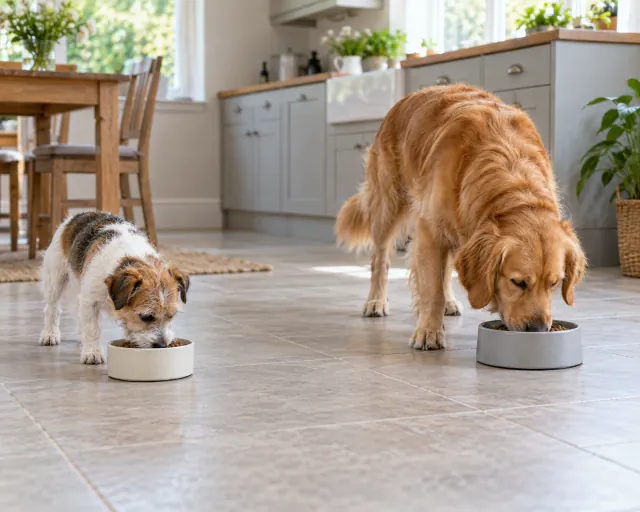
Feeding one dog well is mostly about consistency. Feeding several dogs in the same household adds a layer of logistics on top: dogs eat at different speeds, need different amounts, sometimes need genuinely different diets, and can develop habits around food that only show up once there is competition or proximity at mealtimes. None of this is unusual or a sign of a badly run household, but it does need a deliberate routine rather than assuming things will sort themselves out.
This guide covers the practical side of multi-dog feeding: stopping one dog eating another’s portion, managing different dietary needs under one roof, actually knowing who has eaten what, and handling wariness or guarding around food calmly and safely.
Stop one dog finishing another’s bowl
A faster eater moving on to a slower dog’s bowl once their own is empty is one of the most common multi-dog feeding problems, and it causes two issues at once. The faster dog gets more than their measured amount, undermining any weight management plan, and the slower dog gets less than intended, which matters just as much for a dog who needs the full amount for their size, age or condition.
Feeding dogs in separate spaces solves this cleanly: different rooms, different ends of a room with a barrier between them, or crates used at mealtimes if the dogs are already comfortable with crates for other reasons. Where separate spaces are not practical, supervise the meal directly and remove each dog’s bowl as soon as they finish or after a reasonable, consistent amount of time, rather than leaving bowls down and available to whichever dog gets there first. Consistency in this routine matters more than which specific method is used.
Different diets, different dogs, same kitchen
Multi-dog households frequently need to run more than one diet at once. A puppy and a senior dog have different energy and nutrient needs even before any health condition is factored in, and a dog on a vet-guided diet for a specific health reason should not have casual access to another dog’s standard food, since even small amounts of the wrong food can undo the point of a carefully managed diet.
Physical separation at mealtimes, the same routine used to stop bowl-swapping, does double duty here. Store different foods clearly separated and labelled in the kitchen, particularly where a specific therapeutic diet from a vet needs to stay completely separate from a standard diet fed to other dogs in the house, and make sure everyone who feeds the dogs, including occasional dog-sitters or family members, understands which dog gets which food and why. A mix-up is far more likely when the routine only lives in one person’s head.
Know who has actually eaten, not just that the bowls are empty
Empty bowls at the end of a meal do not necessarily mean each dog ate their own ration. In a household with more than one dog, food can move between bowls, get eaten by the quicker dog, or get abandoned by a dog who ate less than usual and simply not shared with anyone, unnoticed at a glance. If weight, appetite or a specific health condition is being monitored for any dog in the household, watching that dog actually eat their own meal, rather than checking the bowl afterwards, gives far more reliable information.
This matters particularly around any change to a dog’s condition. A dog reported as eating fine because “the bowl was empty” may, in a multi-dog household, not have eaten as much as assumed, and that gap can delay noticing a genuine problem such as reduced appetite linked to illness.
Calm, separate feeding around food guarding
Some dogs show wariness or tension around food, ranging from mild stiffening if approached while eating to more pronounced guarding behaviour directed at another dog or a person. Mild wariness, such as a dog eating a little faster or angling their body away from another dog nearby, is common and usually manageable simply by giving that dog physical space and privacy to eat undisturbed, without anyone approaching or hovering during the meal.
More pronounced guarding, such as growling, snapping, or a dog that reacts strongly whenever another dog or person comes near food, is a genuine welfare and safety concern rather than something to work through casually by trial and error at mealtimes. Feed calmly and separately in the meantime to reduce the immediate risk, and seek a qualified, reward-based behaviourist to assess the situation properly rather than attempting confrontational corrections, taking food away as a test, or forcing proximity to “get the dog used to it,” all of which tend to make guarding worse rather than better.
Base each dog’s portion on that dog, not on a shared total
It can be tempting, especially with dogs of similar size, to work out one combined daily amount and split it evenly, but each dog’s actual needs depend on their own body condition, age, activity level, health status and metabolism, not on how many dogs happen to share a home. Two dogs of the same breed and similar weight can have quite different energy needs, and treating them as interchangeable for feeding purposes risks overfeeding one and underfeeding the other.
Weigh each dog’s food separately using the amount appropriate for that individual dog, informed by a feeding guideline as a starting point and adjusted based on body condition over time, in the same way as for a single dog. The guide on helping a dog maintain a healthy weight covers how to judge body condition and adjust amounts, and applies equally whether a dog lives alone or alongside several others; multiple dogs in a house just means running that process several times over rather than once.
Building a routine that holds up day to day
The households that manage multi-dog feeding most smoothly tend to have a simple, repeatable routine that everyone in the home follows the same way: separate feeding spaces or supervised meals, clearly labelled and separated food where diets differ, bowls removed promptly rather than left down, and each dog’s amount worked out individually. None of this needs to be elaborate, but it does need to be consistent, since an occasional lapse is usually when a bowl gets swapped, a therapeutic diet gets contaminated, or a wary dog gets crowded without anyone intending it.