
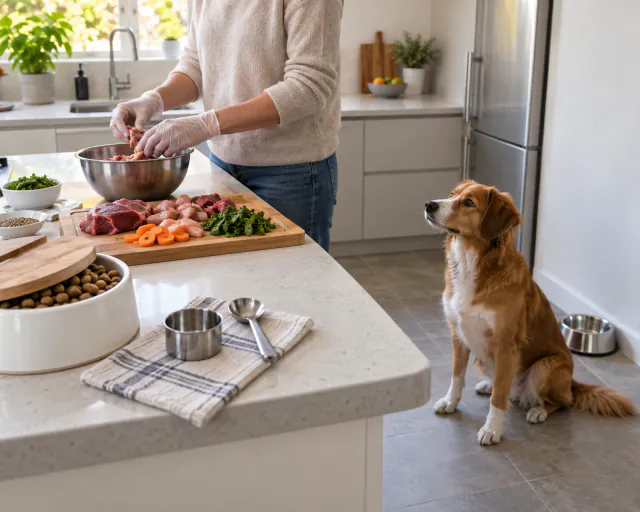
Raw and home-prepared feeding comes up in almost every conversation about dog nutrition, usually with strong opinions attached on both sides. Some owners feed raw or home-cooked meals for years with dogs that appear to thrive on them. Others switch away after a health scare, a difficult conversation with a vet, or simply because the logistics stopped being manageable. Both experiences are real, and neither one settles the question for every dog or every household.
This guide does not tell you whether to feed raw or home-prepared meals. It sets out the genuine considerations on both sides, explains why balance over time matters more than any single meal, and covers what a responsible approach looks like if you decide this is right for your dog and your circumstances.
What owners cite as potential benefits
People who feed raw or home-prepared diets commonly point to a few things. Full control over ingredients matters to owners managing a known food intolerance or trying to avoid a specific additive. Some report a glossier coat, smaller and firmer stools, or a dog that seems more interested in mealtimes, though these are individual observations rather than proven outcomes, and a dog can also do well on a good-quality complete commercial diet for the same reasons. A minority of dogs with sensitive digestion or fussy eating habits do better on home-prepared food that an owner can adjust meal by meal, which a fixed commercial formula cannot offer.
None of these observations amount to evidence that raw or home-prepared feeding produces better health outcomes across dogs generally. They explain why individual owners chose the approach for their own dog, which is a different claim.
The genuine risks
The risks are equally real and worth understanding in full before deciding.
Nutritional imbalance over time. A single meal being slightly off balance does not matter much. A diet that is short on calcium, certain vitamins or trace minerals for months or years can cause real harm, including skeletal problems in growing puppies and long-term deficiency in adult dogs. This is the single biggest risk with ad hoc home cooking, because getting the balance right across an entire diet is more technical than most recipes shared between owners suggest. It requires the same rigour as any formulated diet, not enthusiasm and good ingredients alone.
Bacterial contamination. Raw meat can carry Salmonella, Campylobacter, E. coli and other organisms that pose a risk to the dog and to the people handling the food, particularly children, older adults, pregnant women and anyone with a weakened immune system. Dogs can shed these organisms in their stools even without showing symptoms themselves, which extends the risk to the whole household through surfaces, bedding and hands.
Bone-related injury. Raw bones are sometimes fed as part of a raw diet, and cooked bones should never be given because they splinter. Even raw bone carries a real risk of broken teeth, and of bone fragments causing an obstruction or perforation somewhere in the digestive tract, which can be a genuine emergency. The size, type and hardness of the bone relative to the dog matters enormously, and what is safe for one dog can be dangerous for another of a different size or chewing style.
Why balance over time is the real question
A responsibly formulated home-prepared diet is not the same thing as home cooking done by feel. The distinction that matters is between a diet plan calculated to meet a dog’s nutrient needs across weeks and months, ideally with input from a veterinary nutritionist, and a rotation of meals put together because they look wholesome and the dog enjoys them.
Nutrients do not all need to be present in every single meal. What matters is that the diet, averaged over a reasonable period, supplies everything a dog needs in the right amounts for their life stage and body condition. This is exactly the kind of individualised assessment that matters more than a generic recipe: a growing puppy, a pregnant or nursing dog, a senior dog and a healthy lean adult all have different requirements, and a plan built around body condition and life stage is a different exercise from one recipe applied to every dog in a household.
If you want to feed a home-prepared diet long term, a plan checked or formulated by a veterinary nutritionist is the way to close this gap. Recipes copied from a book, a website or another owner without that check carry a real risk of drifting out of balance without anyone noticing until symptoms appear.
Safe handling if you choose this route
If you decide to feed raw or home-prepared food, hygiene reduces but does not eliminate the contamination risk.
- Keep raw meat frozen until shortly before use and thaw it in a refrigerator, not on a kitchen counter.
- Prepare raw food on a dedicated surface and with dedicated utensils, cleaned and disinfected separately from anything used for human food.
- Wash your hands thoroughly after handling raw meat and after clearing up the dog’s bowl and any mess.
- Feed the dog in an area that is easy to clean, and clean bowls after every meal rather than leaving residue to build up.
- Store raw food separately from other food in the freezer and refrigerator to avoid cross-contamination.
- Dispose of any packaging and leftovers promptly, and keep raw food away from children and vulnerable household members during preparation and feeding.
Why professional opinion is divided
Veterinary and public health bodies vary in how cautious they are about raw feeding, and their positions differ somewhat between countries depending on the food safety and veterinary regulatory framework in place. Some organisations advise against raw feeding altogether because of the contamination and imbalance risks described above. Others take a more neutral position, focusing on minimising risk if an owner chooses to feed raw rather than recommending for or against it outright. This divide reflects a genuine difference in how much weight different professionals give to the documented risks versus the reported experiences of owners whose dogs do well.
Because guidance genuinely varies by country and by professional body, it is worth checking what your own vet and your national veterinary or food safety authority currently say, rather than assuming a single global consensus exists. If your dog has an existing health condition, is very young, senior, pregnant, or immunocompromised, that conversation matters even more, since the risks above are not evenly distributed across the dog population.
Whichever way you feed, a dog’s condition is checked the same way. The guide on helping a dog maintain a healthy weight covers body condition assessment that applies regardless of whether the bowl contains raw meat, home-cooked food or a commercial diet.