- Session length
- 5 to 8 minutes, once or twice a day
- Skill
- Distraction proofing
- Suits
- Any age
What you need
- A long line of 3 to 5 metres (10 to 16 feet), clipped to a well-fitted harness
- High-value food rewards, better than what is used for indoor practice
- A quiet outdoor space to start, such as a garden, empty field or quiet street
- A note of one or two slightly busier locations to progress to later
Name response and attention that only work in a quiet kitchen are not really finished, because the moments they matter most are outdoors, surrounded by smells, movement and other dogs. This closing lesson takes the indoor foundation built earlier in the pathway and tests it against a structured sequence of real outdoor distraction, raised one small step at a time. The aim is a dog who can disengage from something interesting because looking back at you has paid off often enough to be worth it, not a dog who never notices anything else.
Purpose
This lesson proofs the dog’s name response and attention against genuine outdoor distraction, moving through a distraction ladder from a quiet garden to busier settings. It matters because distraction proofing is where most indoor training quietly falls apart. A dog who sits reliably at home but ignores their name near another dog has not generalised the skill, and outdoor life is where reliable attention keeps a dog safe and easy to manage around roads, other animals and people.
Prerequisites
The dog should already turn towards their name and hold brief attention indoors, built during earlier lessons in this pathway. If name response is inconsistent even in a quiet room, that needs rebuilding there before adding any outdoor distraction on top of it.
Equipment
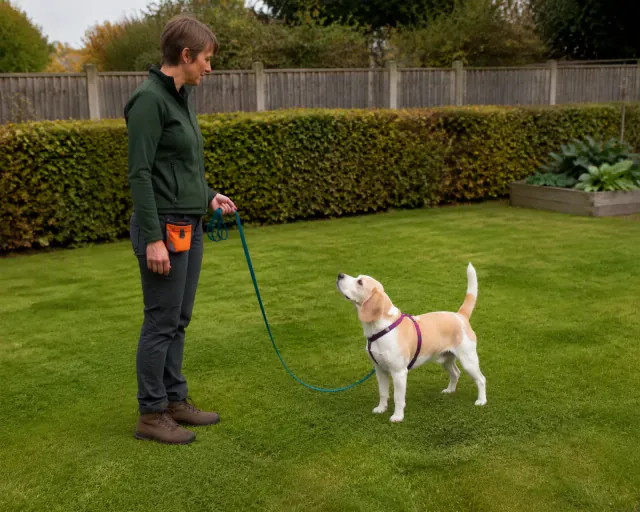
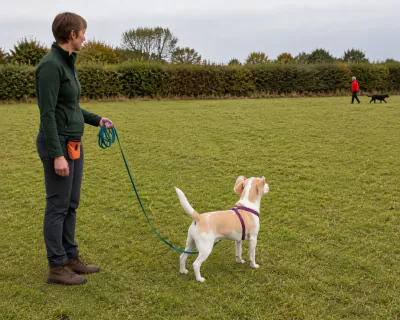
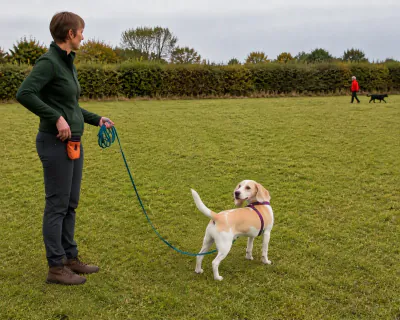
Start in the quietest outdoor space available, such as a garden, an empty field or a residential street with little passing traffic. Use a long line clipped to a well-fitted harness rather than a collar, so the dog has room to sniff and explore between repetitions without any risk of getting loose. Rewards should be genuinely better than what is used indoors, since outdoor smells and sights are competing for the dog’s attention in a way that a quiet kitchen never does.
Method
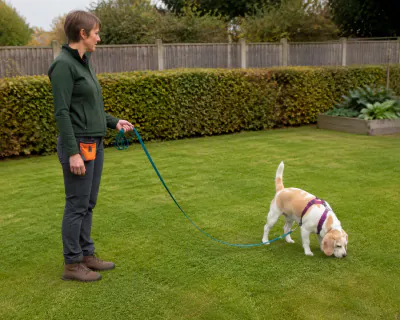
- Start in the quietest space on the ladder with the dog on the long line, allowed to sniff and move naturally rather than staring at you.
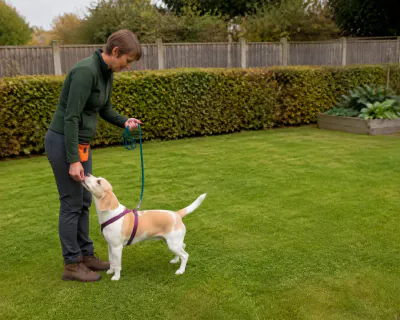
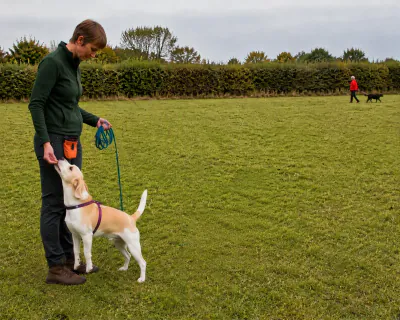
- Say the dog’s name once in a normal voice. The instant they look towards you, mark it and feed generously, several pieces in a row rather than one.
- Repeat at intervals while the dog is mildly occupied, such as sniffing the ground, rather than only when they are already looking at you.
- Once response is reliable in the quietest space, move to the next rung: a slightly busier spot, such as a quiet street or the edge of a field where a person or dog might appear in the distance.
- At each new rung, expect the first few responses to be slower or need a second cue, and reward any response, even a delayed one, while working to bring the response time back down.
- Introduce mild activity at a distance next, such as another dog or a jogger far enough away that the dog notices without becoming fixated.
- Call the name once. If the dog disengages and looks back, reward heavily and calmly, since this exact choice, looking away from something interesting, is the entire point of the lesson.
- If the dog does not respond, do not repeat the cue. Move further away to increase the distance from the distraction, then try again from a point where success is likely.
- If the dog fails to respond twice in a row at any distance or setting, drop back a full step, whether that means more distance, a quieter location, or both, rather than staying at the same difficulty and hoping for a better result.
- Progress the ladder gradually over several sessions: quiet garden, then quiet street, then a field with distant mild activity, then a location with more general activity such as a park at a moderate time of day.
- Fold the same standard into ordinary walks once the ladder is progressing well, calling the dog’s name for genuine attention rather than only during dedicated sessions.
Session length
Five to eight minutes, once or twice a day, works well, since longer outdoor sessions risk the dog becoming either bored or overstimulated by everything around them. A handful of good repetitions at the right level of difficulty beats a long session spent mostly failing at a level that is too hard.
Progression criteria
Move on to a busier rung of the ladder when the dog responds to their name within about two seconds on eight out of ten attempts at the current level, across at least three separate sessions. From there, raise difficulty one variable at a time in this order: duration first, meaning holding attention on you for slightly longer once they respond; then distance, moving closer to whatever distraction is present; then genuine distraction itself, such as a more exciting trigger or more of them at once. Never raise more than one of those at the same time.
Common mistakes
Repeating the dog’s name several times in a row when the first call fails trains the dog that the first cue, or even the first several, can be ignored. Practising only in the easiest setting because it goes well there, without ever adding real distraction, leaves the skill untested where it actually matters. Punishing a missed response, through a sharp voice or a lead correction, adds pressure to a skill that is built on the dog wanting to check in, which works against the entire method.
Troubleshooting
If the dog responds well until a specific trigger, such as another dog, appears, that trigger needs its own dedicated ladder at a greater starting distance rather than being folded into general practice too early. If response degrades across a session, distraction fatigue has likely set in, so end on an earlier success rather than pushing for one more repetition. Dogs bred for scent work or with a strong chase instinct often need more distance and more repetitions before a moving trigger, such as a jogger or a squirrel, though every individual dog varies regardless of breed background.
Safety and when to stop
Keep the dog on the long line in any space that is not fully enclosed until this response is well established, since a strong distraction can override newly built training faster than expected. Stop the session if the dog seems anxious rather than simply distracted, since fearful behaviour around a specific trigger needs a different approach than motivational distraction proofing. If the dog cannot disengage from one particular trigger even with generous distance and plenty of practice, that is worth individual support from a qualified trainer or behaviourist rather than repeating the same ladder indefinitely.
Next lesson
This closes the beginner pathway. The skills covered here, attention, recall, loose lead walking, settling, impulse control and handling, are the base that intermediate training builds on by removing help and raising real-world difficulty further. Its first lesson, fading the food lure, starts with the help most beginner work still quietly depends on.
Useful tool
Reliable attention outdoors is easier to maintain day to day when a dog’s exercise already meets their needs, so the dog exercise planner is worth returning to as you keep applying everything from this pathway on ordinary walks.