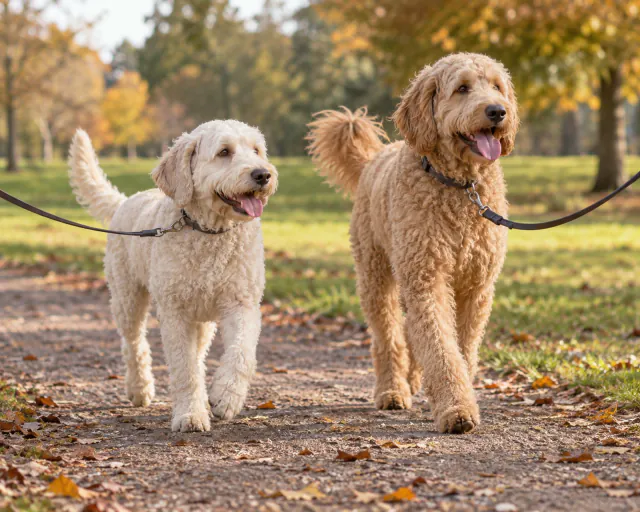
Labradoodles and Goldendoodles get compared constantly because they are, structurally, the same idea applied to two different retriever breeds: cross a Poodle with a popular sporting retriever and hope for a sociable, trainable dog with reduced shedding. The Labradoodle came first, developed in the late 1980s by an Australian guide dog programme crossing a Labrador Retriever with a Standard Poodle for a client whose husband reacted badly to dog hair. The Goldendoodle followed the same template using a Golden Retriever. Neither is a recognised pedigree breed with a kennel club standard, and both breed profiles are direct that outcomes vary considerably between individual dogs, even within the same litter, because genes reshuffle rather than blend predictably across a cross.
That shared uncertainty is the single most important thing to understand before comparing the two on paper, since a table of typical traits describes averages rather than promises for any individual puppy. Full detail sits on both profiles: Labradoodle and Goldendoodle.
How they compare
| Trait | Labradoodle | Goldendoodle |
|---|---|---|
| Size | Medium, though Poodle parent size varies the outcome | Large, usually from a Standard Poodle cross |
| Exercise needs | 60 to 90 minutes a day for most adults | 60 to 90 minutes, more for larger individuals |
| Grooming and shedding | Low shedding claimed, high grooming effort, coat varies hair, fleece or wool | Low shedding claimed, high grooming effort, coat varies flat, wavy or curly |
| Trainability | Beginner-friendly | Beginner-friendly |
| Temperament | Sociable, energetic, variable between individuals | Sociable, biddable, strongly attached to people |
| Good with children | Supervision important | Supervision important |
| First-time owner suitability | Possible with support | Possible with support |
| Typical lifespan | 12 to 14 years | 10 to 14 years |
| Indicative monthly cost | £90 to £170 | £100 to £180 |
Temperament and personality differences
Both profiles describe outgoing, people-focused dogs, which is unsurprising given that both parent breeds, Labrador, Golden Retriever and Poodle alike, were developed to work closely alongside people. The Labradoodle’s profile specifically calls out variability between individuals as part of the temperament description, a direct consequence of crossbred inheritance. The Goldendoodle’s profile leans toward describing a consistently sociable, biddable dog strongly attached to people, though it is equally clear elsewhere that generation labels do not guarantee temperament outcomes. Both profiles agree that guarding instinct is minimal in either cross, and that separation difficulty is a genuine and common issue in both, since both parent lineages were bred to be close to people rather than to cope with solitude.
Exercise and energy differences
Exercise needs are effectively identical on paper, both profiles citing 60 to 90 minutes a day for most adults. The Goldendoodle’s profile adds that larger individuals want more, reflecting the breed’s typically bigger build. Both profiles recommend splitting exercise into purposeful activity rather than one long walk, retrieving and scent work for the Labradoodle, retrieving and problem solving for the Goldendoodle, and both flag adolescence, roughly eight to eighteen months, as the period when poor impulse control and a lack of established loose-lead walking and recall become most obvious.
Grooming and coat differences
Coat unpredictability is a defining feature of both crosses, described in near-identical terms across both profiles. The Labradoodle’s coat is categorised as hair, fleece or wool, with wool coats matting close to the skin while looking tidy on the surface. The Goldendoodle’s coat is categorised as flat, wavy or curly, with the same matting behaviour in the ears, under a collar or harness, and behind the legs. Both profiles note that a puppy’s coat typically changes around eight to twelve months, catching owners out who managed easily until then. Both need brushing several times a week down to the skin and professional clipping roughly every six to ten weeks. Neither coat can be guaranteed non-shedding or safe for someone with allergies, and both profiles are explicit that reactions relate to dander and saliva as much as to hair, so meeting the specific adult dog matters more than the cross’s reputation.
Training and trainability differences
Both crosses are rated beginner-friendly for trainability, and both profiles recommend reward-based methods given how food-motivated each is. The Labradoodle’s profile prioritises recall, calm greetings, mouthing control, standing still for grooming and short comfortable spells alone. The Goldendoodle’s profile prioritises recall, loose-lead walking and a settle on a mat, specifically noting that a large excitable dog on a lead is a bigger practical problem than a small one, a point that reflects the Goldendoodle’s typically larger frame. Training difficulty itself is comparable between the two; the stakes of an untrained adolescent are simply higher with the generally larger Goldendoodle.
Health and lifespan differences
Both profiles recommend screening that reflects both parent breeds rather than treating the cross as automatically healthier through hybrid vigour, which is a genuine biological concept but does not certify any individual puppy. For the Labradoodle, that means Labrador-side hip and elbow scores, eye testing and DNA tests including progressive retinal atrophy and exercise induced collapse, alongside Poodle-side eye and hip screening, with Standard Poodles also watched for an adrenal condition and for bloat. For the Goldendoodle, it means Golden Retriever-side hip and elbow scores, eye testing and a heart assessment, alongside Poodle-side hips, eyes and DNA testing. The Goldendoodle’s profile specifically flags bloat risk in deep-chested individuals as an emergency to watch for, given sudden restlessness with unproductive retching, a point made more prominently there than on the Labradoodle’s profile, reflecting the Goldendoodle’s typically larger, deeper chest. Lifespan is similar, 12 to 14 years for the Labradoodle and a slightly wider 10 to 14 years for the Goldendoodle.
Cost and space differences
Costs are close but not identical, £90 to £170 a month for the Labradoodle and £100 to £180 for the Goldendoodle, both profiles noting these figures are indicative given how much food, insurance, grooming and veterinary care vary. Both are rated suited to a medium-sized home rather than a flat, and both need an owner honestly prepared for the larger end of the size range a Poodle parent can produce, since a puppy sold as medium can grow considerably, particularly when a Standard Poodle is behind either cross.
Which one suits you?
Choose the Labradoodle if you want a slightly more compact result on average, though still with real size variability depending on the Poodle parent used, and you are comfortable with a temperament that may differ meaningfully between littermates. Choose the Goldendoodle if you are planning for a larger, typically taller dog from the outset and want a cross whose profile leans toward a more consistently biddable, attached temperament, while being equally prepared for the higher grooming and larger-dog running costs that come with it.
Neither cross should be chosen on the promise of a guaranteed low-shedding coat, a fixed adult size or suitability for a home left empty most of the day. Meeting adult dogs from the same breeder, rather than a litter of puppies, gives a far more honest preview than any generation label. If a predictable pedigree breed with an established standard would suit you better, the breed comparison tool and the breed finder can both help widen the search.