
At a glance
Key facts
The essentials to compare before deciding whether this breed fits your home and routine.
- Size
- Large
- Lifespan
- 10 to 14 years
- Energy
- Medium to high
- Temperament
- Sociable, biddable and strongly attached to people
- Good with children
- Often good with settled, respectful children
- Exercise
- 60 to 90 minutes a day, more for larger individuals
- Trainability
- Beginner friendly
- Grooming
- Brush several times weekly with professional clipping every few months
- Estimated monthly cost, GBP
- £100 to £180 per month
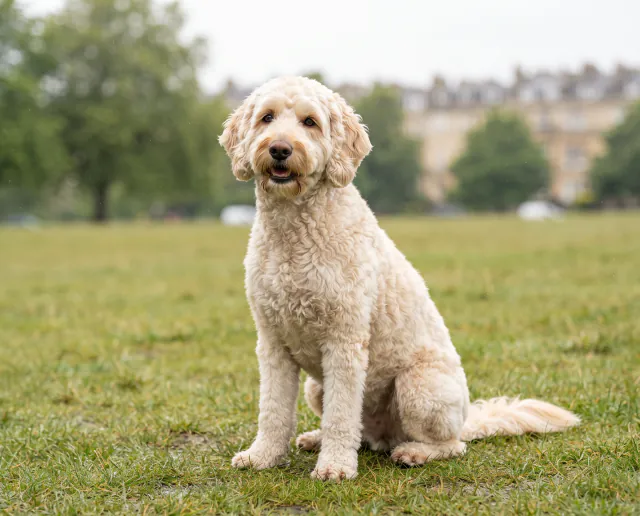
Goldendoodle adverts are written in code. F1, F1b, F2 and multigenerational appear alongside the price as though they were specifications, and buyers reasonably assume the letters promise something about coat, shedding or adult size. They do not. A generation label records which dogs were mated, not what the puppies became. Coat texture, height, build and temperament are inherited separately and reshuffled in every litter, so siblings from one mating can grow into noticeably different dogs. Breeding back to a Poodle shifts the odds towards a curlier coat; it guarantees nothing, and it certainly does not remove any inherited disease carried by either side. The Goldendoodle is a crossbreed, not a breed recognised by the Kennel Club, the American Kennel Club or any other major registry, so there is no breed standard setting out what an adult should look like or how it should behave.
Scale is the other detail that adverts understate. The usual version of this cross comes from a Golden Retriever and a Standard Poodle, both of them large working breeds, and the adult is a tall, strong dog that takes up most of a sofa. Crosses using Miniature Poodles produce smaller results, though these still tend to be bigger than buyers picture. Anyone choosing from a photograph of a small fluffy puppy should insist on seeing both parents standing up and ask what the previous litter’s adults weigh now.
Temperament in the home
Both parent breeds were developed to work with people all day, which shows in the offspring. Most Goldendoodles are outgoing, affectionate and quick to attach themselves to whoever is in the room. Guarding instinct is usually minimal and enthusiasm for visitors is not, so the front door needs training rather than hope. That sociability has a cost. A dog bred from two closely bonded working types often finds solitude genuinely difficult, and separation problems are among the commonest reasons these crosses come into rescue. Short absences should be practised deliberately from the first week rather than tested for the first time on a return to the office. Children usually get on well with them, although a bouncing adolescent of thirty kilograms can knock a small child over during play.
Exercise and training
Plan for around an hour a day for a medium individual and closer to ninety minutes for a large one, split into walks with some free running. Retrieving suits the Golden side and problem solving suits the Poodle side, so a mixture of fetch, scent games and short training sessions works better than distance alone. Growing puppies need less, with controlled outings and no repeated jumping until the frame has matured. Adolescence tends to be long and physically clumsy. Recall, loose-lead walking and a settle on a mat are the three things worth teaching properly, since a large excitable dog on the end of a lead is a practical problem in a way that a small one is not. Reward-based methods suit the intelligence and sensitivity of both parent breeds.
Coat and grooming
Coat is where owners are most often caught out. Puppy fluff usually changes between about eight and twelve months, and the adult coat that follows can be flat, wavy or tightly curled, sometimes on different parts of the same dog. Wavy and curly coats mat wherever something rubs, at the fold of the ear, beneath a collar or harness, in the armpits and behind the back legs, and the felting forms close to the skin while the surface still looks presentable. Working through the coat in sections down to the skin, several times a week, is the only method that reliably prevents it. Most need a professional groom every eight to ten weeks; a matted dog will be clipped short, which is the kind outcome rather than a failure. No coat can be promised as non-shedding or safe for an allergy sufferer, whatever a seller claims. Anyone with an allergy in the household should spend time with adult dogs of similar coat type before committing.
Health and lifespan
Mixed ancestry widens the gene pool but does not delete inherited disease, and a cross can inherit problems from either parent breed. Screening should reflect both. On the Golden Retriever side that means hip and elbow scores, current eye testing and a heart assessment. On the Poodle side it means hips, eyes and the relevant DNA tests, including the inherited retinal condition Poodles are tested for. Ask for written certificates naming the actual parents and check the details match. Ear infections are common in drop-eared dogs with hair in the canal, and deep-chested individuals carry a bloat risk that makes sudden restlessness with unproductive retching an emergency. Most live somewhere between ten and fourteen years. Any lameness, eye change, repeated ear trouble or shift in appetite should be seen by a vet.
Costs and space
Running costs sit at the higher end for a companion dog because grooming is unavoidable and the dog is large. Something in the region of £100 to £180 a month is a reasonable planning figure, though it is only indicative and moves with food, insurance premiums, grooming appointments and veterinary care. Purchase prices for this cross are often high without any corresponding health testing behind them, which is worth checking before paying a deposit. A flat can work if walks are reliable and the dog is not left long, but the practical needs are those of a big dog: room to stretch out, a car that can carry it safely and somewhere to dry a wet coat.
Verdict
A Goldendoodle can be a warm, trainable family dog for a household that is at home most of the day, enjoys training and has budgeted properly for grooming. Buyers who accept that they are choosing an individual rather than a specification are rarely disappointed.
Anyone who needs a guaranteed low-shedding coat, a predictable adult size or a dog that copes with long absences should look at an established breed instead. Meeting adults from the same breeder, rather than a litter of puppies, gives the most honest preview of what is on offer.