
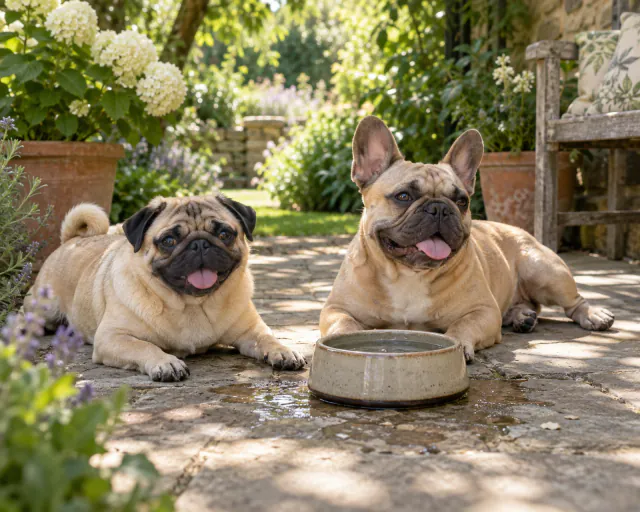
The Pug and the French Bulldog are arguably the two most recognisable flat-faced companion breeds, and they are compared constantly because they occupy almost identical territory: small, affectionate, low on exercise demands, well suited to flats, and both carrying the same underlying conformation concerns that come from a shortened muzzle. Anyone considering one breed has usually looked at the other too, and the differences between them are genuinely useful to understand before choosing.
Both breed pages are worth reading in full: the Pug profile and the French Bulldog profile cover origin, health screening and sizing in more depth than a comparison can.
At a glance
| Trait | Pug | French Bulldog |
|---|---|---|
| Size | Small | Small (27 to 35 cm, 9 to 14 kg for males) |
| Coat and shedding | Short smooth coat, high shedding | Short smooth coat, moderate shedding |
| Grooming need | High, weekly brushing plus daily face checks | Low, weekly brushing plus fold checks |
| Energy level | Low | Low |
| Exercise | Under 30 minutes a day | Up to 1 hour a day |
| Trainability | Moderate | Moderate |
| Good with children | Supervision important | Supervision important |
| First-time owner suitability | Possible with support | Possible with support |
| Left alone | Limited tolerance | Limited tolerance |
| Barking | Moderate | Low |
| Typical lifespan | 11 to 13 years | 10 to 12 years |
| Indicative monthly cost | £100 to £190 | £100 to £200 |
Temperament and personality differences
Both breeds are companionable, low on guarding instinct and generally tolerant of household chaos. The Pug’s own page describes it as companionable, comical and strongly people-focused, noting that the breed has never had another job beyond providing company since its earliest days in Chinese imperial households. The French Bulldog’s page describes it as affectionate, playful and companionable, with a similar origin as a close-contact lap dog for lace workers in nineteenth-century Normandy.
The main personality difference noted between the two is barking. The Pug is rated moderate for barking, while the French Bulldog is rated low, described on its own page as generally infrequent, which its page notes as a genuine advantage in a flat or terraced house with close neighbours. Both breeds share a strong dislike of long periods alone, reflecting that neither was ever bred for independent work.
Exercise and energy differences
Both breeds are rated low energy, and both need only modest daily exercise, but the two breed pages set slightly different expectations. The Pug’s page recommends short, frequent walks and specifically flags under 30 minutes a day as appropriate, judged by the individual dog’s breathing and recovery rather than a fixed target. The French Bulldog’s page allows for up to an hour a day, again adjusted for breathing and weather, making it the slightly more active of the two on paper, even though both are firmly in the low end of exercise need across the whole site.
Both breeds share the same summer caution: walks should move to cooler parts of the day, and both breed pages describe heatstroke as an emergency rather than a normal breed quirk. Neither breed is a safe swimmer, with both pages warning that a heavy front end and short face make staying afloat difficult, and that neither should be left near water unsupervised.
Grooming and coat differences
This is the clearest difference between the two. The Pug is rated high grooming need despite its short coat, with its own page describing heavy shedding for its size and recommending a daily look at the eyes alongside weekly brushing with a rubber mitt and regular checks of the nose wrinkle and facial folds. The French Bulldog is rated low grooming need by comparison, with weekly brushing and less frequent fold checks generally sufficient, and moderate rather than high shedding.
Both breeds need attentive eye care given their prominent, shallow-set eyes, and both need their facial folds and wrinkles kept clean and dry, but the Pug’s page is notably more emphatic about this being a daily task rather than a weekly one.
Training and trainability differences
Both breeds are rated moderate for trainability, sitting below the beginner-friendly breeds covered elsewhere on this site but still realistic for a supported first-time owner. The Pug’s page describes the breed as stubborn about anything it sees no reason for and reasonable once food is involved, recommending scent games, food puzzles and short reward-based sessions as much for mental stimulation as obedience. The French Bulldog’s page similarly recommends brief reward-based sessions and flags that toilet training can take patience, particularly during bad weather.
Neither breed demands an experienced handler, but both benefit from an owner willing to keep training sessions short, consistent and food-based rather than expecting rapid formal obedience.
Health and lifespan differences
Both breeds share the central health concern of any flat-faced dog, brachycephalic obstructive airway syndrome, and both are covered by the Kennel Club’s respiratory function grading scheme run with the University of Cambridge. Both breed pages recommend asking whether a puppy’s parents were graded and having a vet assess breathing at rest and after gentle movement before buying.
The two breeds carry some different specific health notes on their own pages. The Pug’s page highlights the screw tail as linked to spinal malformation, recommending attention to any wobbliness in the back end, dragging feet or loss of toileting control, alongside eye conditions including ulcers and inturned eyelids. The French Bulldog’s page notes that large studies of veterinary records have reported a shorter average lifespan for the breed than the commonly quoted 10 to 12 years, and lists spinal, eye, skin and kneecap problems as also occurring in the breed. Quoted typical lifespan sits at 11 to 13 years for the Pug and 10 to 12 years for the French Bulldog. Neither set of figures is a certainty for an individual dog, and both breeds need careful sourcing that prioritises open nostrils and sound breathing over an extreme, flattened look.
Cost and space differences
Typical monthly costs are broadly similar, £100 to £190 for the Pug and £100 to £200 for the French Bulldog, and both breed pages note that insurance and veterinary fees, rather than food, are the main drivers of higher individual costs, particularly if airway or eye surgery becomes necessary. Both breeds are listed as flat-friendly, and both need somewhere cool to lie and good airflow in summer rather than a large amount of floor space.
Which one suits you?
If low grooming time matters more to you than a slightly lower exercise requirement, the French Bulldog’s lighter coat-care routine and quieter barking level may tip the balance. If you would rather commit to a daily grooming and eye-check habit in exchange for a dog with a marginally longer typical lifespan and a very short daily exercise need, the Pug remains a strong option. In practice the two breeds ask for very similar things: a home that is occupied for much of the day, careful heat management, a vet-checked source that avoids the most extreme flat faces, and an owner realistic about the veterinary costs that can come with either dog.
If you are still weighing a flat-faced companion against a breed with fewer conformation-related health considerations, the breed comparison tool lets you check either dog against other small breeds side by side, and the breed finder is a sensible next step if you decide a flat-faced breed is not the right choice for your household.