
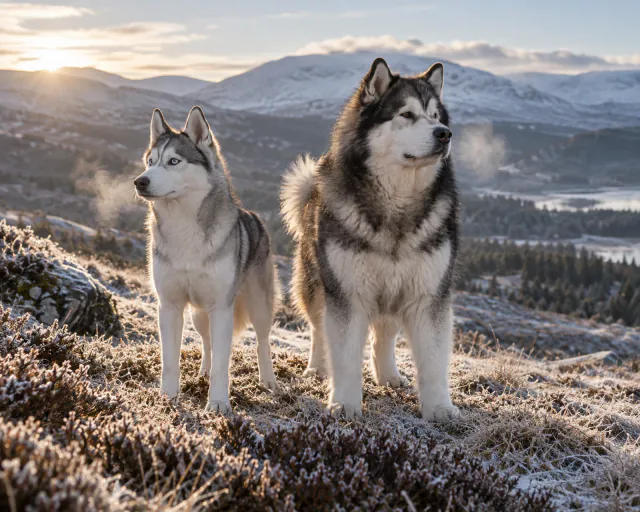
At a glance, a Siberian Husky and an Alaskan Malamute can look like the same dog in two sizes. Both carry a thick double coat, upright ears, a curled tail and the wolfish colouring that draws people to Arctic breeds in the first place. That resemblance is exactly why the two get compared so often, and it hides a working history that pulls in different directions. The Siberian Husky was refined by the Chukchi people to run light loads over long distances at speed. The Alaskan Malamute was built by the Mahlemut people to haul heavy freight slowly across huge distances. One is a distance runner, the other is a haulage animal, and almost every practical difference between them traces back to that split.
Comparison at a glance
| Trait | Siberian Husky | Alaskan Malamute |
|---|---|---|
| Size | Medium | Giant |
| Exercise needs | At least 2 hours a day | Over 2 hours a day of genuine physical work |
| Grooming and shedding | High grooming, heavy twice-yearly coat blow | High grooming, heavy twice-yearly coat blow |
| Trainability | Needs an experienced handler, conditional compliance | Needs an experienced handler, independent judgement |
| Temperament | Friendly, sociable, almost entirely self-directed outdoors | Affectionate with family, independent, strongly pack oriented |
| Good with children | Usually very good, though not protective or watchful | Often good in a confident, well run household |
| Good for first-time owners | Experienced owner preferred | Experienced owner preferred |
| Good with other dogs and small animals | Strong prey drive towards small animals, generally sociable with other dogs | Strong prey drive, and same-sex aggression with other dogs is well documented |
| Typical lifespan | 12 to 14 years | 10 to 12 years |
| Indicative monthly cost | £80 to £150 | £140 to £240 |
Temperament and personality
The Husky is one of the friendliest of the Arctic breeds, sociable with strangers to the point of being nearly useless as a guard dog. It is affectionate in an independent way rather than clingy, and rarely shows aggression towards people. The Malamute shares that lack of interest in guarding territory and is often strikingly affectionate with its own household, but the resemblance stops with other dogs. Same-sex aggression and a strong pack hierarchy instinct are well documented in the Malamute, and introductions to other dogs need careful, lifelong management in a way that a Husky, which is generally sociable with other dogs, usually does not require. Both breeds carry a strong prey drive towards cats, rabbits, poultry and livestock, and neither instinct is something training removes.
Exercise and energy differences
Both breeds need serious daily activity, but the character of that activity differs. The Husky’s two hours a day are best spent moving at pace, and harness sports such as canicross, bikejoring or dryland rig work suit its build and temperament well. The Malamute needs well over two hours of genuine physical work once mature, and ideally some form of pulling, since a slow walk round the block does not touch the instinct that defines the breed. Recall off lead is unreliable in both, driven by prey drive and, in the Husky’s case, a tendency to travel long distances once in pursuit of something. Secure fencing with real height and a dug-in base is essential for both breeds, since both dig, climb and test boundaries.
Grooming and coat differences
Coat care is close to identical between the two. Both carry a dense double coat that needs brushing several times a week during the year and daily work with an undercoat rake during the twice-yearly blow, when the undercoat comes out in large quantities over one to three weeks. Neither breed should be clipped, since the coat reflects heat as well as retaining warmth, and both cope poorly with hot weather as a result. Owners who dislike dog hair on furniture and clothing will find neither breed comfortable to live with.
Training and trainability differences
Both breeds are rated as needing an experienced handler rather than a first-time owner wanting a biddable dog. The Husky’s compliance stays conditional even with good training, a legacy of a role that required a dog to work without checking in constantly. The Malamute’s intelligence comes paired with independent judgement rather than eagerness to please, and its far greater physical strength makes early lead training and handling non-negotiable, since an adult Malamute that decides to go somewhere else can pull an unprepared adult off their feet. Anyone wanting quick, reliable obedience should look outside both breeds.
Health and lifespan differences
The Husky’s typical lifespan of 12 to 14 years is longer than the Malamute’s 10 to 12 years, a difference that reflects the size gap between a medium and a giant breed as much as anything else. Both breeds need hip scoring and eye testing documented in breeding stock. The Husky is associated with juvenile cataract, progressive retinal atrophy, corneal dystrophy, zinc-responsive skin disease and thyroid disorders. The Malamute is associated with hip dysplasia, inherited eye conditions, polyneuropathy and chondrodysplasia related dwarfism. Neither list is a diagnosis for an individual dog, and a prospective owner should ask any breeder for current, dated certificates rather than verbal reassurance. Both breeds tolerate heat poorly given their coats, so summer exercise needs to move to cooler parts of the day regardless of which one you choose.
Cost and space differences
The Malamute is the more expensive breed to keep, with an indicative £140 to £240 a month against the Husky’s £80 to £150, reflecting its greater size and the food, insurance and grooming that come with it. Both breeds need genuinely secure land rather than square footage as such, since a large garden with a low fence suits either breed worse than a small one with a solid boundary. Neither does well in a flat or in a household empty all day, given the Husky’s tendency to howl and the destructive boredom both breeds show when understimulated. Fencing is a capital cost to budget before either dog arrives, not after the first escape.
Which one suits you?
If you are drawn to the Arctic look but want the lighter, faster dog with a slightly longer lifespan and a friendlier default attitude towards other dogs, the Husky fits that brief more closely. If you want a larger, more physically imposing dog for serious pulling work and are prepared to manage its relationships with other dogs carefully for life, the Malamute is the closer match. Neither is a realistic choice for a first-time owner hoping for an easygoing walking companion, a household without secure fencing, or anyone with cats or nearby livestock. Both need an owner with time, land and a genuine interest in harness work.
If you are still weighing this pair against other options, the breed comparison tool lets you check either dog against a different pairing on the same traits, and the breed finder is worth trying if neither Arctic breed turns out to be the right fit once you look honestly at your own routine and living space.