At a glance
Key facts
The essentials to compare before deciding whether this breed fits your home and routine.
- Size
- Giant
- Lifespan
- 10 to 12 years
- Energy
- High
- Temperament
- Powerful, independent and strongly pack oriented
- Good with children
- Often good with children in a confident, well run household
- Exercise
- Over 2 hours a day of genuine physical work
- Trainability
- Experienced handler
- Grooming
- Thorough weekly brushing with a heavy twice yearly blow
- Estimated monthly cost, GBP
- £140 to £240 per month
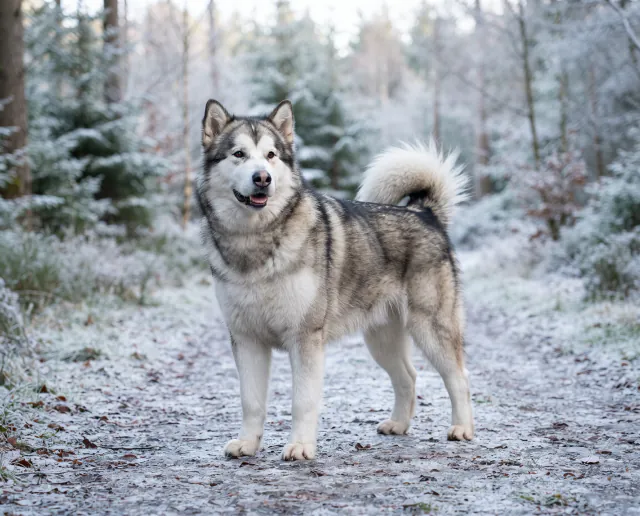
Confusing the Alaskan Malamute with the Siberian Husky is easy from a distance and a mistake up close. Both descend from Arctic sledding stock and both carry a thick double coat, but they were bred for opposite jobs. The Husky was refined for speed over long distances with a light load, essentially a distance runner. The Malamute was built by the Mahlemut people of Alaska to move heavy freight slowly across enormous distances, a haulage animal rather than a racer, and it shows in every part of the dog. Malamutes stand taller, weigh considerably more, carry heavier bone and pull with a slow, deliberate power that a Husky was never bred to produce.
That working history has not been bred out. A Malamute is not a decorative Arctic looking pet. It is a genuinely powerful animal with a mind of its own, developed to make independent decisions on a trail far from human oversight, and every part of managing the breed in an ordinary family home flows from that fact.
Temperament in the home
Malamutes are affectionate with their own people, often strikingly so, and the breed has little interest in guarding territory against strangers, since a working sled dog that turned aggressive toward unfamiliar humans was of no use to a team. That friendliness does not extend to other dogs in the same easy way. Same sex aggression and a strong pack hierarchy instinct are well documented in the breed, and introductions to other dogs need careful management throughout life. Prey drive runs high, and small animals, including cats introduced later in life, are at genuine risk. Left alone for long stretches, a Malamute can become destructive or vocal, less through separation anxiety in the clingy sense and more because a bored, understimulated dog of this size and intelligence finds its own entertainment. Digging is a favourite occupation and a Malamute can dismantle a flower bed in an afternoon.
Exercise and training
This is not a breed for a household that considers an hour a generous walk. Malamutes need well over two hours of genuine physical activity most days once mature, ideally including some form of pulling work such as canicross, bikejoring or a weighted sled on grass, which satisfies the breed’s core instinct in a way that ordinary walking cannot fully replace. Recall off lead is unreliable in most individuals given the strength of the prey drive, and a securely fenced area is essential rather than optional. Training demands patience and consistency from an experienced handler, since the breed’s intelligence comes paired with independent judgement rather than eagerness to please, and repetitive obedience work bores a Malamute quickly. Physical strength has to be respected from puppyhood, since an adult on the end of a lead that has decided to go somewhere else can pull an unprepared adult off their feet.
Coat and grooming
The dense double coat sheds year round at a moderate rate with two dramatic blows a year, usually spring and autumn, when the undercoat comes out in handfuls and a daily session with a proper undercoat rake becomes necessary for a week or two. Outside those periods, a thorough weekly brush keeps the coat in reasonable order and prevents the matting that develops quickly behind the ears and around the tail base if neglected. The coat is naturally weatherproof and largely self cleaning, and bathing is needed only occasionally. Vacuum cleaners in Malamute households earn their keep, and owners who dislike dog hair on every surface should look elsewhere.
Health and lifespan
Ten to twelve years is typical, on the shorter side for the effort and cost the breed represents. Hip dysplasia is well documented and hip scoring under the British Veterinary Association and Kennel Club scheme is essential in breeding stock given the size and working conformation involved. Inherited eye conditions occur in the breed, and the BVA and Kennel Club eye scheme along with relevant DNA tests should be checked with any breeder. Polyneuropathy, a nerve condition affecting movement, and a bleeding disorder called chondrodysplasia related dwarfism have been identified in Malamute lines, and a knowledgeable breeder will discuss what testing their lines have had. Heat tolerance is genuinely poor given the Arctic coat, and summer exercise needs to move to cooler parts of the day.
Costs and space
A giant, high energy breed with a heavy coat carries costs to match, typically a hundred and forty to two hundred and forty pounds a month across food, insurance and grooming, with insurance premiums reflecting both size and breed reputation. Fencing strong and tall enough to contain a determined, athletic dog is a real upfront cost, and a garden that cannot be secured to that standard is a serious problem rather than a minor inconvenience. Space indoors matters less than most people assume, since a tired Malamute settles readily, but a car capable of carrying a dog this size and the stamina to provide daily exercise in all weather are both non negotiable.
Verdict
The Alaskan Malamute suits an experienced owner with real physical fitness, secure land, a genuine interest in pulling sports, and no other small pets in the household. It rewards that commitment with a striking, characterful and deeply engaging companion.
It is entirely the wrong breed for a first time owner, a household wanting a dog that gets along easily with other dogs, anyone without secure fencing, or anyone hoping a big handsome Arctic dog will settle for a lead walk round the block.