At a glance
Key facts
The essentials to compare before deciding whether this breed fits your home and routine.
- Size
- Large
- Lifespan
- 12 to 14 years
- Energy
- Very high
- Temperament
- Independent, powerful and pack oriented rather than obedient
- Good with children
- Better suited to households with older, confident children
- Exercise
- Over two hours a day of genuine physical work
- Trainability
- Experienced handler
- Grooming
- Twice weekly brushing with a heavy annual coat blow
- Estimated monthly cost, GBP
- £120 to £210 per month
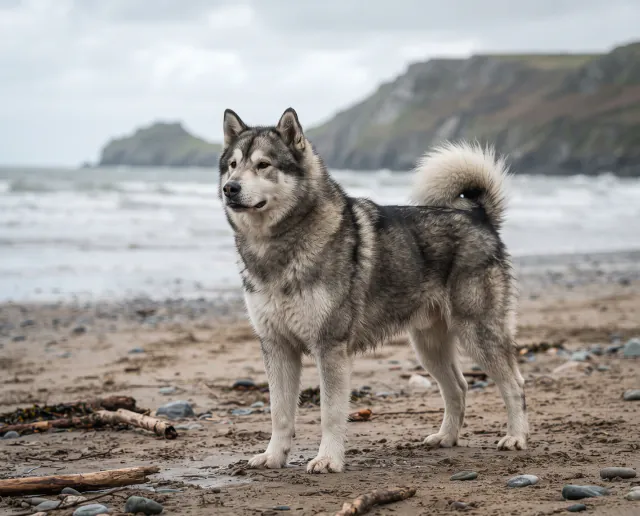
Few breeds in this directory ask for as clear eyed a decision as the Greenland Dog. It is a primitive Arctic type, bred for many centuries by Inuit communities to pull sledges and hunt across ice and tundra, and it has been shaped almost entirely by survival and working usefulness rather than by any desire to produce a companion animal. The result is a dog of real physical power, endurance and a mind that owes far more to a pack of working animals than to a family pet.
UK numbers are vanishingly small. The breed sits on the Kennel Club’s Imported Breed Register, litters are effectively nonexistent domestically, and anyone genuinely interested should expect to speak to the breed club, accept a long wait, and consider that any dog obtained will likely have an imported line close behind it. This is not a breed to source casually.
Temperament in the home
Greenland Dogs are not bred for obedience in the way a working gundog is, and independence of mind is a defining trait rather than a flaw to train out. The breed can be affectionate with its own people while remaining largely indifferent to instructions it sees no purpose in following. Strong pack instincts mean the dog often does better living alongside other dogs than as a solitary pet, and same sex aggression and resource guarding within a group are realistic risks that need experienced management. Small pets and cats are a poor match given the hunting background, and even other dogs unfamiliar to the pack can be treated with real hostility. Children need to be older and confident, since the breed’s size and its lack of instinctive deference to human direction make it a poor pairing with toddlers regardless of the individual dog’s good nature.
Exercise and training
This is one of the most physically demanding breeds an owner can take on, needing well over two hours of genuine, vigorous activity daily, ideally including pulling work such as canicross, bikejoring or properly organised sledding on wheels where snow is unavailable. Without that outlet, a Greenland Dog becomes destructive, escape minded and difficult to live with, since the breed was never selected for a sedentary life. Recall is close to a fantasy for most individuals given the hardwired drive to run and hunt, and secure containment, not voice control, is the only realistic strategy off any working harness. Training benefits from patience, consistency and realistic expectations rather than any hope of producing a conventionally biddable companion dog.
Coat and grooming
The dense double coat is built to withstand genuine Arctic cold and sheds accordingly, with a dramatic annual blow that deposits astonishing volumes of undercoat around the house. Twice weekly brushing manages the coat for most of the year, rising to daily during the seasonal shed. The breed tolerates cold exceptionally well and can struggle in a typical British summer, needing shade, water and exercise scheduled for cooler parts of the day.
Health and lifespan
Twelve to fourteen years is a good expectation for the breed, reflecting a genetically robust working type with relatively little inherited disease compared with many pedigree breeds. Hip dysplasia is still worth screening for given the size and activity level, and any breeder should be asked about hip scoring under the BVA and Kennel Club scheme. Beyond that, documented breed specific conditions are limited simply because so few dogs exist outside Greenland, and prospective owners are better placed asking the breed club what health issues its own small population has actually encountered rather than relying on assumptions carried over from other Arctic breeds.
Costs and space
Feeding a dog this large and this active is not cheap, and £120 to £210 a month is a reasonable indicative range across food, insurance and veterinary care, though the figure depends heavily on how the dog’s exercise and working needs are met. Space needs to be substantial and secure, since a large rural garden with genuinely escape proof fencing is close to essential. A flat or a small urban garden is entirely unsuitable for a dog of this drive and size.
Size and lifespan
Males typically stand 58 to 68 cm (23 to 27 in) at the shoulder and weigh 30 to 32 kg (66 to 70 lb). Females are somewhat smaller, usually 51 to 63 cm (20 to 25 in) and 27 to 29 kg (60 to 64 lb). It is a powerfully built arctic working breed, dense-coated and heavier than its height alone suggests.
A typical lifespan is 12 to 14 years. Dogs bred and kept for genuine sled work tend to stay lean and fit through structured exercise; the same discipline around weight and activity matters just as much for a Greenland Dog kept as a companion.
Verdict
The Greenland Dog suits only a small number of highly experienced owners with rural space, secure containment, the time for several hours of vigorous daily activity, and ideally existing experience of Arctic or primitive breeds. Involvement in an active sport such as canicross or sledding is close to a requirement rather than a bonus for this breed.
Anyone wanting an obedient companion, a dog suited to normal walking routines, or a breed that fits an average household should choose differently. This is a working animal first, kept as a pet second, and it needs to be approached on those terms.