At a glance
Key facts
The essentials to compare before deciding whether this breed fits your home and routine.
- Size
- Medium
- Lifespan
- 12 to 14 years
- Energy
- Very high
- Temperament
- Friendly, sociable and almost entirely self-directed outdoors
- Good with children
- Usually very good with children, though not a watchful or protective breed
- Exercise
- At least 2 hours a day, and rarely safe off lead in open ground
- Trainability
- Experienced handler
- Grooming
- Brush several times weekly, with dramatic coat shedding twice a year
- Estimated monthly cost, GBP
- £80 to £150 per month
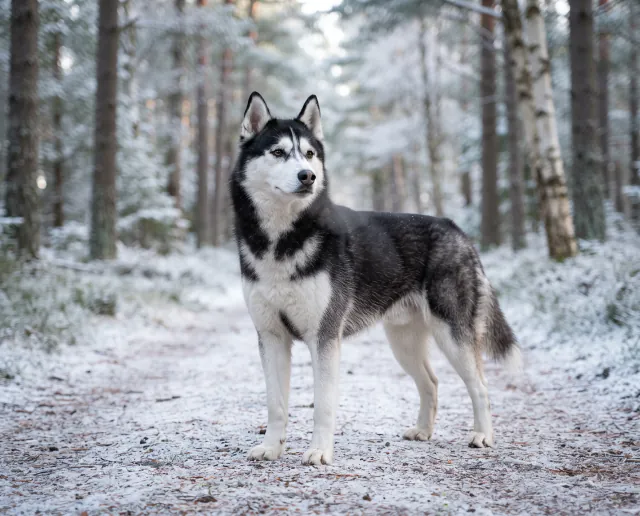
The reputation and the animal have very little to do with one another. Photographs sell a wolfish, loyal, faintly mysterious dog, while British rescue centres take in Siberian Huskies in numbers that rise every time the breed appears on television. That gap is the most useful subject any prospective owner can study.
The Chukchi people of north-eastern Siberia developed the type to haul light loads over long distances at a steady trot, on remarkably little food, working in teams and living loosely around settlements. Every trait that frustrates a modern owner made sense there. A dog that runs for hours without checking in, ignores a handler while working, tolerates other dogs and treats a boundary as a puzzle was exactly what the job required. None of this is a fault in the breed. The mismatch is with a semi-detached house, a fence a metre and a half high and a forty hour working week.
Temperament in the home
Huskies are sociable to an unusual degree and almost useless as guard dogs. Most greet burglars and postal workers with equal enthusiasm, and aggression towards people is rare. Affection tends to be independent rather than clingy, and a Husky often prefers a doorway to a lap. Prey drive is a separate and serious matter. Cats, rabbits, poultry and livestock all trigger a strong chase response, and the instinct is managed rather than trained away. Vocalisation is howling and a range of conversational noises rather than barking, which carries a long way and causes trouble in close housing. Boredom shows up quickly as chewed doors, excavated lawns and shredded furnishings. Children are usually safe with a Husky, which is tolerant and rarely possessive, though a bored adult is physically boisterous.
Exercise and training
Two hours a day is a floor rather than a target, and quality matters as much as length. Harness sports give the breed the outlet it was designed for, and canicross, bikejoring or dryland rig work turn a difficult pet into a contented one. Heat is the limiting factor in any temperate climate, since a dog carrying an arctic coat should not be run hard once temperatures climb, so summer activity moves to first light. Recall requires plain speaking. A Husky in pursuit is effectively deaf, can cover many miles before stopping and is regularly killed on roads or shot near livestock, so most owners treat open ground as lead-only and use a hired secure field for free running. Containment demands the same honesty. Fencing needs real height, a dug-in base or a paved strip along the bottom and secured gates, since this breed digs under, climbs over and works out latches. Training is possible with food and patience, but compliance stays conditional, and anyone wanting instant obedience should look elsewhere.
Coat and grooming
The coat is a dense woolly undercoat beneath straight guard hairs, one of the most effective insulating systems in any domestic dog. Day to day it is easy, needing brushing several times a week and little bathing, since the coat carries little odour and sheds dirt as it dries. Twice a year the undercoat comes out wholesale over two or three weeks in quantities that surprise first-time owners, and daily work with an undercoat rake is the only way to stay ahead of it. Clipping is unhelpful and potentially harmful, because the coat reflects heat as well as retaining warmth. Check the feet after runs on grit, keep nails trimmed and look through the coat for lumps and parasites.
Health and lifespan
Twelve to fourteen years is normal, and the breed is comparatively free of the exaggerated conformation that troubles many popular dogs. Hip scoring should be documented for both parents, and eye testing matters particularly, since juvenile cataract, progressive retinal atrophy and corneal dystrophy are all recognised in the breed. Ask for current certificates rather than assurance that the line is healthy. Zinc-responsive skin disease occurs in northern breeds and shows as crusting around the muzzle and eyes, and it needs veterinary investigation rather than shop-bought supplements. Thyroid disorders and epilepsy also appear. Huskies are efficient feeders and often need less food than their activity suggests, so check body condition by hand regularly.
Costs and space
Around £80 to £150 a month covers feeding, insurance, preventive treatment and equipment for most owners, though the figure is indicative and moves with region, insurer and the individual dog. Two costs sit outside that. Fencing is a capital expense to be met before the dog arrives rather than after the first escape, and harness kit or regular hire of a secure field adds up over a year. Space means security rather than size. A large garden with a low fence is worse than a small one with a solid boundary. The breed does poorly in a flat, given the howling and the destruction, and in any household absent all day. Many owners find a second dog helps, since this is a breed that never expected to live alone.
Verdict
The Siberian Husky suits an active owner with genuinely secure fencing, time most days and an interest in harness work, who accepts a dog that will probably never be safe off lead and has no cats or nearby livestock to consider. Under those conditions it is a hardy, good-natured and rewarding companion.
It is a poor choice for a first-time owner wanting an obedient family dog, for a house empty through the working day, or for anyone choosing on appearance. Rescue centres hold plenty of adolescents surrendered by people who did exactly that, and adopting one is a reasonable route for a home equipped for the breed.