
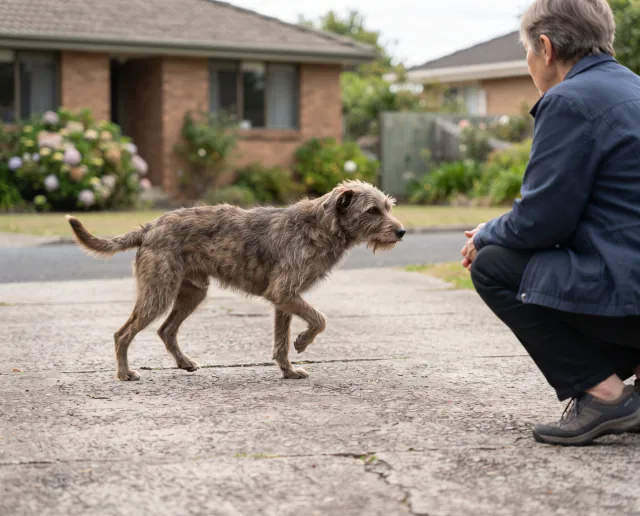
Mobility changes look different depending on when they happen in a dog’s life. A young, boisterous dog might pull up short after a hard session of chasing a ball, an adult dog might come in from a walk favouring a leg after an awkward landing on wet ground, and an older dog might simply seem a little slower to rise each week over several months without any single obvious moment where it began. All three are mobility changes, and all three are worth taking seriously, even though the urgency and likely explanation differ considerably.
This article focuses specifically on movement itself: gait, weight-bearing, willingness to move and how those change over time. It is deliberately narrower than general pain signs, covered in the guide on recognising pain and discomfort in dogs, because a useful description of a mobility problem to a vet needs specific detail that a broader symptom list does not capture.
What is useful to observe
A vet examining a dog for a mobility problem will ask questions that are much easier to answer if you have been paying attention beforehand, rather than trying to reconstruct events under time pressure in the consulting room. Useful details include:
- Which leg or legs seem affected, and whether the dog is putting full weight on it, partial weight, or none at all.
- When it is worse: first thing in the morning, after rest, after exercise, on stairs, on slippery floors, or in cold weather.
- Whether the change is constant or comes and goes, and if it comes and goes, how long each episode lasts.
- Whether rest seems to help, make no difference, or make the dog stiffer once it gets moving again.
- Whether there was a specific moment you associate with the change, such as a fall, a hard landing, rough play with another dog, or a long unaccustomed walk, or whether it crept in with no obvious trigger.
- Any accompanying signs, such as swelling, heat in a joint, licking at a specific area, or a change in appetite or mood.
Filming a short clip of the dog walking and, if possible, trotting on a flat, non-slip surface is often more useful than a written description, since gait changes are frequently easier to see on a screen, at normal speed and in slow motion, than to describe in words. Bring it to the appointment rather than only describing what you saw.
Sudden onset needs prompt attention
A mobility change that appears suddenly, particularly after a fall, a collision, rough play, jumping from a height, or a road traffic incident, needs veterinary attention promptly rather than a wait-and-see approach. This is true even if the dog seems to be walking on the leg to some degree, since dogs frequently continue moving on a limb that would clearly be extremely painful in a person. A dog that is not weight-bearing at all on a leg, that yelps sharply when touched in a specific spot, or that seems distressed alongside the mobility change should be seen without delay.
Sudden severe lameness in a young, growing dog deserves particular caution, since growing bones and joints in large and giant breeds are developing rapidly and an injury during this period can have longer-term consequences if not assessed and managed appropriately.
Gradual change deserves a check too
Slower changes are easier to dismiss, precisely because there is no single dramatic moment that triggers a decision to act. An older dog that takes a little longer to get up each week, that has stopped jumping onto furniture it used to manage easily, or that seems to warm out of stiffness within a few minutes of starting a walk is showing a pattern that is genuinely common in ageing dogs, but common does not mean it should go unexamined. Gradual mobility decline has a range of possible explanations, some of which respond much better to early management than to intervention once the dog has been struggling for a long time.
The same applies to adult dogs at any age who develop a subtle change with no clear cause. It is easy to attribute a slightly altered gait to “probably slept awkwardly” or “must have knocked it playing” and let weeks pass. If the change persists beyond a few days, or recurs after apparently resolving, it is worth a veterinary opinion rather than continued assumption.
Breeds worth extra vigilance
Certain breeds and body types are more prone to joint and skeletal issues than others, generally because of their size, growth rate, proportions or the conformation they have been bred towards. Large and giant breeds, breeds with a long back and short legs such as the Dachshund, and working and herding breeds with a family history of joint problems are all worth watching a little more closely for the kinds of subtle changes described above.
This is not a reason for alarm about any individual dog, and it does not mean these breeds will necessarily develop a problem. It means that owners of these breeds benefit from knowing their dog’s normal movement well, so that a gradual change is noticed sooner rather than being absorbed into “that is just how they move.” Extra vigilance is not the same as expecting a problem, and plenty of dogs from higher-risk breeds live their whole lives without a significant mobility issue.
Rest and controlled activity while you wait to be seen
While waiting for a veterinary assessment, sensible interim caution is reasonable even though it is not a treatment and should not be treated as one. Reducing or pausing off-lead running, jumping, stairs where avoidable, and rough play with other dogs limits the chance of making an injury worse before it has been properly assessed. Short, calm, lead-controlled toilet breaks on level ground are usually a reasonable middle ground between complete confinement, which most dogs find difficult, and normal activity, which could aggravate an existing problem.
Do not give any human or leftover animal medication in the meantime, and do not attempt to work out an appropriate dose of anything based on the dog’s weight. If a vet appointment cannot happen quickly and the dog seems distressed, contact the practice again and explain that, since many practices will bring a genuinely uncomfortable dog forward. For dogs recovering after a mobility issue has been assessed and a vet has approved a return to activity, the Dog Exercise Planner can help structure a gradual increase in walking and play once you have clearance to do so, rather than jumping straight back to a previous routine.
The bottom line
A mobility change, whether sudden or gradual, mild or dramatic, is information rather than something to interpret on your own. Careful observation makes the eventual veterinary examination faster and more accurate, but it does not replace it. When in doubt about whether a change is significant enough to warrant a call, it generally is.