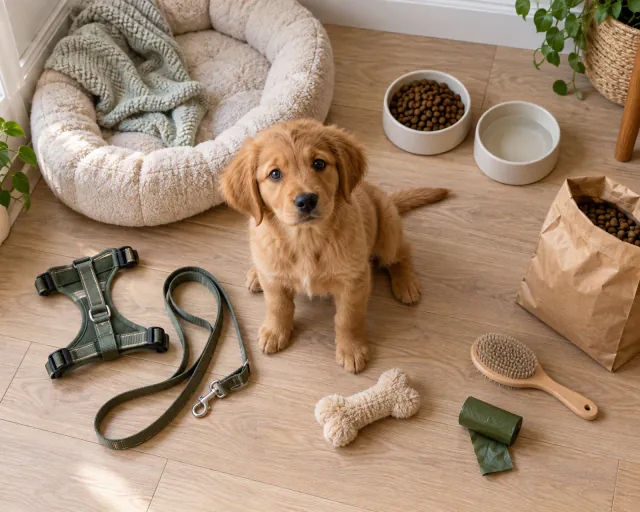
New owners tend to fall into one of two traps with equipment: buying far too much before the puppy has even arrived, filling a cupboard with things that never get used, or arriving home with almost nothing and making urgent trips to the shop during the first exhausting week. Neither is necessary. A relatively small list of well-chosen items, ready before collection day or ordered in the first day or two, covers what a puppy genuinely needs.
This is a checklist rather than a shopping spree. Buy what fits the list below, expect to replace a few items such as harnesses and collars as the puppy grows, and treat anything not on it as optional rather than essential.
Bedding and a crate or pen
A comfortable, washable bed and, for most households, a crate or a folding pen give a puppy a defined space of their own from day one. Buy bedding that can go straight into a washing machine, since accidents and mess are normal in the early months, and have a spare set ready so one can be washed while the other is in use. If a crate is part of the plan, set it up a few days before arrival with the door left open so it becomes familiar furniture rather than a novelty on day one.
Food and water bowls
Simple, stable bowls that will not tip or slide on a hard floor are all that is needed. Stainless steel or ceramic are both easy to clean thoroughly, which matters more for a young puppy’s digestion than any particular design feature. Keep water available at all times, refreshed regularly, and consider a second water bowl if the puppy spends time in more than one part of the house or garden.
A properly sized harness and lead
A well-fitted puppy harness and a fixed lead are worth getting right from the outset rather than treating as a minor purchase. An ill-fitting harness can rub, restrict movement or allow a puppy to back out of it entirely, and puppies grow quickly enough that sizing needs checking regularly rather than assumed to still fit after a few weeks. The detail on getting this right is covered in choosing the correct harness size. A basic flat collar with an identification tag is also worth having from day one, alongside the harness used for actual walking.
Appropriate puppy food
Puppies need a formulated growth food suited to their expected adult size, not an adult diet or a general all-life-stages product chosen without checking. Keep the breeder or rescue’s current food and feeding schedule for the first few days at least, to avoid adding a diet change on top of an already unsettling move. The reasoning behind puppy-specific feeding, and how amounts and frequency change as a puppy grows, is set out in puppy feeding principles.
Grooming basics for the coat type
Even a puppy with a short, low-maintenance coat benefits from early, gentle grooming sessions that build a positive association with being brushed and handled, which pays off considerably later in life. A soft brush suited to the coat type is generally enough at this stage, whether that is a simple bristle brush for a short coat or a slicker brush and comb for a longer or double coat. Nail clippers or a nail file, and a puppy-safe shampoo for the occasional bath, complete the basics.
Safe chew toys
Chewing is a normal, necessary puppy behaviour, not a problem to be stopped outright, so provide several safe, appropriately sized chews and toys rather than leaving the puppy to find their own outlet in furniture or shoes. Vary textures, some firm chews, some softer toys, some designed to make a small amount of food last longer, and supervise new items until it is clear how the puppy uses them. Replace anything that starts to break into pieces small enough to swallow.
Poo bags
An unglamorous but essential item, kept stocked in every coat pocket, by the back door and in the car, so a supply is always within reach rather than run out at an inconvenient moment.
Identification: tag and microchip
A collar tag with up-to-date contact details, alongside microchip registration completed and kept current, are both standard forms of identification, though the exact legal requirements vary by country, so it is worth checking local rules rather than assuming they match wherever the puppy came from. Update the microchip database promptly after moving house or changing phone number, since an out of date record defeats the purpose of having a chip at all.
Insurance from day one
Arranging insurance before a puppy has ever needed to see a vet for anything other than routine care is the point at which cover is most useful, since a policy generally will not cover a condition that has already appeared. Waiting until after a first illness or injury to look into insurance usually means that specific problem is excluded from any policy taken out afterwards.
Budgeting for all of it
Equipment, food, insurance, vet costs and ongoing care add up to a meaningful first-year cost that is easy to underestimate from a shopping list alone. The Puppy First-Year Cost Calculator can help build a realistic picture of what the first twelve months are likely to cost, so the equipment on this list can be planned for as part of a wider budget rather than a series of separate surprises.