
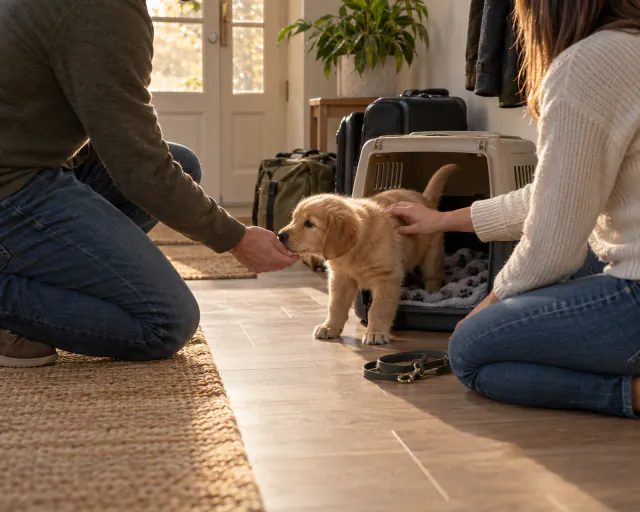
Collection day gets talked about as one event, but it is really a string of small transitions: a car journey, a new smell of home, a first meal in a strange kitchen, a first night without littermates. A puppy has no context for any of it. Everything that happens on day one is a first impression that shapes how safe the house feels, so the aim is not to make the day exciting but to make it forgettable in the best sense: quiet, predictable and short on surprises.
This guide covers the day itself, hour by hour in feel rather than in a strict timetable. For the practical groundwork that should already be done before this day starts, see preparing your home for a new puppy, and for the priorities that carry on past today, see first 5 things for a new puppy.
Keep the journey home low-key
The trip from breeder or rescue to home is often a puppy’s first car ride, frequently on the day it also leaves its mother and littermates for good. Keep the car quiet: no radio, no excited conversation, one person within reach to offer calm reassurance rather than constant handling. A secured carrier or crate lined with something absorbent is safer than a puppy loose on a lap, and it also gives them a small, enclosed space to retreat into rather than an open lap that keeps moving.
Some puppies sleep through the journey. Others whine, tremble or are sick, particularly on a longer drive. None of this means anything is wrong. It means a young animal has just had its whole world rearranged in the space of a car door closing.
Show them the toilet spot and the bed straight away
Before anything else happens indoors, take the puppy directly to the garden or chosen toilet area and give them a few quiet minutes there. They are likely to need to go after the journey, and starting the association between that spot and toileting from the very first minute is more useful than any formal introduction to the house.
Once inside, show them the sleeping area next, calmly and without ceremony. Let them sniff the bed, the crate or pen, and the room around it. This is not the moment for a tour of the whole house. A small, known space they can return to matters far more on day one than seeing every room.
Limit visitors and keep the excitement down
It is tempting to invite the family round or let the whole household crowd into the doorway to meet the new arrival, but a puppy’s first hours are not the moment for it. Keep the immediate household present and calm, and ask extended family and friends to wait a few days. One or two people sitting quietly on the floor, letting the puppy approach in their own time, teaches far more useful lessons about people than a room full of excited voices and reaching hands.
The same applies to other pets in the house. A brief, calm, supervised introduction on neutral ground, kept short, is enough for day one. There is no need to force a full introduction before the puppy has even had a meal in the new house.
Offer food, but do not expect a full meal
Stress and unfamiliar surroundings suppress appetite, so do not be surprised if a puppy eats very little, picks at food, or refuses a meal entirely on the first day. Offer the same food, at roughly the same times, that the breeder or rescue was using, since changing diet on top of everything else is one variable too many. If a puppy skips a meal but is otherwise alert, drinking and toileting normally, it is not usually a reason for concern on day one alone. Persistent refusal to eat or drink into the following day is worth a call to the vet.
Keep meals themselves low-key. A quiet spot away from foot traffic, without an audience, gives an unsettled puppy the best chance of eating something.
Expect the first night to be noisy
Many puppies vocalise the first time they are left to settle alone, particularly once the lights go off and the house goes quiet. This is a genuinely difficult moment: it is very likely the first night of their life without the warmth and movement of littermates nearby, and some crying, whining or barking is a normal response rather than a sign of poor treatment.
The instinct is to rush over and lift the puppy out the moment they make a sound. Resist this where you can. If every cry results in being taken out of the crate or pen, a puppy learns quickly that vocalising works, and that lesson can take weeks to undo later. Instead, respond calmly: a quiet word, a hand near the crate, or a brief, boring visit to check nothing is genuinely wrong, then step back and let them settle. Placing the crate or pen in or near the bedroom for the first nights, so your presence and breathing are audible without direct contact, often helps more than being on the other side of the house. If crying is prolonged, distressed and does not ease at all, a very brief, low-key toilet trip is worth trying before returning them to bed without further engagement.
Don’t try to fit in everything else
Day one is not the day for the first proper walk, a trip to a busy shop, or introducing every toy in the cupboard at once. A puppy arriving into a new home is already processing more than most adult dogs manage in a week. Let the achievements of day one be modest: a calm journey, a first successful trip to the toilet spot, a little food eaten, and some sleep. Everything else, from routine to training to wider socialisation, has time to start properly from day two onward.