
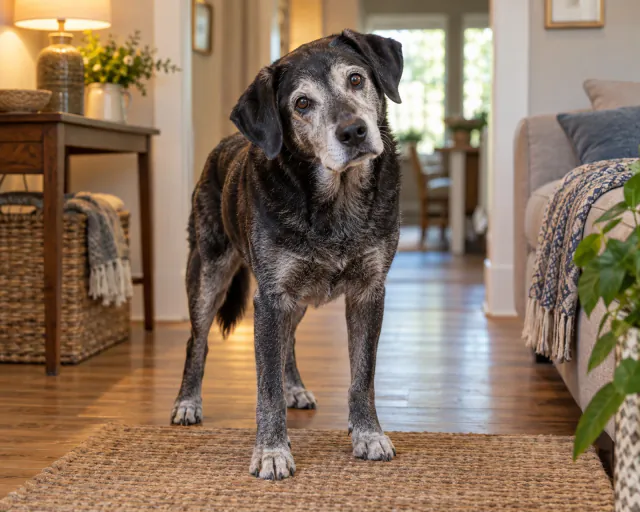
A dog that suddenly seems lost in its own hallway, that no longer responds to a name it has known for years, or that begins toileting indoors after a lifetime of reliability, can be genuinely unsettling to live with, not least because it is easy to interpret as simply what happens when a dog gets old. Some of what follows below does become more common with age. That does not make it something to identify and quietly manage at home without ever raising it with a vet.
This guide describes the kinds of cognitive changes that can appear in older dogs, in general educational terms, and is not a tool for diagnosing any individual dog. Nothing here should be read as confirming a specific condition or ruling one out. A vet, who can examine the dog directly and rule out other causes producing similar signs, is the only reliable route to understanding what is actually happening with a particular dog.
Confusion in familiar environments
A dog that appears to get stuck in a corner, seems unsure how to get around a piece of furniture it has navigated for years, or looks lost in a room or garden it knows well is showing a pattern worth mentioning at a veterinary appointment. This kind of disorientation in a genuinely familiar space is different from ordinary hesitation in a new or unusual environment, and it is the pattern rather than a single isolated moment that matters. Before assuming this reflects cognitive change specifically, it is also worth considering whether vision has declined, since reduced eyesight can produce very similar-looking confusion in an environment a dog previously managed by sight.
Changes in the sleep-wake cycle
An altered sleep pattern, particularly increased restlessness, pacing or vocalising overnight alongside increased daytime sleepiness, is one of the more commonly discussed signs associated with cognitive ageing in dogs. This is different from the general increase in total sleep that is a normal and expected part of getting older, covered in the guide on routine changes as a dog gets older. The distinguishing feature here is disruption to the pattern itself, a dog that seems unsettled and awake when it would previously have been soundly asleep, rather than simply sleeping more overall.
Reduced responsiveness to familiar cues or their name
A dog that seems slower to respond to its name, to well-established training cues, or to sounds that would previously have caught its attention immediately can be showing a cognitive change, but this sign overlaps heavily with hearing loss, which also becomes more common with age and produces very similar behaviour from the outside. Distinguishing between the two, or identifying that both are present together, needs a proper veterinary assessment rather than a guess based on how the dog seems to behave day to day.
House-training accidents in a previously reliable dog
A dog that has been reliably house-trained for years and begins having indoor accidents is showing a change that deserves attention regardless of the underlying cause, since this particular sign has a wide range of possible explanations beyond cognitive change alone, including several medical conditions that specifically affect bladder or bowel control and become more common with age. This is one of the clearer examples of why self-diagnosis is unhelpful here: treating new house-training accidents as an inevitable and unmanageable part of ageing risks missing a cause that responds well to appropriate veterinary management.
Changes in social interaction
Some older dogs become less interested in interaction with people or other animals they previously sought out, seem less responsive to affection, or appear withdrawn in situations that would previously have prompted clear engagement. Others show the opposite pattern, becoming more clingy or anxious than before, sometimes alongside increased vocalising or apparent unease when left alone. Both directions of change are worth mentioning to a vet, since either can reflect a range of underlying causes, cognitive or otherwise, including pain that a dog is not otherwise showing obvious signs of.
Repetitive behaviours
Repetitive actions that seem to serve no obvious purpose, such as pacing a fixed route, staring at walls or into empty space, or repeating the same small movement over and over, are sometimes associated with cognitive changes in older dogs. As with the other signs here, this is a pattern worth describing accurately to a vet rather than a symptom that confirms anything on its own, since repetitive behaviours can also arise from anxiety, discomfort or other causes unrelated to cognitive ageing.
Why a veterinary assessment matters, even when signs seem to fit ageing
The signs above can overlap considerably with ordinary ageing, and it can be tempting to fold all of them into a general impression that a dog is “just getting old” and needs to be managed around rather than properly assessed. This is worth resisting for two reasons. First, a full veterinary assessment can identify or rule out other medical causes that produce very similar outward signs, including pain that is not otherwise obvious, sensory loss such as declining vision or hearing, urinary tract or other medical conditions affecting toileting, and other treatable issues. Second, where cognitive change genuinely is the explanation, it is rarely something to simply accept as unavoidable and unmanageable. A vet familiar with the current understanding of cognitive ageing in dogs is best placed to discuss what, if anything, might help a specific dog, and mentioning changes early generally gives more options than waiting until they have become severe and entrenched.
Bringing specific, dated observations to the appointment, rather than a general impression that “he’s not himself lately,” helps a vet build an accurate picture. Noting when a particular change started, how often it happens, and anything that seems to make it better or worse gives more useful information than trying to summarise months of gradual change from memory in the consulting room.
Practical support at home in the meantime
While waiting for or working through a veterinary assessment, and afterwards if some degree of ongoing cognitive change is confirmed, a few practical measures tend to make daily life easier for a dog experiencing confusion or disorientation. A stable, predictable routine and a consistent home layout reduce the number of unfamiliar things a confused dog has to process at once, and the home adaptations for a senior dog guide covers this in more practical detail, including why changing furniture layout can be particularly disorientating for a dog already struggling to navigate familiar spaces.
Patience matters as much as any physical adjustment. A dog that seems not to recognise a cue it has known for years, or that toilets indoors despite years of reliability, is not being difficult on purpose, and responding with frustration tends to increase a confused dog’s anxiety without helping the underlying issue. Safe, supervised access to the home and garden, rather than either full free access or complete confinement, generally strikes a reasonable balance for a dog whose spatial awareness or judgement has become less reliable, while a vet’s specific guidance for that individual dog should always take priority over general suggestions like these.