
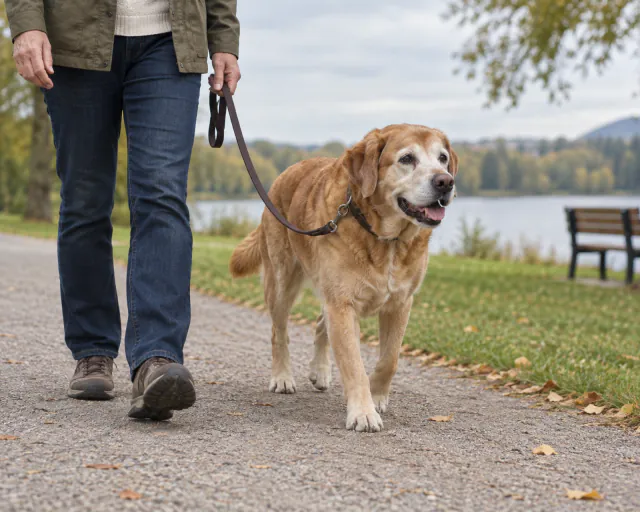
Exercise for an older dog is not simply a smaller version of what worked at three years old, and waiting for an obvious problem before changing anything usually means adapting later than would have been useful. A dog does not need a diagnosed joint condition or a visible limp before its exercise routine is worth reviewing. Age itself changes how much load a body can comfortably absorb, how quickly it recovers, and how forgiving it is of the kind of repetitive or high-impact movement that a younger dog shrugs off without consequence.
This guide is about adjusting exercise proactively as a dog ages, rather than identifying or responding to a specific mobility change, which is covered separately in the guide on mobility changes in dogs. That article is about recognising and describing a movement problem once it appears, at any age. This one is about the exercise side of ageing well before that point, and about working sensibly alongside a vet if a joint or health condition has already been diagnosed.
Shorter, more frequent sessions
A single long walk asks a lot of an older dog’s joints, muscles and stamina in one continuous block. Splitting the same rough amount of activity into two or three shorter sessions across the day is generally kinder on an ageing body, since it avoids the cumulative fatigue that builds over a long continuous outing and gives muscles and joints recovery time between bouts. Many senior dogs are visibly happier and move more freely on a pattern of shorter, more frequent walks than on the single long walk they may have enjoyed as younger adults.
This does not mean cutting total exercise dramatically. It means restructuring how it is delivered. A dog that manages three twenty-minute walks comfortably may struggle noticeably with one sixty-minute walk, even though the total time on the move is identical.
Favouring lower-impact activity
Repetitive high-impact movement, such as jumping for a ball over and over, sprinting hard from a standing start, or repeated jumping on and off furniture or out of a car boot, places concentrated stress on joints and connective tissue. This kind of loading is generally easier for a younger dog to absorb without consequence than for an older one, where recovery is slower and any existing wear is less able to tolerate sudden peak forces.
Steady walking on varied but even terrain is a reliable, low-impact staple for most senior dogs. Swimming, where a suitable and safe facility exists and the individual dog enjoys water, is often well tolerated because it supports body weight while still allowing a genuine workout, though not every dog takes to it and it should be introduced gradually with appropriate supervision. Gentle, controlled play that avoids repeated hard landings, rather than the games that most encourage jumping and sudden direction changes, is generally a better fit for an older dog than the high-arousal fetch sessions that may have suited them at two years old.
Watching for next-day stiffness
One of the most useful ways to judge whether a session was appropriate for an individual senior dog is how they move the following morning rather than how they seemed at the time. Adrenaline and excitement can carry a dog through activity that turns out to have been too much, with the cost only becoming visible once they have rested and stiffened up overnight.
Noticeable stiffness, slower or more reluctant movement, or obvious discomfort getting up the day after a walk or play session is useful feedback, not something to write off as one bad morning. It suggests that particular session, in duration, intensity or terrain, exceeded what that dog could comfortably manage on that day. Adjusting the next similar session down slightly, rather than repeating the same level of activity and hoping for a different result, is generally the better response. This kind of day-after check is worth building into the routine as a matter of habit rather than only after a specific concern arises.
Exercise still matters, even as capacity reduces
There is a common instinct to assume that rest is always the safer option for an older dog, but reduced activity brings its own costs. Muscle mass, which already tends to decline with age, is maintained partly through appropriate use, and a dog that stops moving altogether tends to lose condition and strength faster than one kept gently and consistently active within its current capability. The goal with senior exercise is rarely “less exercise” as a blanket rule. It is exercise matched more carefully to what that individual dog can currently manage well, adjusted as capability changes over time rather than fixed once and left alone.
The Dog Exercise Planner can help build a realistic weekly structure around a dog’s current age, size and activity level, making it easier to plan a sensible mix of shorter walks and lower-impact activity rather than defaulting back to old habits out of convenience.
Working with a vet where a condition is diagnosed
Where a dog has a diagnosed joint, heart, respiratory or other condition that affects exercise tolerance, the appropriate type, duration and intensity of activity should come from the vet managing that condition rather than from general guidance. Some conditions call for continued, carefully structured activity, since the wrong response, complete rest, can allow muscle wasting and stiffness to worsen. Others call for specific limits on particular movements or terrains. A vet-approved plan, reviewed periodically as the dog’s condition and capability change, gives a far more reliable basis for exercise decisions than assumptions drawn from how the dog looks that day.
Enrichment becomes relatively more valuable
As physical capacity for high-intensity exercise reduces with age, mentally engaging, lower-impact activity fills a genuinely useful role rather than acting as a mere consolation. Scent games, such as scattering treats in the garden or setting up a simple nose-work trail indoors, use a dog’s mind and natural instincts without demanding the same physical output as a long walk or vigorous play. Short, low-pressure training refreshers of familiar cues also provide mental stimulation with minimal physical strain, and many older dogs remain keen and capable participants in this kind of activity well after their tolerance for hard physical exercise has reduced.
Building this sort of enrichment into a senior dog’s week, rather than treating physical exercise as the only form of activity that counts, helps keep a dog engaged and satisfied even as the balance between physical and mental activity naturally shifts with age.
A gradual, ongoing process
Adapting exercise for an older dog is rarely a single decision made once. It is an ongoing process of watching how the dog responds, adjusting the pattern, intensity and type of activity as capability changes, and staying in touch with a vet where any diagnosed condition affects what is appropriate. Dogs vary considerably in how and when these changes arrive, and there is no fixed age at which every dog needs the same adjustments. Paying attention to the individual dog in front of you, rather than following a rigid formula, remains the most reliable approach throughout.