
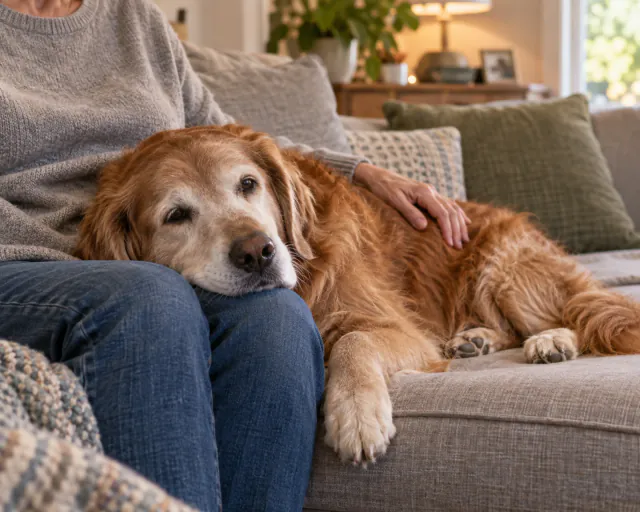
Thinking clearly about an ageing dog’s quality of life is one of the harder parts of caring for a dog through its later years, and there is rarely a single moment where the picture suddenly becomes obvious. More often, it is a gradual accumulation of small changes, some easy to notice and some easy to miss, that only add up to something significant when looked at together over weeks or months rather than day by day.
This guide does not offer a checklist for making a decision, and it does not suggest what any individual owner should do or when. It cannot, because that judgement depends entirely on a specific dog, examined and known by a vet who understands their particular history and condition. What it offers instead is a way of thinking about quality of life that many owners and veterinary professionals find useful, and some practical suggestions for keeping the conversation with your vet honest and ongoing rather than something that only happens in a crisis.
Quality of life is more than one measure
It is tempting to reduce quality of life to a single question, often framed around pain or mobility alone, but most veterinary and welfare guidance on this topic considers several dimensions together rather than any one in isolation. Comfort and pain control matter, but so does appetite and hydration, since a dog eating and drinking normally is telling you something different from one who has lost interest in both. Mobility matters, including whether a dog can still get up, move around and toilet with reasonable independence. Continued interest in normal activities and interactions matters too, whether that is greeting family members, following familiar routines, or simply seeming present and engaged rather than withdrawn.
A useful general question, used in various forms by many veterinary professionals, is whether a dog is having more good days than difficult ones, and whether that balance has been stable or shifting over time. No single bad day, and no single good one, answers the question on its own. It is the pattern across several dimensions, sustained over a meaningful period, that gives a more honest picture than any one moment.
Why a diary helps more than memory
Gradual decline is genuinely difficult to judge from memory alone, because people adapt to slow change in their own dog without fully registering how much has shifted. A dog owner sees their dog every day and naturally recalibrates what “normal” looks like as small changes accumulate, which can make it hard to recognise, in the moment, how far things have actually moved from where they were three months ago.
A simple, brief log kept over time addresses this directly. It does not need to be elaborate. Noting a handful of things regularly, appetite, general mobility, whether the dog seemed interested in its usual activities, and how the day felt overall on a simple scale, builds a record that shows trends far more reliably than trying to reconstruct the picture from memory during a difficult conversation. Reading back over several weeks or months of these brief notes often reveals a clearer pattern than day-to-day impressions alone ever could, and it gives both the owner and the vet something concrete to discuss rather than a general sense that things “seem different lately.”
Ongoing conversations rather than a single crisis-point discussion
Quality of life is easiest to think about clearly when it has already been part of an ongoing conversation with a vet, rather than a topic raised for the first time at a moment of crisis. Bringing it up during routine senior check-ups, discussed in more detail in the guide on senior dog health checks, gives a vet the chance to build a picture of a dog’s baseline and to flag early on what kinds of changes would be worth watching for given that individual dog’s health history.
This matters because decisions made under acute pressure, in an emergency or at a sudden low point, are harder for anyone to think through calmly than ones informed by conversations that have already been happening gradually over time. A vet who has known a dog through several senior check-ups, and who has heard an owner’s observations along the way, is in a considerably better position to help with a difficult decision than one meeting the dog and the situation for the first time.
The role of the vet in this conversation
A vet brings something an owner’s own observation cannot fully replace: clinical assessment of pain, function and prognosis, informed by examination, by any relevant testing, and by experience with how particular conditions typically progress. This does not replace an owner’s knowledge of their own dog’s normal behaviour and personality, which is equally important context a vet cannot get from an examination alone. The two together, an owner’s close daily knowledge of their dog and a vet’s clinical judgement, generally produce a far more complete picture than either alone.
Asking direct questions helps this conversation stay useful rather than staying vague. What does the vet expect over the coming weeks or months, given this dog’s specific condition. What signs would suggest things are moving in a difficult direction. What options exist for managing comfort as things progress. A vet who is not asked these questions directly may assume an owner prefers not to discuss them yet, so raising the subject explicitly, even when it feels difficult, tends to lead to a more honest and useful conversation than waiting for it to come up unprompted.
Decisions remain individual and personal
Where the point comes that end-of-life decisions need to be considered, those decisions are deeply personal and rest on a huge number of factors specific to one dog, one condition and one family’s circumstances. They should always be made with full veterinary guidance for that individual dog rather than drawn from a general article, a forum post about someone else’s dog, or a fixed rule about a particular age or condition. What counts as an acceptable quality of life, and how much decline a family and a dog can manage together, varies enormously and reasonably between situations that might look similar from the outside.
This is not a subject where a generic answer serves anyone well, and it is one where a vet who knows the individual dog’s history, condition and prognosis is far better placed to help than any external source. Reaching out to that vet, honestly and as early as questions arise rather than only once a crisis is underway, remains the most reliable route through what is, whenever it comes, a genuinely difficult part of caring for a dog through its whole life.