The rooms and routines that suited a dog for years do not necessarily suit the same dog once age changes how confidently it moves, sees or navigates. A rug that has sat in the same spot for a decade can suddenly become a hazard once joints stiffen and confidence on hard flooring drops. A favourite spot on the sofa can turn from a simple hop into a jump that is best avoided altogether. None of these changes require an overhaul of the whole house. Most come down to a handful of targeted adjustments that reduce strain and risk without turning the home into something unfamiliar.
This guide covers the physical environment: flooring, furniture access, bedding, bowls and general layout. It does not cover exercise routines, feeding or health monitoring, which are dealt with in their own guides elsewhere on the site, or cognitive changes in detail, covered in the companion guide on cognitive changes in senior dogs, though the two areas overlap where environment and confusion interact.
Flooring and grip
Slippery flooring, particularly laminate, tile and polished wood, becomes a genuine concern for older dogs as joint stability, muscle strength and confidence all tend to reduce with age. A dog that slides even slightly when walking across a hard floor often responds by tensing up and moving more cautiously, which itself can worsen stiffness over time, quite apart from the risk of an awkward slip causing an actual injury.
Non-slip rugs, runners or mats placed along commonly used routes, such as from a dog’s bed to the door, across open-plan living spaces and around food and water bowls, give a dog secure footing at the points where it matters most. Rubber-backed mats or runners specifically designed to stay in place work considerably better than loose rugs, which can bunch up or slide and create a hazard of their own. For dogs finding an entire room genuinely difficult, covering a larger area rather than a single narrow path is worth considering.
Ramps and steps for furniture, beds and cars
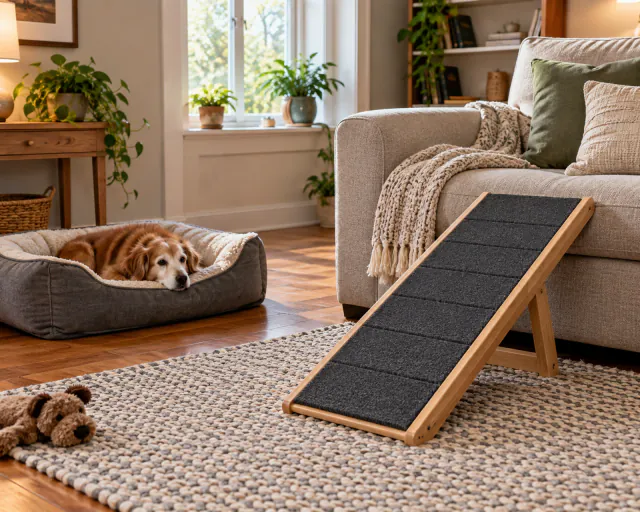
Jumping, whether onto a sofa, into a car boot, or up onto a bed, places sudden concentrated load through joints that may no longer manage that kind of movement comfortably. A dog that used to leap onto furniture without a thought may still try to, out of habit, even once the movement has become uncomfortable or genuinely risky, so waiting for a dog to stop jumping on its own is not a reliable strategy.
A pet ramp or a set of shallow, sturdy steps gives a dog a gentler route up to a favourite spot rather than removing access to it altogether. This matters for both wellbeing and behaviour, since suddenly barring a dog from a sofa or bed it has always used can be confusing and unwelcome, whereas offering a manageable route up preserves the habit while reducing the physical demand. The same applies to car access, where a ramp can spare a dog the jump into a boot or back seat. Where a vet has specifically advised against jumping because of a diagnosed joint or spinal condition, a ramp or steps become a more direct part of managing that condition rather than simply a comfort measure.
Raised food and water bowls
Raising food and water bowls to a more comfortable height is a common suggestion for older dogs, on the reasoning that it reduces how far a dog has to lower its head and neck to eat and drink, which may ease discomfort for a dog with neck or spinal stiffness. This is worth trying for an individual dog who seems to find bending down to eat uncomfortable, but it is not a universally agreed or necessary change for every senior dog, and some research and veterinary opinion has questioned whether raised bowls are beneficial for dogs generally. If you try a raised bowl, watch how the dog actually eats and drinks from it, and revert to a standard bowl height if the dog does not seem to prefer it or if a vet advises against it for a particular condition.
Supportive bedding
An ageing dog often benefits from bedding that offers more genuine support than a well-worn cushion, particularly if joints are stiffer or bonier pressure points have become more sensitive from thinner tissue coverage. Orthopaedic or supportive beds, designed to distribute weight more evenly and reduce pressure on joints, are widely used for older dogs and are generally reasonable to introduce without a specific diagnosis, though a vet can advise on anything more specific to a dog’s known condition.
Placement matters alongside the bed itself. A bed positioned away from draughts, away from a busy through-route in the home, and easy to reach without navigating stairs or slippery flooring, does more for an older dog’s comfort than the bed’s material alone.
Easier access to the garden or toileting area
Toileting needs often change with age, sometimes becoming more frequent, and a senior dog may need to get outside more urgently or more often, including overnight. Reviewing how easy that route actually is matters more than it might have when the dog was younger and more capable of managing an awkward step or a steep bit of garden path without a second thought.
A ramp or shallow step at a back door, a clear and well-lit path to the usual toileting spot, and a door the dog can reach without navigating stairs or slippery flooring in the dark all reduce both the physical demand and the risk of an accident along the way. For dogs whose mobility has become more limited, keeping their bed closer to the usual exit rather than at the far end of the house can make a meaningful practical difference, particularly overnight.
Keeping the environment consistent
Changing furniture layout, moving a dog’s bed to a new spot, or rearranging a room may seem like small decisions, but they can be considerably harder for an older dog to adapt to than for a younger one, particularly where reduced vision or early cognitive changes are also present. A dog that has learned to navigate a familiar space by memory as much as by sight can struggle when that memory suddenly stops matching reality, leading to hesitation, bumping into things, or apparent confusion that has more to do with a changed environment than any underlying decline.
Where a layout change is genuinely necessary, introducing it gradually and keeping the rest of the home stable around it gives a dog a better chance to adjust. Keeping key items, food and water bowls, a dog’s bed, and favourite resting spots, in consistent locations supports confidence and reduces unnecessary stress, and this becomes particularly relevant for dogs already showing early signs of the cognitive changes discussed in more detail in the companion guide.
Temperature comfort around the home
Older dogs are often less tolerant of temperature extremes than they were as younger adults, and this applies indoors as much as outside. A senior dog’s usual resting spot is worth checking for draughts in winter and for excessive heat or direct sun in summer, since a dog with reduced mobility may be less able to move itself away from an uncomfortable spot than it once was. A blanket or heated bed in a genuinely cold home, and access to a cooler room with fresh water during hot weather, are simple adjustments that account for this reduced tolerance without requiring any specialist equipment.
Making changes that suit the individual dog
Not every adaptation here will suit every senior dog, and introducing several changes at once can be its own source of disruption for a dog that copes better with gradual change. Prioritising the adaptations that address a specific dog’s actual difficulties, rather than making every possible change on principle, and introducing them one at a time where practical, tends to work better than a wholesale redesign carried out in a single weekend.