
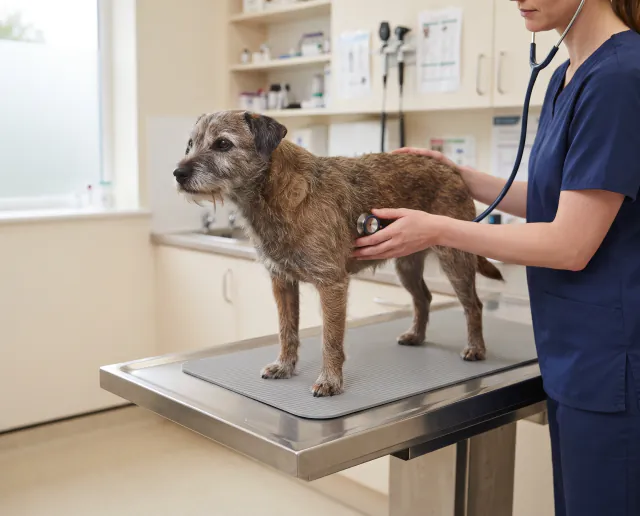
A slowing dog is easy to explain away. She is getting on a bit, he has always been a fussy eater, the stiffness is just old age catching up. Some of that is fair. Ageing itself is not an illness and does not need treating. The trouble is that several genuinely treatable conditions produce exactly the same everyday signs as normal ageing, and the only reliable way to tell them apart is examination and, often, testing rather than a guess based on how the dog looks in the kitchen.
This guide is deliberately narrow. It covers the health-check and veterinary-monitoring side of caring for an older dog: what changes matter, why check-up frequency is often increased for senior dogs, and why assuming “just age” without checking can mean missing something treatable. Broader day-to-day senior care, including adapting exercise, home comfort and cognitive support, is covered elsewhere on the site rather than here.
When “senior” starts depends on the dog
There is no single age at which a dog becomes a senior. Giant and large breeds such as the Great Dane or the Bernese Mountain Dog are often considered senior from around six or seven years old, reflecting their generally shorter lifespans, while small breeds such as the Chihuahua or Yorkshire Terrier may not be thought of as senior until ten or beyond. Breed, size, individual health history and existing conditions all factor into where that line sits for a specific dog, so ask your own vet when it becomes sensible to start treating your dog as a senior for monitoring purposes rather than relying on a fixed number.
Why check-up frequency often increases with age
Many vets recommend moving from an annual check-up to something closer to every six months once a dog reaches typical senior age for its breed and size, though practices and national norms vary and this is not a universal rule. The reasoning is straightforward: conditions that develop with age, including some joint, organ, dental and hormonal changes, tend to progress between visits, and a shorter interval gives a better chance of catching a shift early, while it is still manageable, rather than at a point where it has already become significant. If your practice has not raised this with you and your dog is in the senior range for its breed, it is a reasonable question to ask at the next visit.
Weight and body condition
Weight change in either direction deserves attention in an older dog. Gradual weight gain often reflects reduced activity without a matching reduction in food, covered in more detail in the guide on helping a dog maintain a healthy weight, but unexplained weight loss in a senior dog is not something to wait out, since it can point to a range of underlying issues that need proper investigation. Muscle loss along the back and hindquarters, sometimes alongside stable or even increasing body fat, is also common with age and worth mentioning even if the number on the scale has not changed much.
Lumps, skin and coat changes
Older dogs develop new skin lumps more often than younger ones, and most turn out to be harmless once examined. That does not mean a new lump can be safely assumed benign from a glance at home. Note when it appeared, its size, firmness and whether it changes, using the same approach described in the guide on routine health checks at home, and have any new lump checked rather than deciding for yourself which ones matter.
Mobility and getting up and down
Some slowing after rest is normal in many older dogs, but stiffness that does not ease with gentle movement, reluctance to jump into the car, difficulty with stairs, or a change in gait are not things to simply work around with a ramp and no further conversation. Joint discomfort in older dogs is common and, while it cannot be reversed, it is often manageable once properly assessed, and a dog quietly compensating for pain for months is worse off than one whose mobility has been reviewed and addressed.
Thirst, appetite, toileting, sleep and behaviour
A senior dog drinking noticeably more, toileting more often or having accidents after being previously reliable, eating markedly more or less than usual, sleeping unusually deeply or restlessly, or seeming confused, disoriented or withdrawn are all changes worth raising rather than filing under “getting old.” Altered sleep-wake patterns and apparent confusion in particular are sometimes linked to age-related cognitive change, which a vet can assess properly, rather than something to simply accommodate at home without ever mentioning it.
Dental deterioration and the value of baseline bloodwork
Dental disease tends to worsen with age if left unmanaged, and a mouth that has gone unchecked for years is one of the more common findings at a senior check-up; the guide on dental care routines for dogs covers the home side of this. Baseline bloodwork, run while a dog is well rather than only once something seems wrong, becomes more valuable with age because it gives your vet a personal reference point for that individual dog. A result that looks unremarkable in isolation can be a meaningful change when compared against that dog’s own earlier baseline, which is one reason some practices suggest starting routine senior bloodwork before any symptoms appear. Bringing a calm, cooperative dog to these more frequent appointments matters too, and working through handling practice such as the routine in preparing for veterinary handling makes the physical examination easier for everyone involved.