Starting work with a trainer or behaviourist on a reactivity, fear or similar issue rarely means the dog stops needing walks and everyday life the same day. Owners are usually left managing the day-to-day reality, sometimes for weeks or months, while a longer-term plan takes effect. Getting that in-between period right matters, because how walks are managed while support is underway can either support the professional’s plan or quietly undermine it.
This guide covers practical ways to manage walks safely and fairly during this working period, without diagnosing the underlying issue or replacing the individual plan a qualified professional has already given you. It assumes there is already a trainer, behaviourist or vet involved. If that is not yet the case, see when to contact a behaviour professional for how to find the right kind of help first.
Stick to the specific plan you have been given
The single most important principle during this period is following the plan given by the professional actually working with your dog, rather than mixing in other advice from books, articles, social media or well-meaning acquaintances, however sensible that other advice sounds in isolation. Different approaches can genuinely conflict with each other even when each one is reasonable on its own terms, and inconsistent handling from one walk to the next tends to slow progress rather than add to it.
This applies to this guide as well. Nothing here should override a specific instruction from the professional you are working with. Where something here conflicts with their plan, follow their plan. This guide is aimed at the practical gaps a generic plan does not always spell out in detail, such as route planning and equipment, not at replacing individual professional judgement about your dog.
Planning routes to reduce trigger exposure
Reducing how often a dog encounters its specific triggers during the working period is usually a sensible goal, and route and timing choices are the easiest lever available for this. Walking at quieter times of day, choosing less busy routes even if they are less direct or less interesting, and avoiding known hotspots such as a park entrance where dogs frequently gather, all reduce the number of difficult moments a dog has to work through on a given walk.
Where a vet or behaviourist supports continued exercise, and most do, this is generally a matter of temporarily shortening or changing walks rather than stopping them altogether. A shorter walk in a quiet, familiar location most days is usually preferable to a longer walk that repeatedly puts the dog over threshold, since the latter can rehearse the very response the plan is trying to change. Match the specifics to what your own professional has recommended, since the right balance depends on the individual dog and the specific issue being worked on.
Equipment for extra security during this period
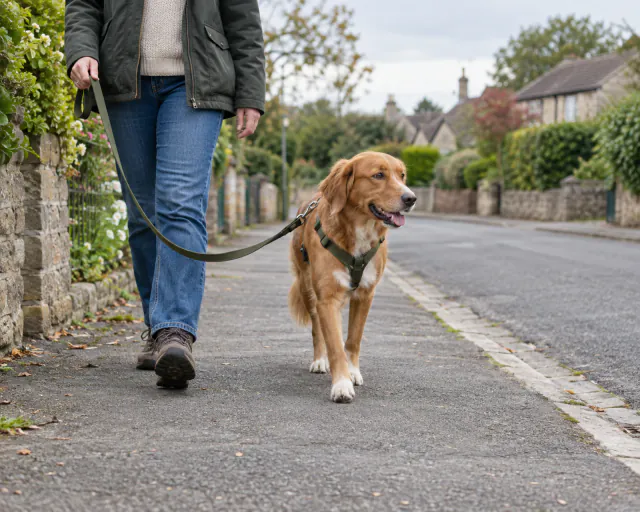
Reliable equipment matters more than usual while working through a behaviour issue, since a slipped lead or an unexpectedly close encounter can set progress back. A secure, well-fitted harness that the dog cannot back out of, combined with a lead long enough to allow genuine distance management rather than a short lead that forces close proximity, gives you more room to manoeuvre when a trigger appears. A snug-fitting collar carrying ID tags is worth keeping on as a backup, in case a harness is ever removed or comes loose, since it is usually a legal requirement as well as a safety measure.
Some professionals recommend a muzzle as a sensible precaution during this working period, particularly where there is any risk of a bite or where the dog is being asked to cope with situations it finds difficult. A muzzle is a safety and welfare tool, not a sign of a bad dog or a sign that things have gone wrong, and plenty of dogs wear one as a straightforward precaution while a plan is underway, in exactly the same way a person might wear protective equipment for a task without it implying anything negative about them. Where a muzzle is part of the plan, it should be introduced through positive conditioning over a series of short, calm sessions at home, building a positive association with wearing it before it is ever needed in public, rather than fitted for the first time directly onto a dog who is already stressed in a real situation.
Having a rehearsed plan for an unexpected trigger
However carefully a route is planned, an unexpected trigger will sometimes appear regardless, another dog around a blind corner, a jogger appearing suddenly from a side path. Having a clear, rehearsed plan for this moment, decided and practised in advance rather than improvised under pressure, makes a real difference to how it goes.
A workable plan usually involves creating distance calmly and promptly, such as turning around, crossing the road, or stepping behind a parked car or hedge to break the dog’s line of sight, using a pre-planned emergency exit route where one is available, and avoiding crowding the dog by staying calm and unhurried rather than adding tension of your own to the situation. Practising this manoeuvre during calm, low-pressure moments, so it becomes familiar to both of you, means it is far more likely to work smoothly the moment it is actually needed.
Being realistic about exercise needs during this period
If walks are genuinely difficult right now, it is worth being honest that a dog’s exercise and enrichment needs may have to be met differently for a while rather than forced through the usual routine regardless. This is a temporary adjustment, not a permanent change of plan. Options include more enrichment and mental work at home, such as scent games, food puzzles and short training sessions using skills the dog already knows well, exercise in a securely fenced private area where available, or choosing a quieter, more predictable location even if it means driving further to reach it.
The Dog Exercise Planner can help work out how to meet a dog’s exercise needs through a mix of activities rather than relying solely on walks during a period when walks are genuinely harder than usual. This is a practical bridge to use alongside your professional’s plan, not a replacement for the walking and exposure work they may specifically want you to do.
Do not test progress prematurely
A common and understandable mistake once things start to feel easier is testing the dog against a more difficult version of its trigger to see how it copes, simply because recent walks have gone well. This risks undoing progress that has taken real time to build, since a dog whose plan has been working at a particular distance or intensity has not necessarily generalised that progress to a harder version of the same challenge, and a setback at this stage can be more discouraging than the same setback earlier on.
Progression should come from the plan itself, at the pace and in the steps the professional working with you has set out, not from an informal test run because things have felt easier lately. If you are unsure whether your dog is ready for a more challenging situation, that is a question for the professional running the plan, not something to find out by trying it.
Working with, not around, the plan
Everything in this guide is intended to sit underneath an existing professional plan, filling in the practical detail of day-to-day walks rather than setting the direction of the work itself. Where your trainer or behaviourist has given specific instructions that differ from anything here, theirs take priority, since they have assessed your individual dog directly. For background on how reactivity, fear and related issues are distinguished from one another, see understanding the differences between nervous, fearful, reactive and aggressive behaviour, and for more on reactivity specifically, see reactivity: what it is and what to do.