Getting two or more dogs through a careful introduction is only the beginning. Once dogs are living together as an established household, a different set of habits keeps things running smoothly: how you feed them, how much individual attention each one gets, how shared resources are managed, and how quickly you notice and respond to small signs of friction before they become a real problem.
This guide covers ongoing, day-to-day management for a settled multi-dog household. For the introduction itself, the first meetings and the early settling-in period, see the guide on introducing dogs safely, which this article builds on rather than repeats.
Feed with enough space to prevent competition
Food is one of the most common sources of tension in a multi-dog household, even between dogs who otherwise get on well. Feeding in the same bowl, or bowls placed close together, can create pressure even in dogs who show no other signs of guarding, simply because food is a naturally high-value resource and proximity during eating raises the stakes.
Feed dogs separately wherever practical, whether that means separate rooms, opposite ends of a room, crates, or simply enough physical distance that neither dog feels the other is close enough to compete over. Pick up bowls once dogs have finished rather than leaving food down, since an empty bowl left in place can still attract guarding behaviour from a dog checking whether more is coming. The guide on feeding multiple dogs covers portioning, timing and specific feeding setups for households with more than one dog in more detail.
Give individual attention and training time
It is easy for life in a multi-dog household to default to group activities: group walks, group play, group training if any happens at all. Each dog benefits from individual time with you as well, whether that is a short one-to-one walk, a solo training session, or simply a few minutes of calm attention without the other dog present.
This matters for more than bonding. A dog who only ever gets attention as part of a pair can struggle with basic skills that are much easier to teach one dog at a time, and a dog who never has time apart from a housemate can become anxious when separation eventually becomes necessary, such as during a vet visit, boarding, or if one dog needs restricted exercise after an injury. Building in some individual time and the occasional short separation as a normal part of life makes future separations, planned or otherwise, considerably less stressful for both dogs.
Manage resources to reduce friction
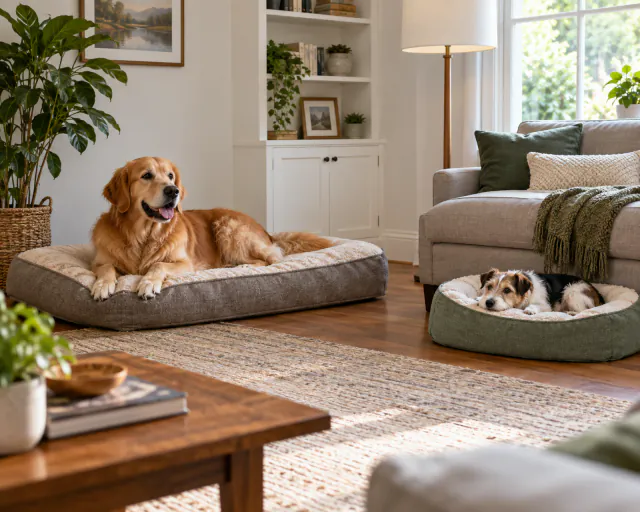
Beyond food, everyday items can quietly become sources of tension: beds, favourite toys, chews, resting spots, and even doorways and narrow passages where dogs might feel crowded. Provide enough beds and resting spots that no dog has to compete for a comfortable place to lie down, ideally more spots than dogs so there is always a free option.
Supervise high-value chews and toys, and consider giving them separately, in different rooms or crates, rather than assuming dogs will share amicably. Watch doorways, stairs and narrow hallways, since some dogs feel pressured by another dog close behind them in a tight space, which can trigger a snap or growl that would not happen in open ground. None of this means treating every household as a powder keg. It means recognising which everyday situations carry more risk of friction and managing them accordingly, rather than assuming goodwill will always be enough.
Dogs do not organise around a strict pack hierarchy
Older ideas about dogs needing a single, fixed “alpha” and a strict linear pecking order in the household have been largely discredited by more recent behavioural research, and building household management around enforcing a rigid hierarchy is not a useful approach. Relationships between dogs living together are more accurately understood as a set of individual relationships that shift depending on context, resource, and mood, rather than one fixed ranking that applies to every situation.
In practice this means it is not helpful to insist one dog always eats first, always goes through doors first, or is otherwise treated as universally dominant, since this does not reflect how the dogs’ actual relationship works and can create confusion or tension rather than resolving it. What matters more is managing resources sensibly as described above, respecting each dog’s individual preferences and tolerances, and paying attention to how the specific dogs in your household actually interact with each other rather than applying a generic hierarchy theory to them.
Recognise early tension before it becomes a fight
Dogs rarely go from a settled relationship straight to an actual fight with no warning signs in between, even in households where an eventual incident catches an owner completely by surprise. Subtle signs worth taking seriously include one dog stiffening when the other approaches a resource, avoidance behaviour such as one dog consistently leaving a room when the other enters, guarding-type postures over food, toys, resting spots or even a person, prolonged staring, and a general sense that one dog has become more watchful or tense around the other than they used to be.
These signs are easy to dismiss individually, especially if the dogs have lived together without incident for a long time, but a pattern of them building up is worth addressing early with a qualified behaviourist rather than waiting to see whether it resolves on its own or escalates into an actual fight. Early professional input, while tension is still at the stiffening-and-avoiding stage, is considerably easier to work with than intervention after a fight has already happened, and it protects both dogs as well as the relationship between them. If an actual fight does occur, treat it as a serious event requiring professional assessment rather than something to manage by simply keeping a closer eye on things afterwards.