
At a glance
Key facts
The essentials to compare before deciding whether this breed fits your home and routine.
- Size
- Large
- Lifespan
- 10 to 12 years
- Energy
- High
- Temperament
- Exuberant, affectionate and slow to grow up
- Good with children
- Often good, though the breed's bounce needs supervision
- Exercise
- About 1 to 2 hours a day, avoiding the heat
- Trainability
- Beginner friendly
- Grooming
- Weekly brushing with steady shedding all year
- Estimated monthly cost, GBP
- £90 to £170 per month
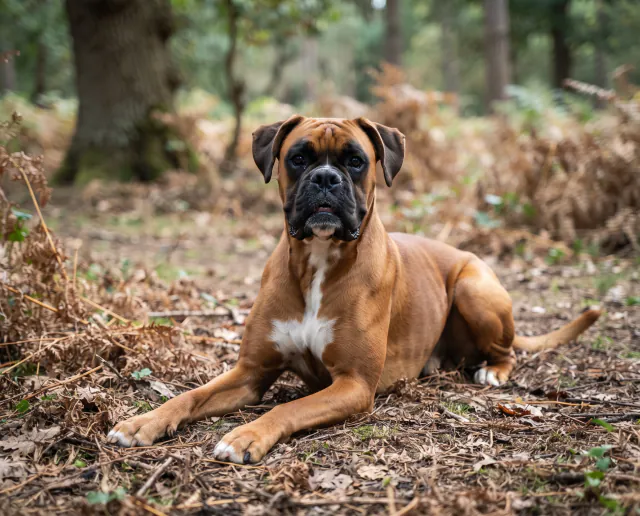
Boxers stay juvenile for a long time. The breed matures slowly, and a three year old may still greet visitors by springing on the spot and pawing at the air, the habit that gave the dog its name. German in origin and descended from the Bullenbeisser hunting dogs crossed with imported English Bulldogs, the Boxer was developed to seize and hold large game, then reworked into a police, military and family dog.
What that leaves in a British living room is a powerful, affectionate athlete with the emotional timetable of a teenager and around thirty kilograms behind every enthusiasm.
Living with the breed
Boxers are demonstrative dogs that want physical contact and a part in whatever the household is doing. They are usually excellent with children they have grown up with, although the sheer bounce of a young one is a genuine hazard around toddlers and elderly relatives, so calm greetings need teaching from the first week. Many are reserved with strange dogs, same-sex tension is not unusual, and introductions should be unhurried rather than thrown into a busy park. The breed does not tolerate being ignored and copes poorly with long days alone. Expect snoring, a degree of drool and short hairs that show up on every dark fabric in the house.
Daily exercise
An hour to two hours a day suits a healthy adult, split rather than delivered in one burst. Boxers enjoy running and play hard, but the shortened muzzle limits how efficiently they cool themselves, and warm weather is a real constraint. Walk early, carry water and stop before the dog is labouring rather than afterwards. Puppies and adolescents need restrained exercise while joints and growth plates mature, which takes discipline with a breed this keen. Structured games with rules, such as tug with a clear release, are more useful than endless chasing. Off-lead work is usually straightforward once recall is established, since Boxers are people-focused and rarely inclined to disappear over the horizon.
Training and mental work
Clever and willing, Boxers are also easily excited and quick to turn a training session into a game. Short sessions with high-value rewards work better than long ones, and impulse control deserves as much attention as obedience. Teach a settle, a hand touch, four feet on the floor for greetings and a solid wait at doorways, all of which help manage a dog that expresses joy at speed. Harsh handling produces a flustered, defensive animal rather than a calm one. Mental work counts as much as walking, so use scent games, food puzzles and trick training on wet days to take the edge off without building fitness indefinitely.
Grooming and shedding
The short, tight coat asks for little beyond ten minutes with a grooming mitt once a week, though shedding is steady all year and fawn hair shows on dark upholstery. Skin is thin and prone to lumps, warts and allergic irritation, so grooming doubles as a chance to run hands over the whole dog. Wrinkles on the muzzle should be wiped and dried. Boxers feel the cold badly given a single coat and little body fat, and most benefit from a fitted coat for winter walks. White markings and pale skin can burn, so shade matters in summer.
Health and costs
Boxers live around ten to twelve years, and the breed has well-known health considerations that should shape both buying and budgeting. Heart disease is the main one, since aortic stenosis and a form of cardiomyopathy occur in the type, and a responsible breeder will have had the adults heart tested under a recognised scheme and will show the certificates. Cancers are seen more often than in many breeds, so any new lump deserves veterinary assessment rather than monitoring at home. Hip scoring and the DNA test for degenerative myelopathy are worth asking about. Predominantly white puppies occur in the breed and can be deaf, which needs checking. Insurance is not cheap for this profile, and roughly £90 to £170 a month for food, cover, preventive care and equipment is indicative rather than fixed.
Size and lifespan
Males typically stand 57 to 63 cm (22.5 to 25 in) at the shoulder and weigh 30 to 32 kg (66 to 70 lb). Females are somewhat smaller, usually 53 to 60 cm (21 to 23.5 in) and 25 to 27 kg (55 to 60 lb). The breed is muscular and athletic rather than heavily boned, built for agility and short bursts of speed.
A typical lifespan is 10 to 12 years. Boxers mature slowly in temperament even after they stop growing physically, and many stay boisterous well into adulthood before settling into a calmer middle age.
Verdict
A Boxer suits an active household that is home for most of the day, enjoys physical, comic dogs and will keep training through a long adolescence. Families with older children, runners and people who want a dog thoroughly involved in family life usually get the best from the breed.
A quiet house, a full-time working owner or a budget with no room for significant veterinary bills all argue against the breed. Buy from a breeder who tests hearts and speaks openly about what the line has died of, and the years on offer are generally very good ones.