
At a glance
Key facts
The essentials to compare before deciding whether this breed fits your home and routine.
- Size
- Large
- Lifespan
- 10 to 12 years
- Energy
- High
- Temperament
- Devoted, steady at home, exuberant outdoors, slow to mature
- Good with children
- Usually very good with children raised alongside a big bouncy dog
- Exercise
- 1.5 to 2 hours a day with free running once mature
- Trainability
- Beginner friendly
- Grooming
- Brush several times weekly, with feathering that mats and moderate shedding
- Estimated monthly cost, GBP
- £110 to £190 per month
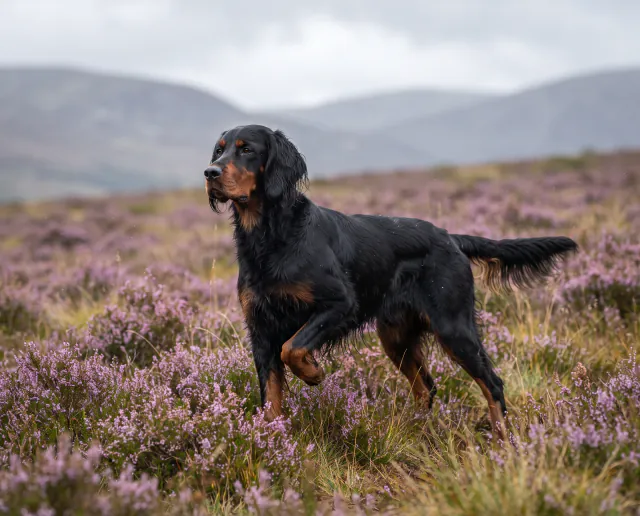
Grouse moors made the Gordon Setter. The breed was developed on Scottish estates, and takes its name from the Dukes of Gordon at Gordon Castle in Moray, to quarter wide heather ground, find birds by scent carried on the wind and hold a point until the guns walked up. That called for stamina, a nose that worked at distance and enough substance to push through heather in Highland weather. The result is the heaviest and slowest maturing of the setters, and the only one in black and tan.
Set beside an Irish Setter, the Gordon looks the more serious dog, and in most respects it is. It is steadier, more inclined to attach itself to one household and slower to make friends with strangers, though never to the point of guarding. The trade is a longer adolescence. Many Gordons are not mentally adult until three, and owners who expect a settled dog at eighteen months are the ones who struggle.
Living with the breed
Indoors, a mature Gordon is calm, affectionate and content to lie across a doorway keeping an eye on the family. Puppies and adolescents are another matter, big, clumsy and prone to sweeping anything at tail height onto the floor. Attachment to its own people is strong, and thin socialisation shows as barking at visitors or reluctance to be handled by strangers. Separation is tolerated poorly by many, so whole working days alone are a poor match. Other dogs are usually fine. Cats need early introduction; poultry are birds and will be found. Most Gordons are good with children, particularly those raised with the dog, though a bouncing 30kg adolescent needs managing around toddlers.
Daily exercise
An adult wants a good hour and a half to two hours a day, and a fair part of that should be free running on ground where the dog can range, quarter and use its nose. Recall is the difficulty, because a setter on scent runs with its head up into the wind and may cover several hundred metres before it thinks about the handler again. Secure fields, a long line during training and caution near roads and livestock are all sensible. A dog running loose among sheep is an offence and the owner is liable, so lead control in farmland is not optional. Puppies need short outings, no repetitive jumping and no long hikes until the growth plates close, which in a Gordon can mean eighteen months or later.
Training and mental work
Gordons are intelligent and willing but they are not Labradors, and they take longer to grasp that a request applies every time rather than only when nothing better is on offer. Reward-based training with a patient handler works well; harsh handling produces a dog that sulks or shuts down. Short sessions, plenty of scent-based work and a job of some kind pay off. Gundog classes, working tests and scent detection all suit the breed. Adolescence often brings a spell where recall evaporates and learned behaviour seems to vanish, and keeping the routine steady through it is the most useful thing an owner does.
Grooming and shedding
The coat is long, silky and flat, with feathering on the ears, chest, belly, legs and tail. It sheds moderately all year and more in spring, and it collects burrs, mud and grass seeds by the handful. Brushing several times a week with a slicker and a comb keeps the feathering free of mats, particularly behind the ears, in the armpits and between the hind legs. Grass seeds in summer work into the skin between the toes or down the ear canal, so check after every walk on rough ground. The drop ears are heavily feathered and hold moisture, so ear infections are common and a weekly look inside belongs in the routine. Feet and ear fringes can be tidied at home without a professional groomer.
Health and costs
Hip dysplasia is recognised in the breed and hip scoring under the BVA and Kennel Club scheme is the first thing to ask a breeder about. A late onset form of progressive retinal atrophy occurs in Gordons, and a DNA test known as rcd4 identifies carriers, so both parents should have results. A DNA test also exists for a cerebellar degeneration that causes a wobbly gait in young dogs, and the breed club encourages breeders to use it. Like all deep-chested breeds, Gordons are at risk of gastric dilatation and torsion, and a dog that retches without bringing anything up, paces and swells behind the ribs needs a vet at once. Weight management is straightforward for an exercised dog and difficult for an under-exercised one. Running costs across food, insurance, routine care and coat maintenance fall roughly between £110 and £190 a month, with insurance the biggest variable. Gordons are neither rare nor common, and litters tend to come from a small group of committed breeders, many of them working their dogs, so the breed club is the sensible first contact. Setter rescue organisations regularly rehome adults.
Verdict
A Gordon Setter suits an active household in the countryside or with easy access to it, with someone at home for much of the day and the patience for a long and occasionally exasperating adolescence. Walkers, hill goers and people interested in gundog work get the most from the breed.
It is a poor match for a flat, for owners out at work all day, or for anyone who wants a dog that is reliably off lead by its first birthday. Those drawn to the colour should meet an adolescent Gordon before committing.