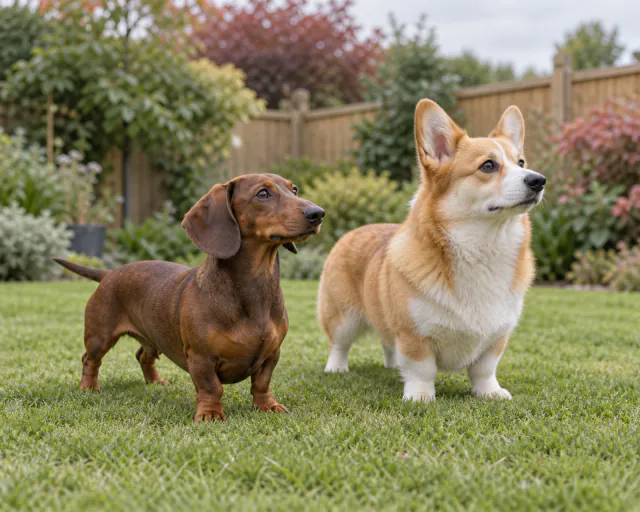
Dachshunds and Welsh Corgis get compared constantly for an obvious reason: both are unmistakably short-legged, long-backed dogs, and both carry a well-documented risk of intervertebral disc disease, known as IVDD, that comes directly from that shape. Beyond the silhouette, though, the two breeds were built for entirely different jobs. The Dachshund is a scent hound developed in German-speaking Europe to follow badger and fox underground, working alone and out of earshot. The Corgi is a Welsh droving dog, bred to move cattle across hill country by nipping at their heels and dropping flat to avoid the kick that followed. Those different histories show up clearly in temperament, trainability and the kind of household each dog suits.
Anyone drawn to either breed for its distinctive shape should read both profiles in full, since the shared structural risk deserves the same seriousness regardless of which one you choose: Dachshund and Welsh Corgi. Corgi covers two separately recognised breeds, and what follows applies to both unless stated; the Pembroke Welsh Corgi and Cardigan Welsh Corgi profiles cover the differences between them.
How they compare
| Trait | Dachshund | Welsh Corgi |
|---|---|---|
| Size | Small, standards 9 to 12 kg, miniatures around 4.5 to 5 kg | Small, around 10 to 12 kg |
| Exercise needs | Up to 1 hour, adjusted to build and fitness | About 1 hour across two controlled walks |
| Grooming and shedding | Moderate shedding, weekly grooming, varies by coat type | High shedding, regular brushing, heavy seasonal coat blow |
| Trainability | Moderate | Beginner-friendly |
| Temperament | Bold, curious and independent | Bold, busy and vocal for its size |
| Good with children | Supervision important | Supervision important |
| First-time owner suitability | Possible with support | Suitable |
| Typical lifespan | 12 to 16 years | 12 to 15 years |
| Indicative monthly cost | £70 to £140 | £70 to £130 |
Temperament and personality differences
The Dachshund’s profile describes a bold, curious and independent hound with strong opinions about recall, visitors and bad weather, a personality that follows directly from being bred to work alone underground and make its own decisions without a handler’s voice to guide it. The Welsh Corgi’s profile describes a similarly confident dog, but one that stays closely involved in household routine, following the busiest person from room to room and announcing visitors enthusiastically, a trait that comes from droving work requiring constant engagement with livestock and handler alike. Both are vocal breeds rated high for barking, but for different reasons: the Dachshund’s alertness to strangers versus the Corgi’s watchfulness combined with a herding instinct that can show up as circling and nipping at moving children.
Exercise and energy differences
Exercise needs are close between the two, with the Dachshund’s profile calling for up to an hour a day adjusted to the individual dog’s build and fitness, and the Corgi’s profile calling for about an hour across two controlled walks. Both profiles stress building duration gradually rather than alternating between inactivity and an exhausting weekend outing. Recall is a genuine challenge with both breeds once a scent or a moving target takes priority, and both profiles recommend a long line in open or unfenced areas until reliability is established. Neither breed needs the mileage a working sporting breed would, but both benefit from mentally engaging activity, scent work for the Dachshund and structured training games for the Corgi.
Grooming and coat differences
This is where the two breeds diverge most clearly. The Dachshund’s profile rates shedding as moderate and grooming as weekly, varying by the breed’s three coat types, smooth, long-haired and wire-haired, with wire coats sometimes needing specialist trimming. The Welsh Corgi’s profile rates shedding as high, driven by a proper weatherproof double coat that blows its soft undercoat wholesale twice a year, producing what the profile describes as a volume of hair that seems impossible for the dog’s size. An undercoat rake and sustained brushing are needed during those seasonal periods, and the profile specifically warns against shaving the coat, since it insulates against both heat and cold. Owners sensitive to hair around the home should weight this difference heavily, since the Corgi is a considerably higher-shedding breed than the Dachshund.
Training and trainability differences
The Welsh Corgi’s profile rates trainability as beginner-friendly, describing the breed as sharp, food-driven and quick to work out what earns a reward, calling training itself a pleasure. The Dachshund’s profile rates trainability as moderate, and frames toilet training in particular as something that benefits from frequent outdoor opportunities and quiet, consistent praise rather than quick results. Both breeds need early, consistent handling to prevent problem behaviours becoming habits, recall and calm door responses for the Dachshund, and redirection away from heel-nipping for the Corgi, whose herding instinct is not aggression but can frighten or hurt a small child if left unmanaged.
Health and lifespan differences
Both breeds share the central health concern that comes with their shape: a long back carried on short legs raises the risk of IVDD, in which disc material presses on the spinal cord. Both profiles are direct that sudden yelping, reluctance to move, a hunched posture or weakness in the back legs needs same-day veterinary attention rather than a wait-and-see approach. The Dachshund’s profile points to a joint Kennel Club and Dachshund Health UK screening scheme for IVDD risk. The Welsh Corgi’s profile additionally flags degenerative myelopathy, a progressive spinal cord condition of older Pembrokes with its own DNA test, alongside hip dysplasia, eye conditions and a bleeding disorder that responsible breeders should screen for. Lifespan is similar, 12 to 16 years for the Dachshund and 12 to 15 years for the Corgi, and both profiles are explicit that keeping the dog lean matters more than almost any other single factor in managing spinal risk over a long life.
Cost and space differences
Monthly costs are close, £70 to £140 for the Dachshund and £70 to £130 for the Corgi. Both breeds are described as suited to a smaller home, the Dachshund’s profile rating it flat-friendly and the Corgi’s profile rating it suited to a small home, provided walks are genuine and, in the Corgi’s case, stairs are managed with ramps or gates given the spinal risk. Insurance deserves early attention for both breeds, since spinal treatment is expensive and a condition already on record is unlikely to be covered later.
Which one suits you?
Choose the Dachshund if an independent, scent-driven hound with a strong personal streak appeals, and you are prepared to manage stairs, jumping and weight for a long-lived dog that makes up its own mind. Choose the Welsh Corgi if you want a genuinely trainable, food-motivated dog that thrives on engagement with its household, are a first-time owner looking for a more forgiving learning curve, and can commit to managing significant seasonal shedding.
Both breeds demand the same seriousness about spinal health regardless of which one you choose, and neither is a good fit for a household unwilling to manage weight and jumping for the dog’s entire life. If you are still deciding between short-legged breeds generally, the breed comparison tool can set either against other candidates, and the breed finder is useful if the spinal risk in both of these turns out to be more than you want to take on.