Also known as: Cardigan, Welsh Corgi (Cardigan).
At a glance
Key facts
The essentials to compare before deciding whether this breed fits your home and routine.
- Size
- Small
- Lifespan
- 12 to 15 years
- Energy
- Medium
- Temperament
- Steady, watchful and slower to trust a stranger
- Good with children
- Generally reliable with sensible supervision
- Exercise
- Around an hour a day, and content with more
- Trainability
- Beginner friendly
- Grooming
- A weekly brush, then daily work through two heavy moults
- Estimated monthly cost, GBP
- £70 to £135 per month
The Cardigan is the Corgi most people have never knowingly met. It comes from Ceredigion in mid-Wales, it is the older of the two Welsh Corgis, and it is a genuinely different breed from the Pembroke rather than a long-tailed version of it. Registrations run at a small fraction of the Pembroke’s, which is why a great many people who like the look of a Corgi have only ever seen one of the two.
Where the breed came from and what it was for
Cardigans worked the hill farms of mid-Wales as drovers’ dogs, moving cattle by heeling them and ducking the kick, and doing a good deal else besides: seeing off strangers, killing vermin, and keeping an eye on the holding generally. That second half of the job description is worth noticing, because it still shows in the temperament. A dog expected to guard as well as drive is not a dog that greets every visitor as a friend on sight.
Its ancestry is usually placed with the low-set, long-bodied hunting dogs of the teckel or dachshund type rather than with the spitz group that produced the Pembroke. The two breeds arrived at a similar shape by different routes, for a similar job, in neighbouring parts of the same country. That is why they look alike at a glance and feel quite different in the hand.
Build, ears and tail
The Kennel Club standard gives an ideal height of 30 cm (12 in) at the shoulder and, notably, does not name a weight range: it asks for weight in proportion to size, with overall balance as the first consideration. In practice a Cardigan is a heavier, more substantial dog than a Pembroke of the same height, with more bone, a deeper chest, larger feet and a slight crook to the front legs where the Pembroke’s are straight. Standing them side by side, the Cardigan reads as the longer and more solid of the two.
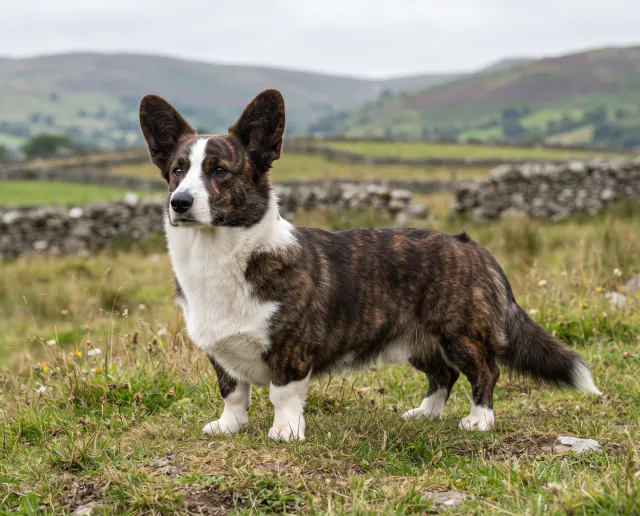
The ears are erect and proportionately rather large, with slightly rounded tips, moderately wide at the base and set about 9 cm (3½ in) apart. They are one of the two reliable ways to tell the breeds apart at a distance.
The other is the tail, and it is the single clearest difference. A Cardigan carries a long tail like a fox’s brush, set in line with the body and long enough to touch or nearly touch the ground. It was never a docked breed and never a bobtailed one. A Corgi with a full brush tail is very probably a Cardigan; a Corgi with no tail is not one.
Coat, colour and shedding
The coat is a hard-textured double coat of medium length over a dense undercoat, built for wet Welsh hill weather. The colour range is much wider than the Pembroke’s: blue merle, brindle, red, sable, tricolour with brindle points and tricolour with red points, usually with white markings. The standard is specific that white should not predominate on the body or head, and should never surround the eyes.
Blue merle is the colour that needs care rather than enthusiasm. Merle is inherited in a way that makes mating two merle dogs together a serious risk to the puppies, with deafness and eye defects among the recognised consequences, so ask any breeder offering merle puppies directly what the colours of both parents were. That is a reasonable question and a good breeder will expect it.
Shedding is heavy. The coat moults hard twice a year and drops steadily in between, and a Cardigan is a bigger dog than a Pembroke, so there is more of it. A weekly brush covers ordinary weeks; during a moult, plan on daily sessions with an undercoat rake until the soft layer has come away. Do not clip the coat back: it insulates against summer heat as well as winter wet, and the texture can be permanently spoiled.
Living with a Cardigan
The temperament is the reason most owners of the breed chose it. Cardigans are steady, deeply attached to their own household and noticeably more reserved with strangers than Pembrokes. A visitor is usually assessed for a while before being accepted, and that is normal for the breed rather than a sign of poor socialisation, though early, unhurried introductions to plenty of people and places still pay for themselves. Watchfulness means they will announce an arrival, but most are less continuously talkative than a Pembroke.
They are generally reliable with children, and the herding response to running and shrieking is usually less immediate, though it exists in every Corgi and should be managed the same way: redirect the dog to a toy when the noise rises, teach children to stop moving rather than run, and supervise until both are habit. With other dogs and with cats they are usually straightforward, helped by a slightly slower, more considering manner.
Training suits a beginner who is prepared to be consistent. Cardigans are intelligent and food motivated, but they think about an instruction rather than firing at it, and a handler who mistakes that pause for stubbornness and starts repeating cues will get less than a handler who waits. Around an hour a day across two walks suits a healthy adult, and the breed has more stamina than the leg length suggests, so longer days out are welcome. Most settle well enough to be left for a normal working day once that has been taught deliberately.
Health considerations
Twelve to fifteen years is usual. The long back on short legs brings the same risk of intervertebral disc disease as in the Pembroke, and the same rule applies: sudden yelping, a hunched posture, reluctance to move or hind-leg weakness needs a vet the same day. Hip dysplasia and inherited eye disease are both screened for, and a form of progressive retinal atrophy found in this breed has a DNA test, as does degenerative myelopathy. Ask which tests were carried out on both parents for the specific mating and ask to see the certificates.
Because the breed is numerically small, the pool of breeding dogs is small too, and questions about health testing and about how closely related the parents are matter more here than in a common breed. Expect to travel and to wait for a well-bred litter.
The everyday management is the same as for any long-backed dog and makes a real difference: keep the dog lean, put non-slip runners on hard floors, use a ramp into the car, gate the stairs, and lift by supporting chest and hindquarters together so the back stays level.
Costs and who the breed suits
A realistic running figure is around £70 to £135 a month, moving with food prices, insurance, veterinary fees and how much grooming is done at home. The purchase price and the wait are both likely to be higher than for a Pembroke simply because there are so few litters. Insure before the puppy arrives, since spinal treatment is expensive and an existing clinical note will usually be excluded.
A Cardigan suits an owner who wants a small, sturdy, sensible dog with a working history and does not need it to be instantly demonstrative with everyone it meets. It rewards patience, both in finding one and in training it. It is a poor match for someone who wants an immediately outgoing dog, for a household unwilling to manage weight and jumping for the dog’s whole life, or for anyone who cannot cope with the coat. If the busier, more talkative temperament appeals instead, read the Pembroke Welsh Corgi profile, and the comparison of the two breeds sets the differences out side by side.