At a glance
Key facts
The essentials to compare before deciding whether this breed fits your home and routine.
- Size
- Small
- Lifespan
- 12 to 15 years
- Energy
- Medium
- Temperament
- Bold and busy in the Pembroke, steadier in the Cardigan
- Good with children
- Both suit families once heel nipping is redirected early
- Exercise
- About an hour a day for either breed
- Trainability
- Beginner friendly
- Grooming
- A weekly brush, then daily work through two heavy moults
- Estimated monthly cost, GBP
- £70 to £130 per month
There is no single breed called the Welsh Corgi. There are two, and they have been registered, bred and judged as separate breeds since the Kennel Club divided them in 1934: the Pembroke Welsh Corgi and the Cardigan Welsh Corgi. Almost everyone who says Corgi means the Pembroke, because it is the one that became familiar through royal association and, more recently, through television. The Cardigan is older, heavier, rarer and in several respects a different dog to live with.
This page exists to sort out which one you are actually looking at, and which one is likely to suit you. Each breed has its own full profile with the detail on health, training, grooming and cost.
Telling them apart
Two features settle it in a couple of seconds.
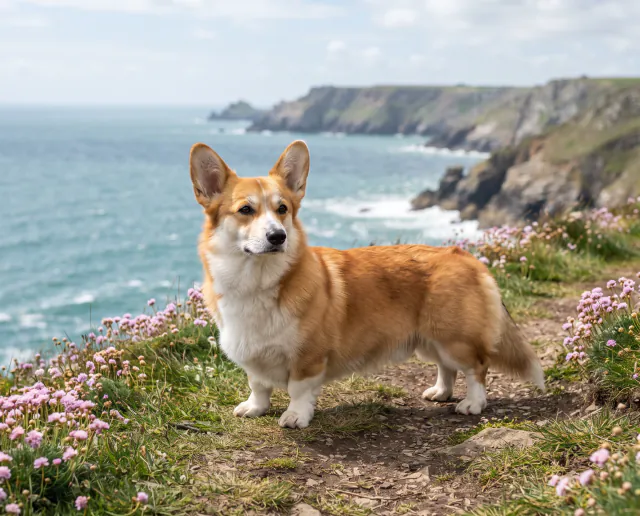
The tail is the first. A Cardigan carries a long tail like a fox’s brush, set in line with the body and long enough to touch or nearly touch the ground. It has never been a docked breed. A Pembroke may have a full tail, a natural bobtail, or, in an older dog, a tail docked before docking was restricted in the United Kingdom. So a Corgi with a long brush tail is very likely a Cardigan, and a Corgi with no tail at all is not one. A full-tailed Corgi could be either, which catches people out.
The ears are the second. A Cardigan’s are erect and proportionately rather large, moderately wide at the base with slightly rounded tips, set about 9 cm (3½ in) apart. A Pembroke’s are pricked and medium sized, and the Kennel Club standard gives a neat test for them: a line from the tip of the nose through the eye should, extended, pass through or close to the ear tip. Side by side, the Cardigan looks like it is wearing bigger, rounder ears, and the Pembroke’s head reads as more foxy.
After that, look at substance. The Pembroke standard asks for roughly 25 to 30 cm (10 to 12 in) at the shoulder, with dogs at 10 to 12 kg (22 to 26 lb) and bitches at 9 to 11 kg (20 to 24 lb). The Cardigan standard gives an ideal 30 cm (12 in) and deliberately declines to name a weight, asking instead for weight in proportion with balance as the first consideration. In the flesh the Cardigan is the heavier, longer, more substantial dog, with more bone, bigger feet and a slight crook to the front legs where the Pembroke’s run straight beneath the body.
Colour is the last clue and the most reliable in one direction. Cardigans may be blue merle, brindle, red, sable, or tricolour with either brindle or red points, usually with white markings. Pembrokes are red, sable, fawn or black and tan, with or without white. There is no merle in the Pembroke, so a merle Corgi is either a Cardigan or a dog with something else in its recent ancestry.
Different histories, similar job
Both breeds were drovers’ dogs, and both did the same dangerous work: running in low at a cow’s heels, nipping, and dropping flat as the kick came over. That job produced the short legs, the long back, the strong jaw, the carrying voice and the willingness to act without being asked. All of it still arrives in a modern household.
The routes to that shape differ. The Pembroke, from Pembrokeshire in the south-west, is generally traced to spitz-type ancestors, which fits the pricked ears and the busy forward manner. The Cardigan, from Ceredigion in mid-Wales, is placed with the low, long hunting dogs of the teckel type, and it was expected to guard the holding and clear vermin as well as move stock. That extra guarding role is the clearest reason the two temperaments differ.
How they differ to live with
The Pembroke is the more outgoing, more demonstrative and considerably more talkative of the two. It attaches itself to whoever is busiest, supervises the household and comments freely on visitors, deliveries and passing cars. That is the breed working as designed rather than a training failure, but it does mean a quiet response has to be taught early and consistently.
The Cardigan is steadier and slower to commit to a stranger. Visitors tend to be assessed before being accepted, which is normal for the breed rather than shyness, and most are less continuously vocal than a Pembroke. Owners often describe the difference as the Pembroke telling you what it thinks and the Cardigan thinking first.
That carries into training. Both are intelligent, food motivated and well within the reach of a sensible first-time owner. The Pembroke tends to fire straight at a cue; the Cardigan often pauses over it. A handler who reads that pause as stubbornness and starts repeating themselves will get less from a Cardigan than one who waits.
With children, both need the same management. A running, shrieking child looks like stock to either breed, and the answer is the same: teach the dog to grab a toy when the noise rises, teach children to stand still rather than run faster, and supervise until both are habit. The response is usually a little less instant in a Cardigan, but it is present in both.
Exercise and housing are much the same. Around an hour a day across two walks suits a healthy adult of either breed, both have more stamina than the leg length suggests, and both live perfectly well in a flat or a small house provided the walks are real and the stairs are managed. A secure garden matters more than a large one.
Shared health priorities
Whichever you choose, you are taking on a long back carried on short legs, and intervertebral disc disease is the risk that defines both breeds. Sudden yelping, a hunched posture, reluctance to jump or any weakness in the hind legs needs a vet the same day rather than overnight observation. Keeping the dog lean is the single most useful thing an owner does, and reducing everyday jolts helps: non-slip runners on hard floors, a ramp into the car, a gate at the foot of the stairs, and lifting with the chest and hindquarters supported together so the back stays level.
Both breeds are screened for hip dysplasia and inherited eye disease, and both have DNA tests available for degenerative myelopathy. Ask any breeder which tests were done on both parents for that particular mating, and ask to see the certificates rather than accepting a verbal assurance. For a Cardigan there are two extra questions: the colours of both parents, because mating two merles together risks deafness and eye defects in the puppies, and how closely related the parents are, because the breeding pool is genuinely small.
Which one should you get?
Choose the Pembroke if you want the busier, funnier, more openly sociable dog, you can find a litter without much difficulty, and you are honest with yourself about tolerating a vocal household. Choose the Cardigan if you prefer a steadier, more self-contained dog, you are drawn to the heavier build or the wider colour range, and you are prepared to travel and wait, because there are far fewer litters in a year.
Do not choose either on the strength of the shape alone. Both are working dogs in a small package, both moult heavily twice a year, both need weight and jumping policed for a decade and a half, and neither is a placid lapdog with short legs. If you are still deciding, meet adults of both breeds rather than puppies. The difference in manner is obvious in an adult and almost invisible in an eight-week-old.