Also known as: Pembroke, Welsh Corgi (Pembroke).
At a glance
Key facts
The essentials to compare before deciding whether this breed fits your home and routine.
- Size
- Small
- Lifespan
- 12 to 15 years
- Energy
- Medium
- Temperament
- Outgoing, quick-witted and talkative
- Good with children
- Usually good once heel nipping is redirected early
- Exercise
- Around an hour a day, split across two walks
- Trainability
- Beginner friendly
- Grooming
- A weekly brush, then daily work through two heavy moults
- Estimated monthly cost, GBP
- £70 to £130 per month
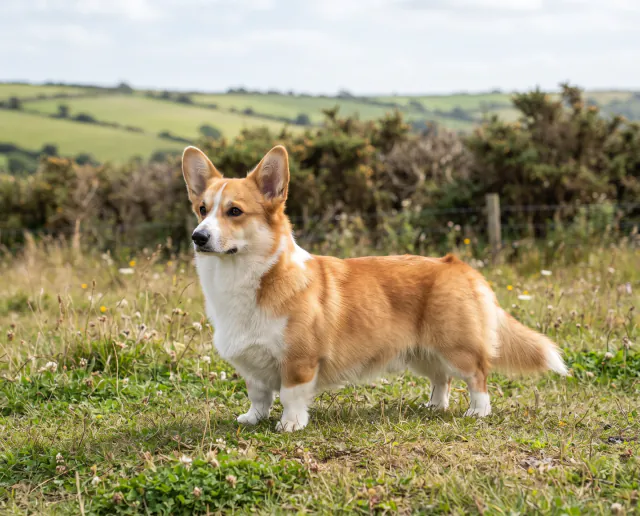
The Pembroke is the Corgi most people picture: a low, quick, foxy-headed dog with upright ears and an expression that suggests it is already three steps ahead of you. It takes its name from Pembrokeshire in south-west Wales, and it is a separate breed from the Cardigan Welsh Corgi, not a variety of it. The two have been registered and judged independently since 1934, and anyone choosing between them should read both profiles rather than assume the name covers one dog.
Where the breed came from and what it was for
Pembrokes are drovers’ dogs. Their job was to move cattle along Welsh lanes and open hill ground, and they did it by running in low, nipping a heel and dropping flat as the kick came over the top. A dog that could turn a bullock and survive doing so needed to be short in the leg, strong in the jaw, loud, and willing to make its own decisions without waiting for instruction. Every one of those traits is still in the breed, and every one of them arrives in a modern kitchen whether or not there is any livestock within fifty miles. The Pembroke also earned its keep as a general farm dog, clearing vermin and announcing anyone who came up the track.
Its ancestry is usually traced to spitz-type dogs, which is a genuinely different line from the Cardigan’s, and it accounts for the pricked ears, the wedge-shaped head and the busy, forward manner.
Build, ears and tail
The Kennel Club standard puts a Pembroke at roughly 25 to 30 cm (10 to 12 in) at the shoulder, with dogs weighing 10 to 12 kg (22 to 26 lb) and bitches 9 to 11 kg (20 to 24 lb). That is a small dog carrying a long back on short legs, and the proportions matter more than the numbers. The front legs are straight beneath the body rather than turned out, and the whole outline reads as neat and moderately long rather than deliberately stretched.
The ears are pricked, medium sized, with slightly rounded tips. The standard gives a useful test for their placement: a line drawn from the tip of the nose through the eye should, if extended, pass through or close to the ear tip.
The tail is where most confusion starts. Docking is no longer permitted in the United Kingdom outside narrow working exemptions, so a Pembroke bred here may carry a full tail set in line with the topline, a natural bobtail of any length, or, in an older dog, a docked tail from before the change. All three are within the standard. A full-tailed Pembroke is still a Pembroke, and a long tail is not evidence that a dog is a Cardigan.
Coat, colour and shedding
The coat is a working double: a harsh, weather-resistant outer layer of medium length over a dense, soft undercoat. Permitted colours are red, sable, fawn and black and tan, with or without white on the legs, brisket and neck, and some white is allowed on the head and foreface. There is no blue merle in this breed, and a merle Pembroke should raise questions about what has been crossed in.
Shedding is constant and unglamorous, and twice a year the undercoat comes out in sheets. A dog this size produces a quantity of hair that surprises people who chose it for being small. A thorough brush once or twice a week handles most of the year; through a moult, expect to work at it daily with an undercoat rake for a fortnight or so. Clipping the coat off is a poor answer, because the same double layer that holds warmth in winter keeps heat off the skin in summer, and it does not always grow back with its original texture.
Living with a Pembroke
This is a dog that involves itself in everything. It follows whoever is busiest, supervises the unloading of shopping, and comments on the postman. The barking is not a training failure so much as the breed working as designed, and it is far easier to teach a short bark followed by a settle in the first few months than to unpick a two-year habit later. Flats and small houses suit a Pembroke perfectly well; a secure garden is worth more than a large one.
Around children the herding instinct shows itself directly. A running, squealing child looks like stock, and the response is to circle, drive and nip at the ankles. It is not aggression, but it hurts and it frightens small children. Teach the dog to pick up a toy when the noise level rises, teach children to stand still rather than run faster, and supervise until both halves of that are reliable. With cats and other dogs Pembrokes are usually sociable, though the same instinct means a cat that bolts may get chivvied.
Training is genuinely enjoyable. Pembrokes are sharp, strongly food motivated and quick to work out what pays, which makes them a reasonable choice for a first-time owner who is willing to take the noise and the weight seriously. Keep sessions short, build recall properly before trusting the dog near livestock, and use scent games and puzzle work when a walk has to be cut short. Around an hour a day across two walks keeps a healthy adult in condition, and a fit one will happily do considerably more. Most cope with a normal working day alone once they have learned to settle, but a bored Pembroke is a barking Pembroke.
Health considerations
Expect twelve to fifteen years. The structural risk is intervertebral disc disease, where disc material presses on the spinal cord. Sudden yelping, a hunched back, reluctance to jump or any weakness in the hind legs is a same-day veterinary matter, not something to watch overnight. Degenerative myelopathy, a progressive spinal cord disease of older Pembrokes, has a DNA test, and results for both parents should be available in writing. Hip dysplasia, inherited eye disease and von Willebrand’s disease are also screened for in the breed, so ask a breeder which tests were done for that specific mating and ask to see the paperwork rather than a verbal assurance.
Body weight is the one factor an owner controls outright. A Pembroke will carry several unnecessary kilograms cheerfully, and the spine carries them too. Reducing the everyday jolts helps as well: non-slip runners on hard floors, a ramp into the car boot, a gate at the bottom of the stairs, and lifting with the chest and hindquarters supported together so the back stays level. Children should not carry the dog.
Costs and who the breed suits
Somewhere around £70 to £130 a month is a realistic running figure, moving with food prices, insurance, veterinary fees and whether the coat is managed at home. Arrange insurance before a puppy arrives rather than after, because spinal treatment is expensive and anything already on the clinical record is unlikely to be covered.
A Pembroke suits an owner who wanted a small dog with a working brain and is prepared to train it like one. Families with school-age children, active retired owners and anyone who enjoys teaching a clever dog tend to get on with the breed. It is a poor choice for a household that cannot tolerate a vocal dog, for anyone unwilling to police weight and jumping for a decade and a half, or for someone expecting a placid lapdog because the legs are short. If quieter and more reserved appeals, look at the Cardigan Welsh Corgi, and read the comparison of the two breeds before deciding.