
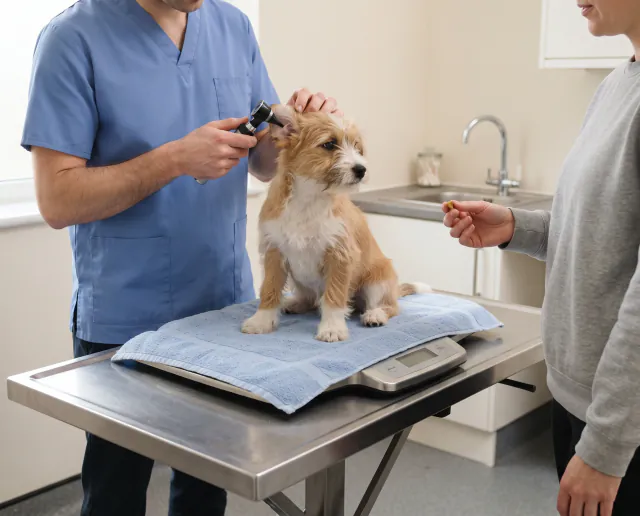
Settling a puppy into home life and looking after its health are related but different jobs. Getting the house ready, choosing a routine and managing those first noisy nights is covered elsewhere on the site, including in the guides on preparing your home for a new puppy and the first five things for a new puppy. This guide is about the health-check side specifically: what typically happens at those early vet visits, what a young puppy’s normal development looks like, and which signs in the early weeks mean picking up the phone rather than waiting for the next booked appointment.
Young puppies are more vulnerable than adult dogs to rapid decline. A puppy with a small, developing immune system and little in reserve can go from mildly off-colour to seriously unwell within a day, which is one reason the early check-up schedule tends to be closer together than it will be later in life.
What the first vet visit typically covers
A first puppy check-up usually includes a general physical examination, a weight check, and a conversation about feeding. The vet will listen to heart and lungs, check eyes, ears, mouth and teeth, feel over the abdomen and joints, and look for anything that needs following up. Bring any paperwork from the breeder or rescue, including whatever vaccination or worming history already exists, since gaps or uncertainty in that history change what happens next. This is also the natural point to raise any question about the puppy’s behaviour, appetite or toileting that has come up since collection day.
Vaccination, worming and parasite prevention
Your vet will discuss a vaccination course appropriate to your puppy’s age, breed and local disease risk, since exact schedules and which diseases are routinely vaccinated against vary by country and by individual veterinary practice. The same visit usually covers a worming and flea or tick prevention plan tailored to the puppy’s age, weight and local parasite risk. Do not use adult-dog products or estimate a dose yourself; follow the specific plan your vet provides for this puppy at this age and weight, and ask if you are ever unsure whether a product is safe to combine with another.
Microchipping and the neutering conversation
Microchipping requirements and typical timing vary by country, and in some places microchipping a puppy by a certain age is a legal requirement rather than a recommendation, so ask your vet what applies where you live. The same early visits are often where a first, general conversation about neutering starts, covering the sort of factors that matter for your specific puppy rather than a fixed answer. That decision deserves its own unhurried conversation with your vet once your puppy is a little older, which the guide on responsible neutering covers in more depth.
Normal development you can sanity-check without anxiety
Puppies go through predictable stages that can look alarming without context. Teething typically runs from a few weeks old through to around six months, with baby teeth gradually replaced, increased chewing, and occasionally a little blood on a toy from a loose tooth, all of which is ordinarily unremarkable. Growth spurts can be uneven, with a puppy briefly looking gangly or out of proportion as different parts of the body grow at different rates, particularly in larger breeds. Sleep needs are considerably higher than for an adult dog, and a young puppy sleeping much of the day between bursts of activity is normal rather than a sign of illness. What is not normal is a puppy who seems abnormally quiet and hard to rouse, stops wanting to play altogether, or shows sudden pain when chewing rather than the ordinary discomfort of teething.
Signs that warrant an earlier call
Some signs in a young puppy should prompt a call to the vet the same day rather than waiting to see if things settle. These include persistent vomiting or diarrhoea, particularly if repeated or containing blood, a puppy who seems lethargic or unusually withdrawn, one who is not eating or drinking at all, and any sign of laboured or noisy breathing. Because young puppies can deteriorate quickly, especially through dehydration from vomiting or diarrhoea, it is better to call and be told it can wait than to wait and find it could not. Most practices are used to fielding these calls from new owners and would rather answer a question that turns out to be nothing than see a puppy arrive in a genuinely serious state.
Making the check-ups themselves easier
A puppy who learns early that being handled, examined and weighed is unremarkable makes every future visit easier, for the puppy and for the practice. Short, positive handling practice at home, along the lines of the routine in preparing for veterinary handling, pays off well beyond the puppy stage. Keep a simple written note of dates, weights and anything discussed at each visit; it becomes a genuinely useful record once the vaccination course, worming plan and any other early treatments are spread across several appointments rather than one.