- Session length
- 1 to 2 minutes, two or three times a day
- Skill
- Impulse control
- Suits
- Puppy
What you need
- Two grades of food, one ordinary and one clearly better, both from the daily ration
- A non-slip mat or carpeted floor to kneel on
- A quiet room with no other pets or distractions nearby
Leave it is one of the most useful cues a puppy can learn, and one of the easiest to teach incorrectly. Said as a nag, repeated three or four times while a puppy keeps trying, it teaches nothing except that the words can safely be ignored. Taught properly from a closed fist, it teaches a puppy that turning away from something pays better than pursuing it, which is the actual skill this lesson is building rather than simple obedience to a word.
Purpose
To teach a puppy to disengage from food or an object on cue, by rewarding the choice to look away rather than the choice to keep trying. This is the puppy-level foundation for leave it, built here with your own closed hand in a calm room. A later lesson in the pathway proofs the same skill against real distractions such as dropped food outdoors, so there is no need to rush that stage here. The habit matters well beyond food: a reliable leave it also gives you a way to interrupt interest in something unsafe on the ground without a chase or a grab.
Prerequisites
Your puppy already takes food gently from your hand rather than snatching, and is comfortable wearing a harness, both covered in the previous lesson. There is nothing further needed before starting.
Equipment
You need two grades of food: an ordinary piece is what stays inside your closed fist, and a clearly better piece is what your puppy is paid with from your other hand. That difference is what makes leaving the fist a good trade rather than a loss. Work on a non-slip floor in a quiet room with nothing else competing for your puppy’s attention, since this exercise asks for genuine impulse control rather than simple food manners.
Method
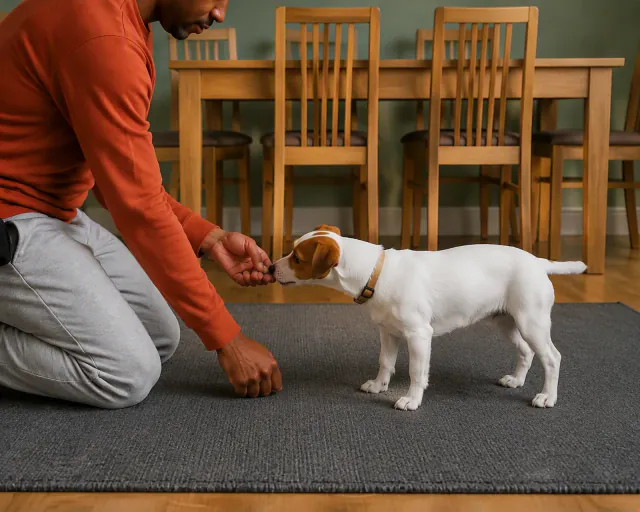
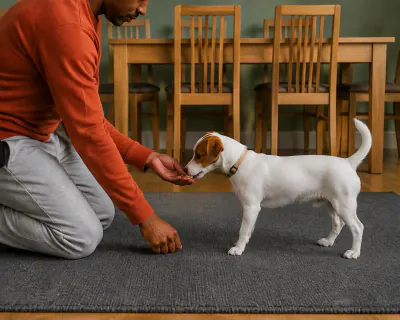
- Kneel on the floor with an ordinary piece of food held inside a closed fist, resting near the ground where your puppy can easily reach it.
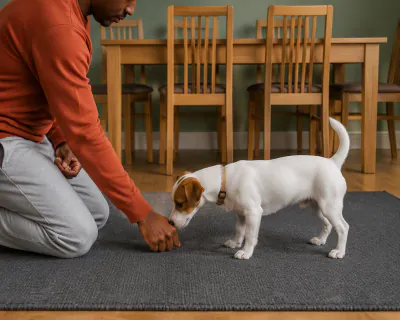
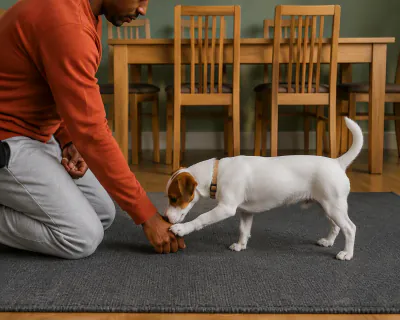
- Let your puppy sniff, lick, nudge and paw at your closed fist. Say nothing and do not move your hand away or open it.
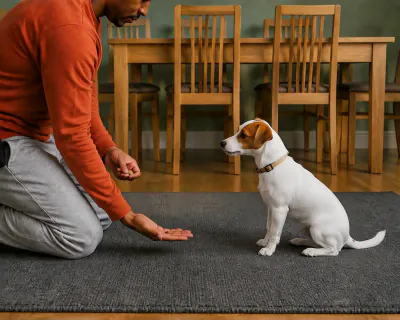
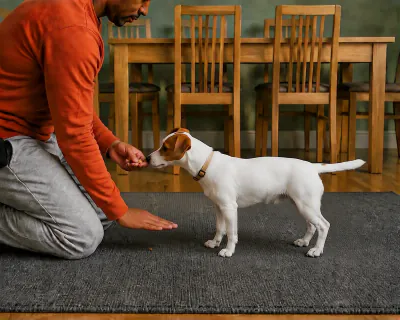
- The instant your puppy backs off, turns their head away or simply pauses, even briefly, mark the moment with a calm word such as “yes” and immediately reward from your other hand, never by opening the closed fist.
- Repeat five or six times. Most puppies start disengaging faster with each repetition once they learn that trying harder at the fist produces nothing.
- Once your puppy reliably backs off from a closed fist within a second or two, add the cue: say “leave it” once, calmly, just before you present the fist, rather than repeating it while your puppy is still trying.
- Progress to an open palm with the food visible but not offered. Close your hand again quickly if your puppy moves towards it, and reward the choice not to take it with a better piece from your other hand.
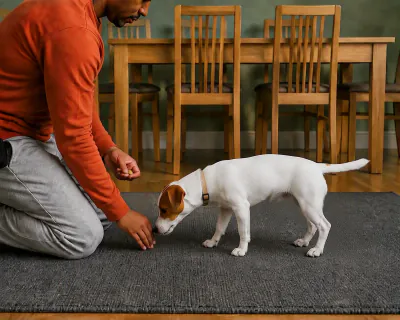
- Extend this to food placed on the floor with your hand hovering just above it, ready to cover it if needed, always paying from your other hand rather than the item itself.
- Once that is solid, move your hand slightly further from the floor item, building towards a puppy who leaves food on the ground with your hand nowhere near it, though this later stage belongs to the beginner-level lesson that follows on from this one.
- Practise leave it with a single low-value object such as a sock or a dull toy in the same way, since the skill needs to generalise beyond food alone.
- Keep every repetition calm and quiet. If your puppy is lunging, barking or overexcited, the exercise has moved too fast, and the answer is to return to an easier step rather than push through.
Session length
One to two minutes, two or three times a day, is plenty. Six to ten repetitions make a complete session, since this is a mentally demanding exercise for a young puppy and quality of response drops quickly once they are tired.
Progression criteria
Move on when your puppy backs off from a closed fist within about two seconds on eight out of ten repetitions, across three separate sessions on different days, without you needing to repeat the cue. From there, increase difficulty one variable at a time. Extend duration first, so your puppy holds back for slightly longer before being rewarded rather than disengaging and instantly trying again. Then move to the open palm stage, keeping the room and food the same. Only once that is solid should distance and real distraction be introduced, which the following lesson in this pathway takes further.
Common mistakes
Saying “leave it” repeatedly, in a rising tone, while your puppy keeps trying at your hand teaches that the first cue, and probably the second and third, can be ignored. Opening your fist to reward the puppy for finally backing off gives them exactly what they were told to leave, which reinforces persistence rather than restraint. Moving too quickly from a closed fist to food loose on the floor, before the fist stage is reliable, usually produces a puppy who simply grabs the food, which then teaches the opposite of what you intended.
Troubleshooting
If your puppy will not stop pawing or mouthing at your closed fist, the step is too hard, so reward the tiniest pause rather than waiting for a full disengagement. If they seem to understand indoors but ignore the cue the moment you try it with a toy instead of food, treat that as a fresh generalisation step rather than a regression, and rebuild the closed-fist stage with the toy specifically. If your puppy consistently seems anxious rather than simply persistent around your closed hand, soften your body language, slow down, and make sure the better reward is genuinely more appealing than what is in your fist.
Safety and when to stop
Do not rely on leave it as your only line of defence around anything genuinely hazardous, such as human medication, spoiled food or a dropped object with a choking risk. Manage the environment and supervise first, and treat the trained cue as a backup rather than a guarantee. Never open your puppy’s mouth to remove something once this lesson has moved beyond food you offered yourself, and never chase or grab, both of which teach a puppy to swallow quickly or run. If your puppy stiffens, freezes or growls over an item rather than mouthing or pawing at your closed hand in the ordinary way described here, stop and arrange an individual assessment with a qualified behaviourist working alongside your vet.
Next lesson
With the closed-fist foundation in place, move on to teaching a puppy to drop and release, which teaches your puppy to willingly give up something already in their mouth.
Useful tool
This lesson uses a reasonable amount of food across the day, so the dog food calculator is worth checking to make sure training rewards come out of the measured daily ration rather than being added on top of it.