At a glance
Key facts
The essentials to compare before deciding whether this breed fits your home and routine.
- Size
- Large
- Lifespan
- 11 to 14 years
- Energy
- High
- Temperament
- Outgoing, energetic and closely involved with people
- Good with children
- Often good with active families able to supervise a boisterous dog
- Exercise
- Two hours or more a day for a fit adult
- Trainability
- Moderate
- Grooming
- Weekly brushing, with short stiff hairs shedding all year
- Estimated monthly cost, GBP
- £90 to £160 per month
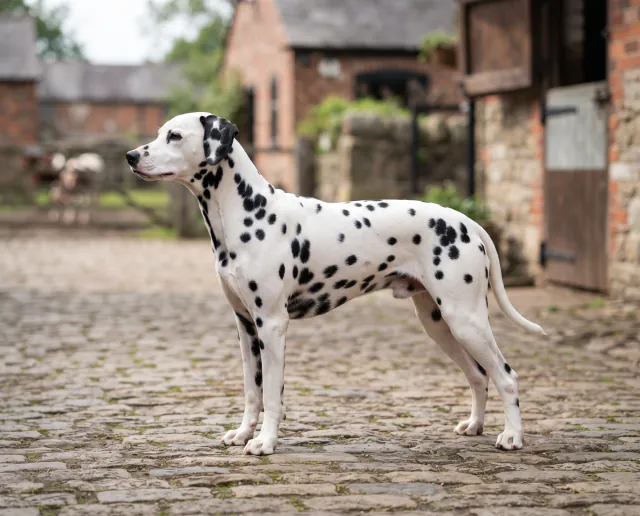
Dalmatians were bred to run. The historic job was to travel with horse drawn carriages, trotting alongside for hour after hour and settling in the stable once the work stopped. That produces an efficient stride, a deep chest and an appetite for distance that a short circuit of a housing estate does not begin to satisfy.
The spots arrive later than people expect. Puppies are born white and the pattern develops over the following weeks. The coat itself is the practical detail most owners underestimate. Short, stiff white hairs shed throughout the year, work themselves into upholstery and survive several washes in a dark jumper.
Suitability
Active households suit this breed best. Runners, cyclists, hillwalkers and families who are outdoors in most weather all provide the sort of routine a Dalmatian needs. The temperament is friendly rather than guarded, and most enjoy visitors and busy places once properly socialised.
Size and exuberance are the limiting factors indoors. An adolescent is large, fast and not yet sensible, and will clear a low table with its tail without noticing. Families with children under school age often find the first two years hard work for that reason rather than for any aggression. First-time owners can succeed with a strong commitment to training and exercise, though the breed is less forgiving than a Labrador of a household short of time. Long days alone do not suit a dog this sociable, and an under-exercised Dalmatian will chew, dig and pace.
Exercise
Two hours a day is a reasonable baseline for a fit adult, and many will take more. Steady distance suits the breed better than repeated sprinting, which reflects the original work. Once fully grown, a Dalmatian makes an excellent running or cycling companion.
Growth is the caution. Large breed puppies should not be run on hard surfaces or encouraged to jump repeatedly until the growth plates have closed, and a vet can advise on sensible limits by age. Recall needs proper work, since a sociable dog at speed can be some way off before it hears anything. Fresh water should be available at every stage of a long outing, which matters more here than in most breeds.
Grooming
The coat is short, dense and harsh, and needs brushing once or twice a week with a rubber curry or hound glove. That is quick, though it does not solve the shedding, which is continuous rather than seasonal. Most owners accept hair on clothing and in the car as permanent, and a robust vacuum earns its cost.
Skin merits attention too. Some Dalmatians are prone to itching, and the pale skin under a thin coat can catch the sun on the nose, ears and belly. Bathe only occasionally with a product suitable for dogs. Nails need checking regularly, and tooth brushing is far easier if started in puppyhood.
Health
Two health areas are particularly associated with the breed, and both are best discussed with a vet and a breeder. The first is hearing. Deafness in one or both ears occurs, and reputable breeders arrange a specific hearing test for puppies before they leave, providing the results in writing. The second concerns the way Dalmatians process a component of protein, which differs from other breeds and can lead to urinary stones. Constant access to fresh water, frequent opportunities to urinate and dietary guidance from a vet are the practical responses.
The type is also watched for hip problems and skin conditions, and breeders should use the relevant screening schemes on parent dogs. Ask which tests were carried out and request dated certificates. Straining to urinate, blood in the urine, or a dog repeatedly attempting to pass water without success needs urgent veterinary attention. Any limp, persistent scratching or apparent loss of hearing should also be assessed professionally rather than judged at home.
Choosing and training
Buy from a breeder who talks openly about hearing test results, screening and the temperament of both parents, and who keeps the litter in a normal household environment. Popularity spikes following films have historically produced poorly bred puppies, so patience is better than convenience. Rescue is well worth considering, since adolescents are surrendered fairly often once the exercise requirement becomes clear, and an adult’s hearing and temperament are already known.
Training should start early and stay reward-based. The breed is intelligent without being especially compliant, and dull repetition or heavy handedness produces resistance. Concentrate on loose-lead walking before the dog outweighs the handler, on a recall built over months with a long line, and on a solid settle indoors. Scent games, food puzzles and short trick sessions supply the mental work that walking alone does not.
Verdict
A Dalmatian is an excellent match for a fit, outdoor household that wants a sociable large dog and can commit to two hours of daily exercise for a decade or more. Owners who run, ride or walk long distances and accept hair as part of the deal tend to find the breed exceptional company.
It is a poor choice for a quiet home, a full working day of solitude, a household with very young children, or anyone drawn mainly to the appearance. The coat pattern is the least demanding thing about the breed. Research the hearing and urinary considerations thoroughly, and speak to a vet about routine care before the puppy arrives.