
At a glance
Key facts
The essentials to compare before deciding whether this breed fits your home and routine.
- Size
- Large
- Lifespan
- 10 to 12 years
- Energy
- High
- Temperament
- Bold, tolerant of people and strongly driven
- Good with children
- Better with older children in an experienced home
- Exercise
- One to two hours daily with substantial mental work
- Trainability
- Experienced handler
- Grooming
- Weekly brushing plus sun protection for pale skin
- Estimated monthly cost, GBP
- £110 to £190 per month
The legal position comes first. The Dogo Argentino is banned or restricted in a number of countries, including the United Kingdom, where it is a prohibited type under dangerous dogs legislation. Restrictions also exist in parts of Europe, Australia and elsewhere, and rules vary between national and local authorities. Anyone considering the breed must check the current law where they live, and where they intend to travel, before going any further. Where ownership is lawful, this is a large, capable hunting dog that asks a great deal of its owner and gives little back to a casual one.
Origin and purpose
The breed was created in Córdoba province in Argentina in the 1920s by Antonio Nores Martínez, who wanted a pack hunting dog capable of working wild boar and puma across difficult country. He began with the old Cordoban fighting dog and crossed in other breeds, including pointer, Great Dane, boxer and Irish wolfhound, selecting for stamina, scenting ability, courage and a white coat that made the dog visible in cover. He also selected against dog aggression, because a hunting pack has to work together. Recognition came slowly, with the FCI accepting the breed in 1973 and the American Kennel Club in 2020.
Temperament and behaviour
A sound Dogo is confident, physically bold and generally straightforward with people, including strangers, since suspicion of humans was never part of the job. What it has instead is drive. Prey drive is high and persistent, and a dog on a scent becomes extremely difficult to interrupt. Pain tolerance is notable, so minor injuries go unnoticed. Many are territorial about the home despite being sociable away from it. Barking is low, which is a mixed blessing, because a quiet dog gives less warning. Adolescence brings a marked increase in independence and strength.
Family life and other animals
Within the household these dogs are typically affectionate and closely attached to their people. Older children who understand how to behave around a large dog usually do well. Toddlers are a poor combination, not through hostility but because a 40 kg dog moving at speed is a hazard in a confined space. Pack tolerance was bred for, and many Dogos live happily with other dogs, but same sex disputes occur. Cats, poultry and livestock are a genuine problem given the prey drive, and a garden fence needs to be high, solid and maintained. This is not a suitable first dog.
Exercise and mental stimulation
Adults need one to two hours of daily exercise, and quality matters more than distance. Long, varied walks on lead, scentwork, tracking, obedience practice and controlled retrieve work suit a dog bred to use its nose and think for itself. Off lead freedom needs a recall that holds against a strong scent, and in many areas it is safer to accept that a long line is the permanent arrangement. Growing puppies should be kept off hard surfaces and away from repetitive jumping while joints develop, on veterinary advice.
Training
Training needs to be consistent, early and reward based, delivered by someone who can stay ahead of a dog that learns quickly and tests thoroughly. Confrontation is counterproductive with a breed selected for physical courage. The core skills are a reliable recall, disengagement from prey and moving objects, calm greetings, lead manners that will hold at full adult weight, settle on cue and comfortable acceptance of handling and muzzling. Muzzle training taught positively is a practical necessity in many jurisdictions. Experienced handling and professional support are close to essential, and the consequences of getting it wrong with a dog of this power are serious.
Coat, grooming and shedding
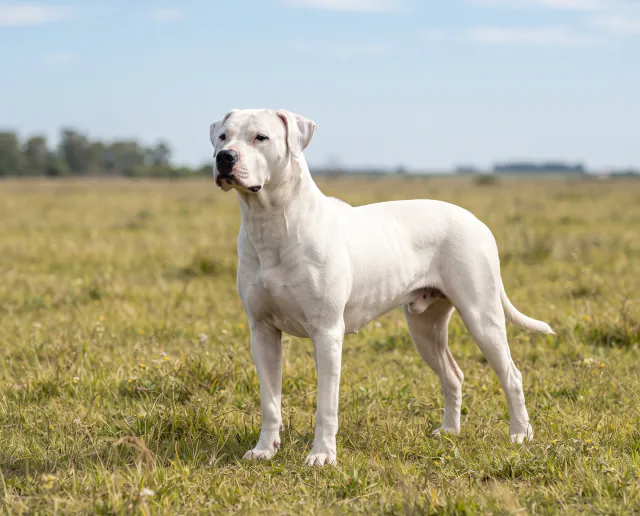
The coat is short, smooth and entirely white, with a small dark patch near the eye permitted in the standard. Grooming needs only a weekly rub down with a rubber mitt, and shedding is moderate and year round, with fine white hairs that show on dark fabric. The lack of pigment brings a practical issue, since pale skin sunburns readily on the nose, ear tips and belly, so shade and sun protection your vet recommends are sensible. Check the skin for cuts and rashes a stoical dog may ignore. Ears, nails and teeth need routine attention.
Size, lifespan and health
Males typically stand 60 to 68 cm (24 to 27 in) at the withers and weigh 40 to 45 kg (88 to 99 lb). Females typically stand 60 to 65 cm (24 to 26 in) and weigh 35 to 43 kg (77 to 95 lb). Life expectancy is usually given as 10 to 12 years. The most widely discussed health consideration is congenital deafness, associated with the extreme white coat, which can affect one or both ears. BAER hearing testing of puppies is the recognised screening method and results should be available before purchase. Other recognised screening themes include hip and elbow scoring, eye testing and cardiac assessment. Ask for written results for both parents and discuss what they mean with a vet rather than accepting general assurances.
Living costs, space and time alone
Expect roughly £110 to £190 per month for food, preventive care, insurance and equipment, with insurance potentially difficult or expensive where the breed is restricted. Secure fencing, a well sized home and access to varied walking are practical requirements rather than luxuries. Most adults will settle alone for a few hours if properly exercised and taught to relax, but an under-occupied young Dogo does substantial damage. Noise is rarely the issue with neighbours. Legal compliance may add costs through insurance requirements, registration or handling restrictions.
Verdict
Where ownership is lawful, the Dogo Argentino suits an experienced, physically capable owner with secure property, time for daily training and a clear understanding of prey drive. In the right hands it is a stable and affectionate dog.
For most households it is the wrong choice, and in several countries including the United Kingdom it is not a choice at all. Check the law first, then be honest about whether you can meet the demands.