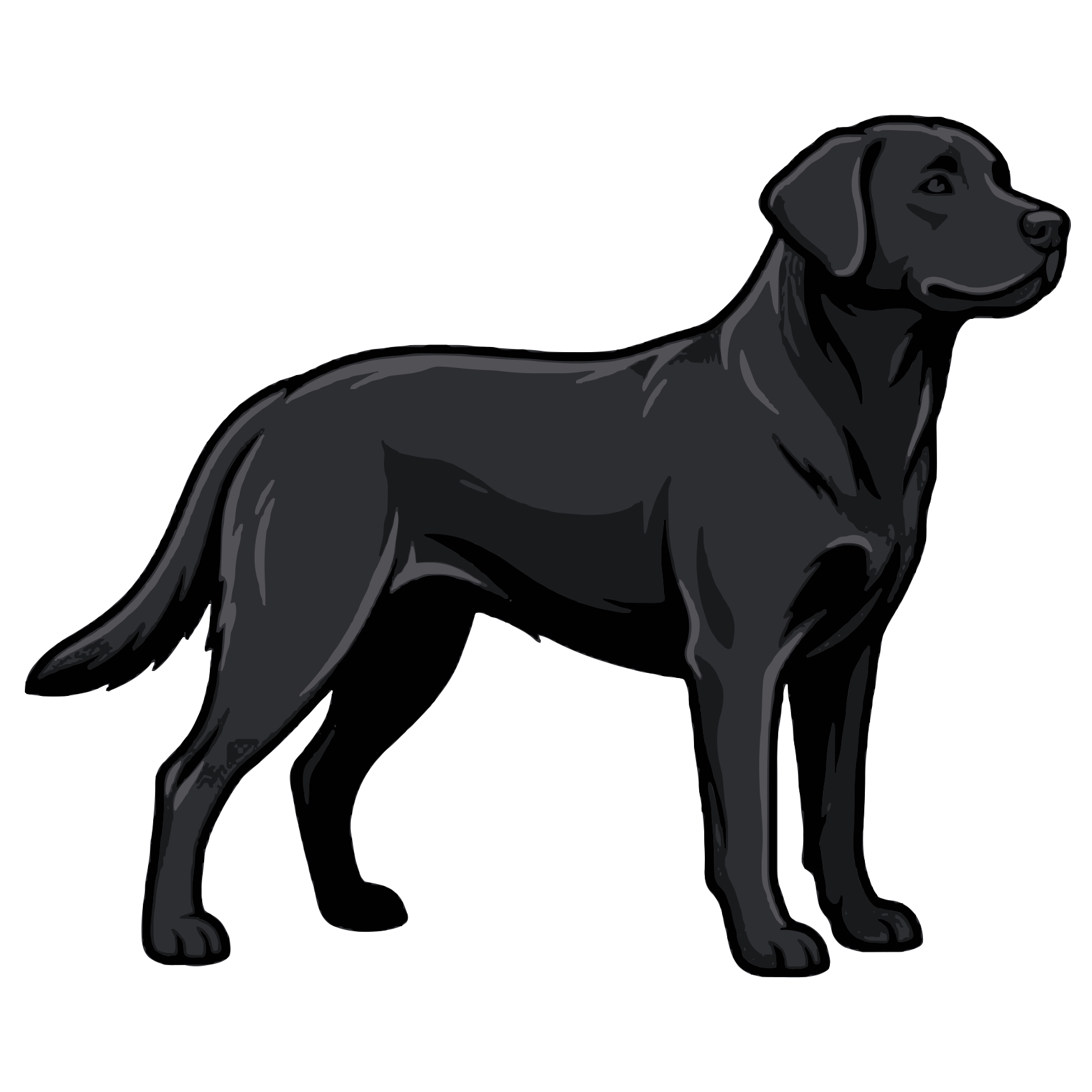
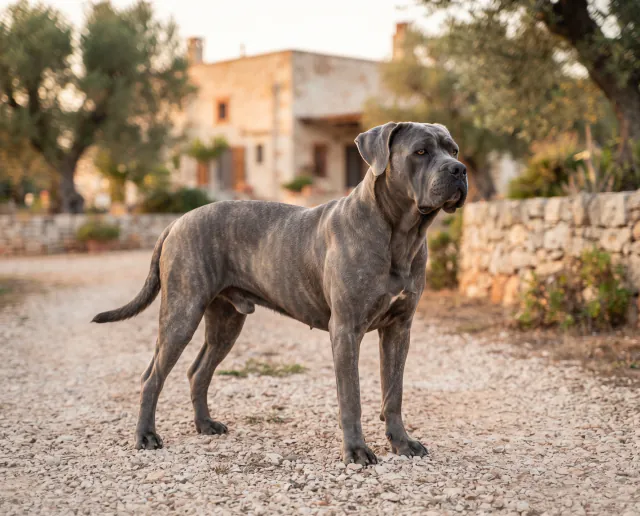
Also known as: Italian Mastiff.
At a glance
Key facts
The essentials to compare before deciding whether this breed fits your home and routine.
- Size
- Large
- Lifespan
- 9 to 12 years
- Energy
- High
- Temperament
- Steady, watchful and strongly territorial
- Good with children
- Better with older children in an experienced household
- Exercise
- One to two hours daily with structured mental work
- Trainability
- Experienced handler
- Grooming
- Weekly brushing plus routine ear, nail and skin checks
- Estimated monthly cost, GBP
- £120 to £200 per month
The Cane Corso has moved from Italian farmland into ordinary pet homes faster than most owners’ experience has kept pace with. A well bred Corso is calm indoors, closely bonded to its household and steady in familiar surroundings. It is also large, strong, territorial by instinct and inclined to form its own opinion about unfamiliar people. That combination rewards people who train deliberately and manage the dog’s environment with care, and punishes anyone assuming a naturally calm dog needs little work. Nothing here is a verdict on an individual dog: build says nothing about behaviour, and a Corso’s temperament comes from its breeding, its early weeks and the work its owner puts in.
Origin and purpose
The breed descends from the heavy working dogs of the Italian peninsula, used across southern Italy as a general farm dog rather than a specialist. A Corso moved cattle and pigs, guarded the farmstead and its stock, and was used on wild boar where landowners hunted them. Mechanised agriculture in the middle of the twentieth century removed most of that work, and the type nearly disappeared before Italian enthusiasts rebuilt it from the remaining rural dogs in the 1970s. The Italian kennel club recognised it in 1994 and the FCI accepted it internationally in 1996, under standard number 343.
That history explains a dog built to cover ground and make decisions on its own, not one bred purely for mass. It also explains the two traits that dominate ownership: a strong attachment to territory, and a willingness to act without being asked.
The breed is not on the Kennel Club’s breed register in the United Kingdom, so there is no British breed standard and no Kennel Club registration route here. British buyers are therefore reading the Italian and American standards, and there is more variation in what is sold as a Cane Corso than in a breed with a single domestic registry behind it. That makes seeing the parents, and asking what they were bred for, more important than usual.
Build and scale
The Corso is a large, athletic molosser rather than a heavyweight. The Italian standard puts males at 64 to 68 cm (25 to 27 in) at the withers and 45 to 50 kg (99 to 110 lb), and females at 60 to 64 cm (24 to 25 in) and 40 to 45 kg (88 to 99 lb), with a tolerance of two centimetres either way on height. The body is slightly longer than it is tall, with visible muscle definition and a clear waist behind the ribs.
Those figures matter in practice more than they look on paper. An adult male is roughly the weight of an adult person, moves faster than one, and is strong enough that lead handling has to be a trained behaviour rather than a physical contest. A dog of this build should look dry and defined, not bulky and loose. Exaggerated width, a heavily wrinkled face, splayed feet or a rolling gait are departures from the standard rather than signs of a better specimen, and they tend to come with breathing, skin and joint problems attached.
Head, coat, ears and tail
The head is large and broad with a marked stop and a short, deep muzzle that is noticeably wider than it is long. The bite is slightly undershot. The muzzle is short but should still be a functioning muzzle: a Corso that snores heavily at rest, tires quickly in mild warmth or cannot settle after light exercise is showing a breathing problem, not a breed characteristic.
The coat is short, dense and rather stiff, with a light undercoat that thickens in cold weather. Recognised colours are black, lead grey, slate grey, light grey, light fawn, deer fawn, dark fawn and brindle, with fawn and brindle dogs carrying a black or grey mask that should not extend past the eyes. Small white markings on the chest, toes and nose bridge are permitted.
Ears are naturally medium sized, triangular and dropped forward against the cheek. The tail is set fairly high and thick at the root. Cropping ears and docking tails is illegal in the United Kingdom other than in the narrow exemptions the law allows for working dogs, and cropped ears are what most people picture when they picture this breed. A Corso with natural ears and a full tail is the normal dog, and the drop ear and moving tail both carry signalling that a cropped, docked dog cannot use, which matters for a breed whose intentions other dogs need to be able to read.
Temperament and guardian behaviour
A sound adult Corso is settled and undemanding in the house, often content to lie near its people and watch. That calm sits alongside a strong territorial instinct. Most are reserved rather than friendly with strangers and assess a situation before reacting.
Guarding is not a fault to be trained out and it is not aggression. It is a working trait: the dog notices a change, positions itself, and waits for information. The owner’s job is not to suppress it but to make sure the dog looks to a person before deciding what the change means, and to arrange life so the dog is rarely put in the position of deciding alone. A Corso that barks once at a delivery driver and then settles when told to is doing the job properly. A Corso that escalates, or that has to make the call itself because nobody is supervising, is a management failure rather than a temperament fault.
Adolescence, roughly twelve to twenty four months, is the hardest phase. Boundaries get tested, reactions to novelty get stronger, and the dog reaches close to adult strength before it reaches adult judgement. Barking is moderate and purposeful. Prey drive can be significant around livestock.
Socialisation
Socialisation for this breed is not a matter of quantity. Dragging a Corso puppy into busy places to meet as many people and dogs as possible tends to produce a dog that expects to greet everything, which is the wrong expectation for an adult guardian, or one that has been overwhelmed and becomes defensive.
What works is controlled, low-intensity exposure: seeing people, traffic, other dogs, livestock and household comings and goings at a distance the puppy can cope with, being paid for calm observation, and being moved on before it gets tense. The aim is a dog that finds novelty unremarkable and looks to its handler when unsure. That work does not stop at sixteen weeks; it needs maintaining through adolescence, which is when a poorly prepared Corso starts making its own decisions.
Children, other dogs and other animals
Corsos are typically devoted to the household they live with. The difficulty with young children is physical rather than temperamental: a dog of this weight can knock a child over without any intent, and no child can hold one on a lead. Households with older children who understand how to behave around a large dog manage better. Visitors, including children’s friends, need managed introductions rather than being allowed to walk in unannounced, and no child should be left unsupervised with a dog this size regardless of how reliable it has been.
Same-sex friction with other dogs is common and often appears at maturity rather than in puppyhood, so an adolescent that has been sociable can change. Two entire males, or two females of similar age, are a harder proposition than most households expect. Cats and other household pets can work where the dog has grown up with them and the relationship is actively managed, but outdoor cats, poultry and livestock should never be assumed safe, and a rural home needs stock-proof fencing before the dog arrives rather than after the first incident.
Exercise and mental stimulation
An adult in good condition needs roughly one to two hours of activity a day, spread across walks in varied surroundings rather than one exhausting session. This is not an endurance breed, and repetitive high-arousal games such as constant ball chasing wind a guarding dog up rather than settle it. Scentwork, tracking, obedience practice and simple problem solving at home suit it better, and a Corso that has used its nose and its head for twenty minutes usually settles more thoroughly than one that has run for an hour.
Growing puppies need exercise limited while joints develop; a vet can advise sensible amounts for the dog in front of them. Hot weather requires shorter, cooler outings with reliable shade and water, because a short-muzzled dog carrying this much muscle sheds heat poorly.
Training
Reward-based training, started in the first weeks at home and continued through adolescence, produces a far better adult than any attempt to overpower the dog. Confrontational handling with a breed of this strength creates defensiveness rather than cooperation, and loses the one thing that actually controls a Corso in a difficult moment, which is its willingness to check in with its handler.
The priorities are narrow and specific: calm greetings, a reliable settle, disengagement on cue, comfortable acceptance of veterinary and grooming handling, and lead manners good enough that the adult never has to be physically restrained. Muzzle training taught as a positive exercise is worth doing early, for veterinary work, for travel, and because a dog that already finds a muzzle unremarkable is not learning about one during a crisis. Professional help from an experienced trainer is a reasonable expectation rather than an admission of failure, and it is easier to find before adolescence than during it.
Grooming, shedding and drooling
Grooming demands are low. A weekly going over with a rubber mitt or hound glove is usually enough, increasing during the seasonal moult, when a short, stiff coat sheds moderately and the hairs work their way into upholstery and clothing more stubbornly than a longer coat’s do. Ears, nails, teeth and any facial folds need routine attention, and nails are far easier to manage if handling was established in puppyhood.
Loose lower lips mean some drooling, most noticeably after drinking and around food, though less than in the heavier mastiff breeds. A cloth by the door and by the water bowl is a reasonable expectation rather than a sign of a problem.
Health
Life expectancy is commonly given as 9 to 12 years, short relative to the commitment involved. Recognised screening themes for the breed include hip and elbow scoring, eye testing for entropion, ectropion and cherry eye, and cardiac assessment. Ask a breeder for written results for both parents rather than verbal reassurance, and take those results to a vet to interpret rather than accepting a summary.
As a deep-chested breed, the Corso is in the group at raised risk of gastric dilatation-volvulus, in which the stomach distends and can twist. It is a surgical emergency and it kills quickly, so every owner should be able to recognise the signs before they need to: a swollen or tight abdomen, unproductive retching, restlessness and drooling. Feeding practices, family history and chest shape all feature in the recognised risk factors, and a vet is the right person to advise on preventive options for an individual dog.
Keeping an adult lean is the single most useful thing an owner controls. Excess weight on this frame loads joints that are already carrying a lot, and it makes heat and breathing worse in a dog that is not well equipped for either.
Feeding and weight management
Feed to body condition rather than to a figure on a bag. A Corso in good condition has ribs that are easy to feel under a thin covering, a visible waist from above and a tuck-up from the side, and those checks are more useful weekly than a monthly weigh-in. Puppies are the point at which most damage is done: overfeeding a large-breed puppy, or using a food that is not formulated for large-breed growth, pushes growth faster than the skeleton can support it, so a growth diet appropriate to the adult size and a vet’s view on rate of growth are both worth having.
Adults do well on measured meals rather than free feeding, which also makes a change in appetite visible. Splitting the daily amount across two or more meals, and avoiding hard exercise immediately around eating, are commonly advised for deep-chested dogs; ask your own vet how that applies to your dog.
Living with one
Running costs are substantial. Food, preventive care, equipment, training support and boarding all scale with size, and insurance premiums for large guarding breeds are often higher than average. A realistic monthly figure sits around £120 to £200, before any unexpected treatment, and a single orthopaedic or emergency abdominal procedure can exceed a year of that.
Secure fencing is not optional. A territorial dog that can leave its garden is a serious liability, and boundaries need to be tall enough, solid enough and gated in a way that a delivery driver cannot leave open. A garden the dog can patrol with a clear view of the street tends to make guarding worse rather than better; screening the boundary is usually more effective than more training.
Most adults cope with a few hours alone once genuinely settled, but a bored young Corso is destructive on a scale that matches its size, and separation problems in a dog this strong are harder to manage than in a small one. Time alone needs building deliberately, from short absences, before it is relied on.
The compromises
Every Corso household ends up accepting some of these. Visitors are managed rather than spontaneous, and some people will not want to come in at all. Holidays are harder, because not every boarding kennel takes the breed and not every friend can handle one. Off-lead freedom is limited by recall that has to hold against a serious prey drive, so many owners use long lines and enclosed fields rather than open parkland. Other dogs are met on the owner’s terms, which rules out busy dog parks. Equipment costs more and wears out faster. And a household that wants a dog it can hand to anyone, take anywhere and leave with anyone has chosen the wrong breed.
Who it suits, and who it does not
The Cane Corso suits an experienced, physically capable owner with space, secure boundaries, a genuine interest in training and the budget for a large dog’s veterinary care. It suits someone who wants a quiet, watchful, deeply attached companion and is content for that dog to be reserved with the rest of the world. Handled well from the start, that is exactly what it is.
It is the wrong breed for a first-time owner without sustained professional support, and it is a poor fit for a busy household with young children, for a home with constant unfamiliar visitors, for anyone whose plan depends on a dog being friendly to strangers, and for anyone who cannot commit to structured training through a difficult adolescence. Getting it wrong with a dog of this size and strength has consequences that getting it wrong with a small breed does not.
Meet several adults of the breeding you are considering before committing, ask what the parents are like with strangers rather than only what they look like, and check what rules apply where you live, since dog control law, insurance requirements and housing restrictions vary by country and by landlord.
Sources
- Breed standard number 343, Cane Corso Italiano, Fédération Cynologique Internationale
- Cane Corso breed entry in the Italian stud book, Ente Nazionale della Cinofilia Italiana
- Cane Corso breed information, American Kennel Club
- Gastric dilatation-volvulus, owner information, American College of Veterinary Surgeons