At a glance
Key facts
The essentials to compare before deciding whether this breed fits your home and routine.
- Size
- Giant
- Lifespan
- 8 to 10 years
- Energy
- Medium
- Temperament
- Calm, confident and quietly protective
- Good with children
- Often good with children in a supervised, settled home
- Exercise
- About 45 minutes a day at a steady pace
- Trainability
- Experienced handler
- Grooming
- Weekly brushing plus regular wiping of facial folds
- Estimated monthly cost, GBP
- £130 to £230 per month
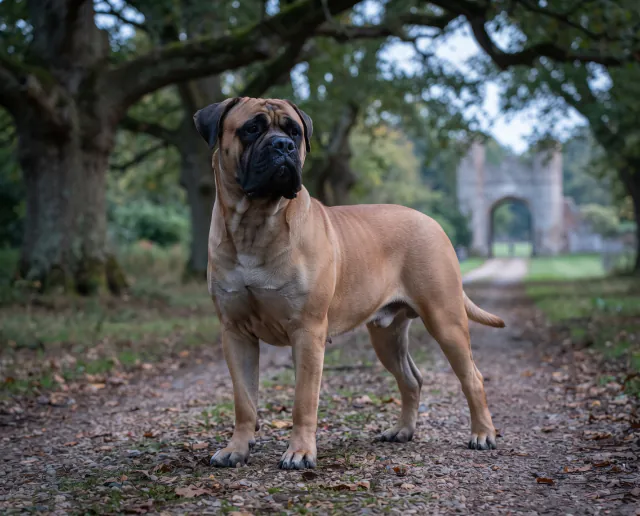
English estates in the nineteenth century had a poaching problem large enough to justify breeding a specialist dog for it. Gamekeepers crossed the Mastiff for bulk and the Bulldog for speed and courage, aiming for something fast enough to run a man down in the dark and strong enough to pin him there without killing him, since a dead poacher was a legal liability a keeper did not want. The resulting dog patrolled silently at night and worked by scent rather than by barking, which is why the modern Bullmastiff still tends toward quiet rather than noisy.
That specific job explains a temperament that can otherwise seem contradictory. A Bullmastiff is naturally protective and physically formidable, yet the breed standard prizes a dog that is confident rather than aggressive, one that assesses a situation calmly before deciding whether it needs to act at all.
Suitability
A well bred, well raised Bullmastiff is typically calm indoors, deeply attached to its family and notably tolerant of the everyday chaos a household produces. It is not naturally a barker, preferring to watch and assess rather than announce, which some owners find reassuring and others find means less advance warning than a vocal breed would give. Children usually do well with a settled adult Bullmastiff, though the dog’s sheer bulk means a boisterous puppy or an excited adult can knock a small child over without any aggressive intent at all, so supervision is about physics as much as temperament. Guests unfamiliar to the dog should be introduced properly, since the protective instinct that made the breed useful to gamekeepers has not been bred out. Other dogs of the same sex can be a source of friction, and this is generally not a breed to keep in a same sex pair without careful management.
Exercise
Roughly forty five minutes of steady exercise a day suits most adults, and the breed has no interest in marathon walking or repetitive fetch. Short bursts of activity followed by long periods of rest reflect the dog’s original job, which involved patrolling and then sudden brief exertion rather than continuous work. Heat is a genuine concern given the breed’s bulk and shortened muzzle relative to a true Mastiff, so exercise in hot weather should move to cooler parts of the day and always include access to shade and water. Puppies need exercise carefully limited while bones and joints are still developing, given the size the adult will reach, and a vet’s guidance on this is worth following closely rather than guessing.
Grooming
The short, dense coat needs only a weekly brush to control moderate shedding and keep it in good condition. Facial folds and wrinkles need regular wiping and drying to prevent soreness and infection developing in the skin creases, and this matters more in a Bullmastiff than in a breed with a flatter face, since debris and moisture collect readily. The breed drools, sometimes heavily, particularly after drinking or in warm weather or excitement, and households need to accept tea towels and wiped walls as part of daily life. Nails, ears and teeth need the routine checks any large dog requires, and skin folds around the neck deserve the same attention as the face.
Health
Life expectancy sits notably lower than most breeds, commonly eight to ten years, and this is a serious consideration for anyone weighing up the breed. Hip and elbow dysplasia are well documented, and hip and elbow scoring under the British Veterinary Association and Kennel Club scheme should be checked in both parents before buying. Bullmastiffs are also prone to certain cancers at rates higher than average for a pedigree dog, and this contributes significantly to the shortened lifespan. As a large, deep chested breed, gastric dilatation and torsion is a real risk, and owners should learn the warning signs and avoid vigorous exercise close to meals. Entropion, where the eyelid rolls inward, occurs in the breed and is usually correctable surgically if it develops. Weight control matters enormously given the strain excess weight places on joints already carrying a heavy frame.
Choosing and training
Reward based training started early and continued consistently produces a far better adult than any attempt at physical dominance, which tends to produce a defensive or shut down dog rather than a compliant one. Priorities should include calm greetings, reliable recall, and comfortable acceptance of handling and veterinary examination, all easier to install in a twenty kilogram puppy than to retrofit in a fifty kilogram adult. An experienced handler, or a first time owner working closely with a good trainer from the start, gets the best from this breed. Ask a breeder about temperament in the pedigree as carefully as about health results, since confidence without aggression is a specific trait worth breeding for rather than assuming.
Verdict
The Bullmastiff suits an experienced, settled household with space, a realistic budget for veterinary care, and the physical capability to manage a large, strong dog through its life. It rewards a calm, structured upbringing with a steady, watchful and deeply devoted companion.
It is the wrong breed for a first time owner without support, a small flat, a household unwilling to manage drool and facial cleaning, or anyone unprepared for a life expectancy shorter than most dogs of comparable cost and commitment.